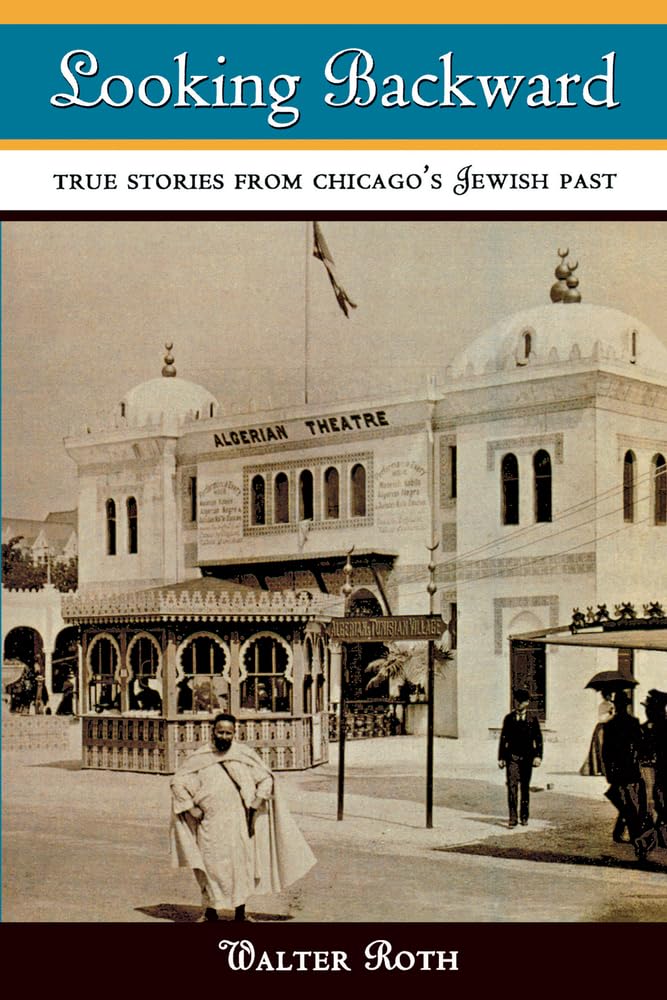



The history of Jews in Chicago is a fascinating, complex and largely unknown story. Thanks to the unstinting efforts of Walter Roth, much of this history has been preserved. Now, for the first time, this material has been distilled into a single volume, chronicling events and people from the late nineteenth century to the end of World War II. There are six broad themes, each of which includes several essays: the first of which is "Chicago Jews and the Secular City: Builders, Movers, Shakers" about HL Mettes' huge 1924 history of Chicago Jews; financier Lazarus Silverman; the U of C Centennial; Jewish participation in the World's Columbian Exposition; Julius Rosenwald and the Museum of Science & Industry and the Jewish Day Pageant at the Century of Progress in 1933. The other five themes are "Chicago Jews and Anti-Semitism: Tragedy Abroad, Challenges at Home"; "Chicago Jews and Zionism: Local Idealists"; "Chicago Jews and Zionism: Renowned Visitors"; "Chicago Jews and the Arts: The Page and the Stage" and "Chicago Jews on Both Sides of the Law: Colorful Characters. "Anyone interested in Chicago history, ethnic history, Jewish history, will find Looking Backward a fascinating and informative read. "Roth writes about the well known and the not so well known, bringing to life the people, events, and institutions that shaped the Jewish community." — Booklist Walter Roth is a prominent local attorney and co-author of An Accidental Anarchist , also available from Academy Chicago Publishers. Looking Backward True Stories from Chicago's Jewish Past By Walter Roth Chicago Review Press Incorporated Copyright © 2002 Walter Roth All rights reserved. ISBN: 978-0-89733-540-9 Contents Foreword, Introduction, Acknowledgments, I CHICAGO JEWS AND THE SECULAR CITY: BUILDERS, MOVERS, SHAKERS, Meites' History of the Jews of Chicago, Who Was Lazarus Silverman?, The University of Chicago Centennial, World's Columbian Exposition: Jews on the Midway, Julius Rosenwald and the Museum of Science and Industry, Century of Progress: Jewish Day Pageant, II CHICAGO JEWS AND ANTI-SEMITISM: TRAGEDY ABROAD, CHALLENGES AT HOME, Adolf Kraus: Efforts to Help Russian Jews, Return of Russian Refugees Prevented, Blood Libel: Prejudice on the South Side, Ambijan: Autonomous Jewish Region of the USSR, Kristallnacht Haunts Chicago, Robert Adler Papers: Refugee Affidavits, III CHICAGO JEWS AND ZIONISM: LOCAL IDEALISTS, Reverend William Blackstone: Methodist Minister, Rabbi Bernhard Felsenthal: Pioneer Zionist, Leon Zolotkoff: Chicagoan at the First Zionist Congress, Julius Rosenwald Meets Aaron Aaronsohn, Zionist Convention in Chicago, Memoir: Camp Avodah, Summer of 1946, Memoir: Israel Independence Celebration, IV CHICAGO JEWS AND ZIONISM: RENOWNED VISITORS, Shmarya Levin, Nachum Sokolow, Einstein and Weizmann: A Zionist Odd Couple, Chaim Nachman Bialik: Hebrew Poet, Clarence Darrow and Stephen S. Wise Debate Zionism, Peter Bergson, the Irgun and Chicago, Ben Hecht Pageant I: We Will Never Die, Ben Hecht Pageant II: A Flag is Born, V CHICAGO JEWS AND THE ARTS: THE PAGE AND THE STAGE, Rosa Sonnenschein: Journalist, Feminist, Zionist, Sol Bloom, The Music Man, Carl Sandburg's Letter to Jacob Loeb, Edna Ferber: Novelist and Playwright, Maxwell Bodenheim: Doomed Poet, Meyer Levin: Compulsion, VI CHICAGO JEWS ON BOTH SIDES OF THE LAW: COLORFUL CHARACTERS, Dora Feldman McDonald: Sex, Politics and Murder, Davey Miller: The Referee's Scrapbook, Ben Reitman: His Unorthodox Life, Samuel "Nails" Morton: 20th Century Golem, Al "Wallpaper" Wolff: G-Man and Untouchable, Kingfish Levinsky: Fighter Could Take a Punch, Moe Berg: "The Catcher Was a Spy", Index, Photographs, CHAPTER 1 MEITES' HISTORY OF THE JEWS OF CHICAGO * * * H.L. Meites' classic History of the Jews of Chicago was first presented to the public at a meeting of the Chicago Historical Society on May 19, 1924, the year of its original publication. This invaluable work contains nearly 900 pages of illustrated entries about individuals, organizations and buildings in Chicago from the early 1800s to 1924. A small supplement was added to the book's second edition published in 1927. Meites, an immigrant from Odessa, Russia, loved his adopted city and wanted to document the Jewish contribution to Chicago's success. He begins his history with the pre-Civil War Jewish settlements along Clark and Wells Streets in what is today downtown Chicago. In 1840, Jews also bought land in what is now northwest suburban Schaumburg in an unsuccessful attempt to settle there. During the Civil War, the Jewish community, numbering less than one thousand, were able to raise a company of soldiers in two days, immediately after the call for volunteers from President Lincoln. Meites talks about Abraham Kohn and his family, merchants who had originally set up business in Massachusetts. They soon discovered that they had settled in a colony of Ch