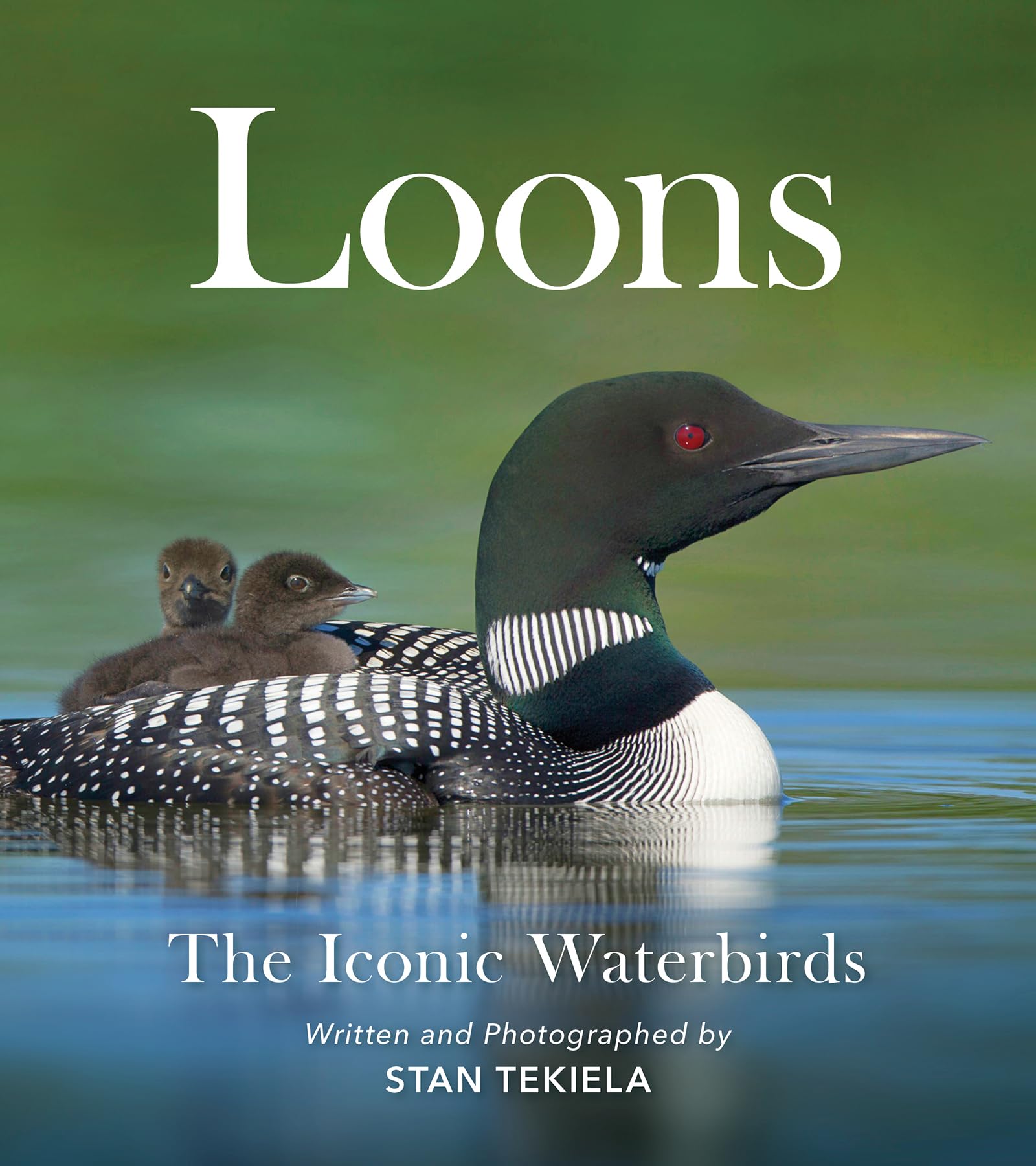



Celebrate the lives of common loons with this collection of photographs and information by award-winning author and wildlife photographer Stan Tekiela. Their stunning beauty inspires us. Their haunting calls fill us with nostalgia. Loons remind us of joyful days at the lake, of time spent with family. Their arrival each spring signals the end of winter and that warmer days are ahead. Award-winning author, naturalist, and wildlife photographer Stan Tekiela believes that loons are the most fascinating of birds. He spent years studying loons, noting their behaviors and capturing them in photographs. Stan’s research spanned major events such as migration and courtship, as well as everyday activities including feeding and sleeping. The result is a striking portrayal of these amazing birds in Loons . Stan’s extraordinary photographs depict the water birds in a new, unique fashion. His fascinating text, drawn from detailed research and personal observations, provides information about every aspect of the loons’ lives. Presented with headings and short paragraphs, the coffee-table book is pleasurable to browse and easy to read. “They’re one of my favorite birds because they’re so beautiful,” says Stan. “Their calls can send shivers down my spine, and they have incredible parenting skills.” Unmatched by any other book on the market, Loons is a must-have for bird watchers, water bird enthusiasts, and nature lovers. Naturalist, wildlife photographer and writer Stan Tekiela is the author of more than 175 field guides, nature books, children’s books, wildlife audio CDs, puzzles and playing cards, presenting many species of birds, mammals, reptiles, amphibians, trees, wildflowers and cacti in the United States. With a Bachelor of Science degree in Natural History from the University of Minnesota and as an active professional naturalist for more than 25 years, Stan studies and photographs wildlife throughout the United States and Canada. He has received various national and regional awards for his books and photographs. Also a well-known columnist and radio personality, his syndicated column appears in more than 25 newspapers and his wildlife programs are broadcast on a number of Midwest radio stations. Fascinating Loons Loons have fascinated people for thousands of years. The striking black-and-white breeding plumage and deep red eyes of the Common Loon befit its elegance and grace. Loons are physically amazing, with large, powerful feet that propel the bird underwater at speeds fast enough to overtake fish. They have wings capable of carrying them thousands of miles to wintering grounds and back again with the changes of the seasons. The call of the loon catapults our memories to a time spent camping or brings to mind a lakeside summer vacation. Yes, loons have fascinated people for thousands of years―just as they do today. Here is the story of the Common Loon. Myths of the Creation Several native cultures tell stories of how the loon was created. According to one, the loon and the crow were once men. They were good friends and did everything together. One day they decided to go fishing. One of the men caught lots of fish. The other man caught none. The man who had no fish became so upset that he hit his friend, cut out his tongue and threw him overboard. The Great Spirit felt sorry for the beaten man and turned him into a beautiful loon, while his friend was turned into a crow. A story from Finnish culture tells us when the first loon was created, it didn’t have legs or feet. Nature realized its mistake and flung a pair of legs and feet at the bird as it was leaving, which is why the legs and feet are located so far back on the loon’s body. Folklore of the Necklace Loons have played a part in the lives of native peoples around the world. Many ancient cultures had stories and myths about loons. There are various folktales about loons restoring sight to blind children or healing the failed sight of medicine men. Legend has it that a loon would carry an afflicted person on its back to the bottom of a lake, once, twice, again and again until enough water washed over the person’s eyes to restore the eyesight. It has been said that a grateful person made the loon a gift of thanks―a necklace of white shells―and hung it around the loon’s neck for all to see. To this day, all loons wear a necklace of white plumage resembling the strand of white shells given in gratitude long ago. The Lore of the Call A story about the loon’s call comes from Micmac Indian culture. A man named Glooscap came to visit the Micmac tribe one day. The people enjoyed his company so much, they did not want him to leave. Even so, after a few days he had to move on. Because the Micmacs were so lonely, Glooscap appointed Kwee-moo, the loon, as his special messenger. Glooscap said he would return whenever the loon called because his call could be heard from far away. Today we call that special call the wail of the loon. Down through history it wa