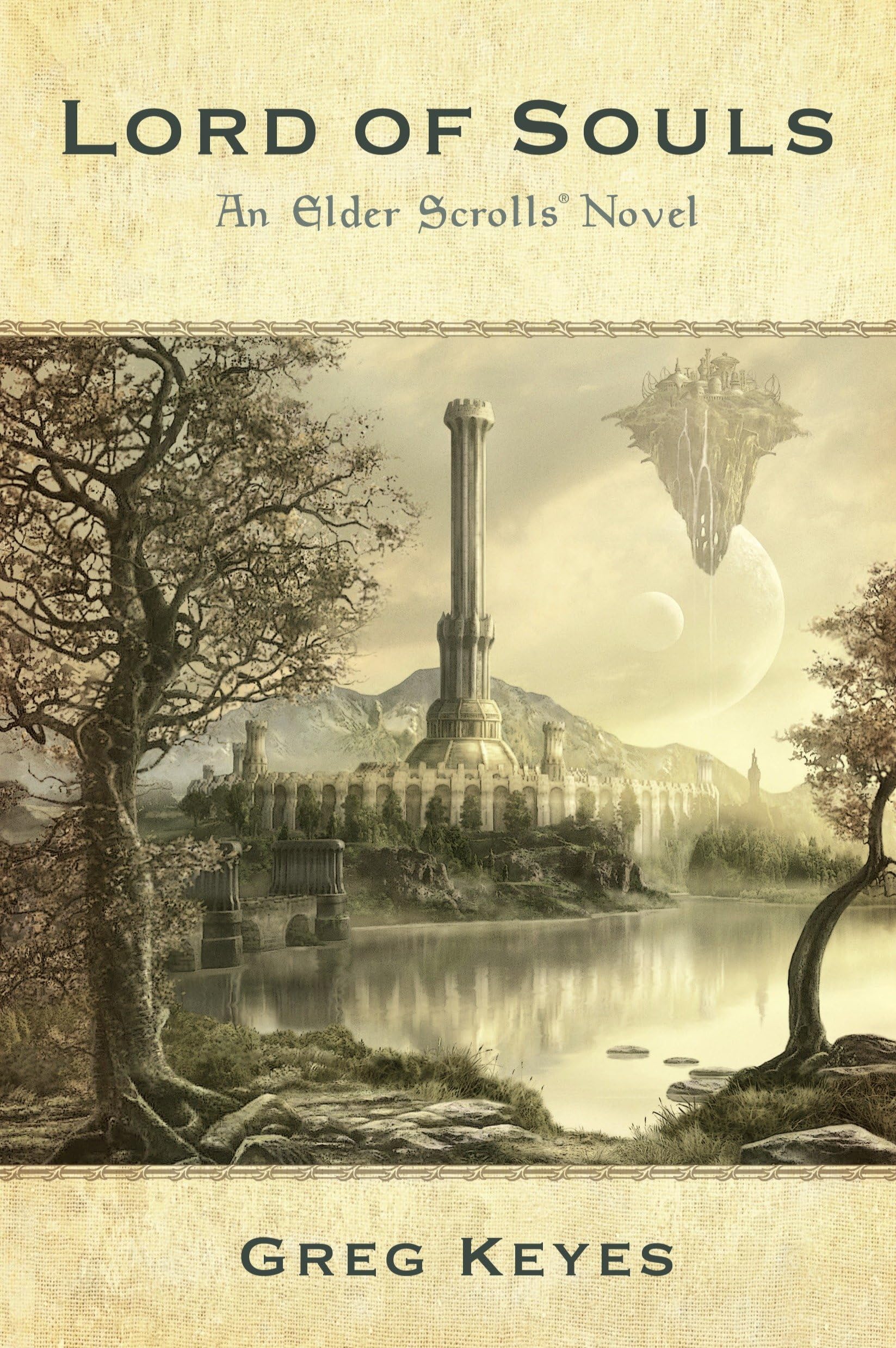



Forty years after the Oblivion crisis, the empire of Tamriel is threatened by a mysterious floating city, Umbriel, whose shadow spawns a terrifying undead army. Reeling from a devastating discovery, Prince Attrebus continues on his seemingly doomed quest to obtain a magic sword that holds the key to destroying the deadly invaders. Meanwhile, in the Imperial City, the spy Colin finds evidence of betrayal at the heart of the empire—if his own heart doesn’t betray him first. And Annaïg, trapped in Umbriel itself, has become a slave to its dark lord and his insatiable hunger for souls. How can these three unlikely heroes save Tamriel when they cannot even save themselves? Based on the award-winning Elder Scrolls ® series, Lord of Souls is the second of two exhilarating novels that continue the story from The Elder Scrolls IV: Oblivion, named 2006 Game of the Year by numerous outlets, including Spike TV, the Golden Joystick Awards, and the Associated Press. Born in Meridian, Mississippi, in 1963, Greg Keyes spent his early years roaming the forests of his native state and the red rock cliffs of the Navajo Indian reservation in Arizona. He earned his B.A. in anthropology from Mississippi State University and a master’s degree from the University of Georgia, where he did course work for a Ph.D. He lives in Savannah, Georgia, where, in addition to full-time writing, he practices ethnic cooking—particularly Central American, Szechuan, Malaysian, and Turkish cuisines—and Kapucha Toli, a Choctaw game involving heavy sticks and no rules. While researching the Age of Unreason series, he took up fencing, and now competes nationally. Greg is the author of The Waterborn, The Blackgod, the Babylon 5 Psi Corps trilogy, the Age of Unreason tetrology (for which he won the prestigious Le Grand Prix de l’Imaginaire award), and three New York Times bestselling Star Wars novels in the New Jedi Order series. one Wind opened Colin's eyes, but it was the unfastened window that sped his heart, and the utter lack of sound that sent his fingers to the knife under his mattress. A hand met his there and gripped his wrist, hard. He swung over to kick at the vague shadow, but he was grasped at the ankles as well, and a bag was forced over his head, followed by a return to sleep that would have been gentle if part of him wasn't screaming to the rest that he wouldn't ever wake up. He did wake again, however. The bag and the cloying scent of somniculous remained, but the drug itself was obviously dissipated. He was lying on a hard but inconstant surface, and he soon recognized by the motion that he was in a boat, on water. His hands and feet were efficiently bound. His captors did not speak, but he could hear their breathing and exertions at the oars. He couldn't make out anything through the sack except light, but he felt the sun on his skin and guessed it was approaching midday. Not much later, there was a bit of jostling and then the shock of the boat coming on shore. He smelled pine. They cut the bindings on his feet and made him walk. He kept thinking he ought to say something, but his kidnappers behaved so professionally he knew there wasn't much point. There was no talking them out of whatever they were doing with him. All he could do was wait, and wonder. Would he feel it? Would he know anything had happened? Colin killed a man once. He died confused, begging, unwilling to admit even as the knife cut into him what was happening. He wished he could have seen his mother again, and-realizing he was weeping-felt ashamed. He'd wanted to be braver. The hand on his arm came away. He tried not to shake. Then one of the men made a peculiar sound, a sigh like a very tired man finally lying down. "What?" the other asked, before sucking a sharp breath. Colin heard two distinct thumps-then for a moment, nothing. He wondered if he should run. "Who do you work for?" a feminine voice asked. He recognized it, and a deep chill wracked through him. The last time he'd heard that voice had been in a house in the Market District, just before its owner slaughtered at least eight men. "Come," she said. "Tell me." "I'm not at liberty to say," he replied. "Keep still," she said. A moment later the sack came off his head. And there she was, regarding him, Letine Arese. Her small frame, turned-up nose, and short blond hair made her seem almost like a little girl, but he knew her to be thirty-one years of age, and her blue eyes held a cold intensity that was quite un-childlike. Those eyes narrowed now. "You look familiar," she said. "I've seen you. I suppose that makes sense." He glanced behind her, at the two bodies on the ground. Both were male; one was an Argonian, the other a Bosmer. They both seemed quite dead, although he could not see the cause. "They brought you out here to kill you," she said. "I gathered that," he replied. "I'm grateful you stopped them." "Are you? We'll get back to that in a moment." She fold