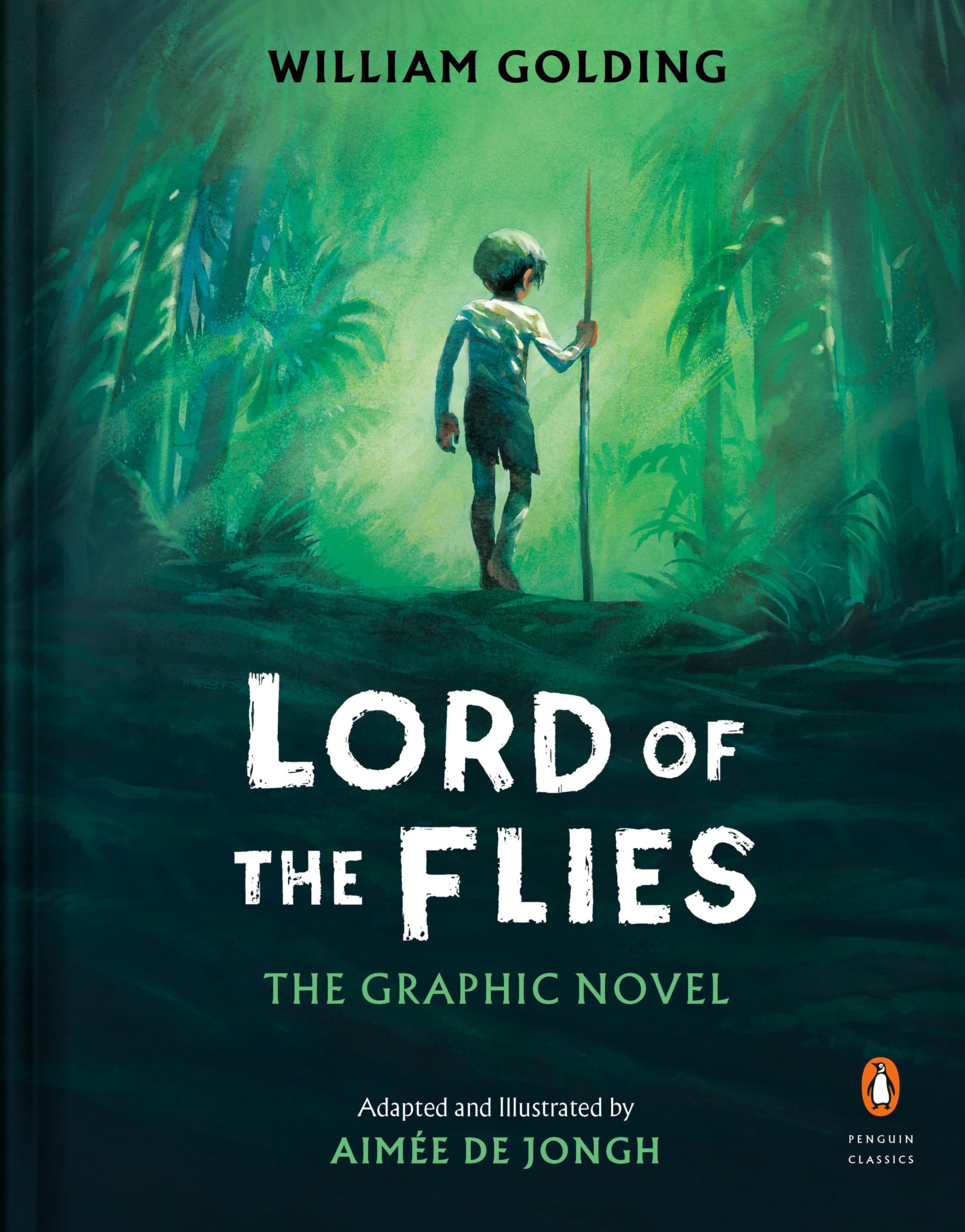
Lord of the Flies: The Graphic Novel (A Penguin Classics Hardcover)
$19.59
by William Golding



For the 70th anniversary of William Golding’s classic, the first graphic novel adaptation of Lord of the Flies The original tale of stranded youth devolving into disorder that inspired Yellowjackets and The Hunger Games , now a Penguin Classics Hardcover The well-known plot: A plane crashes on a desert island. The only survivors are a group of schoolboys. By day, they explore the dazzling beaches, gorging fruit, seeking shelter, and ripping off their uniforms to swim in the lagoon. At night, in the darkness of the jungle, they are haunted by nightmares of a primitive beast. Orphaned by society, they must forge their own; but it isn't long before their innocent games devolve into a murderous hunt … William Golding’s Lord of the Flies was originally published in 1954 and has been a canonical text on school syllabi and a familiar literary reference within the public’s consciousness. For the first time this unforgettable classic has been given new life with Aimée de Jongh’s graphic style and gorgeous color adaptation. " Lord of the Flies is one of my favorite books. I still read it every couple of years." —Suzanne Collins, author of The Hunger Games trilogy "The first book with hands – strong ones that reached out of the pages and seized me by the throat. It said to me, ‘This is not just entertainment; it’s life or death.’ ... I’ve been thinking about it ever since, for fifty years and more." —Stephen King "This brilliant work is a frightening parody on man's return [in a few weeks] to that state of darkness from which it took him thousands of years to emerge. Fully to succeed, a fantasy must approach very close to reality. Lord of the Flies does. It must also be superbly written. It is." — The New York Times Book Review "Thrills me with all the power a fiction can have ... Exemplary." —Ian McEwan, author of Atonement "An existential fable backlit with death's incandescent glare." —Ben Okri, Booker Prize-winning author of The Famished Road . William Golding (1911–1993) was born in Cornwall, England, and educated at Oxford University. His first book, Poems , was published in 1934. Following a stint in the Royal Navy and other activities during and after World War II, Golding wrote his first novel, Lord of the Flies (1954), while teaching school. Many novels followed, including The Inheritors (1955), Pincher Martin (1956), Free Fall (1959), and The Spire (1964), as well as a play, The Brass Butterfly (1958), and a collection of shorter works, The Hot Gates and Other Occasional Pieces (1965). He received the James Tait Black Prize for Darkness Visible (1979) and the Booker Prize for Rites of Passage (1980). In 1983, he was awarded the Nobel Prize in Literature “for his novels which, with the perspicuity of realistic narrative art and the diversity and universality of myth, illuminate the human condition in the world of today.” He was awarded the title “Companion of Literature” by the Royal Society of Literature in 1983 and was knighted by Queen Elizabeth II in 1988. William Golding died in June 1993 and is buried in Holy Trinity churchyard in Bowerchalke, Wiltshire, in England. Aimée de Jongh is an Eisner-nominated comic author and animator from the Netherlands. At the age of 22, Aimée's career in comics took off with the popular daily series Snippers for the Dutch newspaper Metro. At 25, she then published her first graphic novel The Return of the Honey Buzzard , which won the Prix Saint-Michel and was adapted to a live-action film. Her international breakthrough came when Blossoms in Autumn was released, a graphic novel about elderly love, written by Belgian comic author Zidrou. In 2019, Aimée published her autobiographical comic TAXI! , about four intriguing taxi rides she made. Aimée's most well known graphic novel is the award winning and Eisner nominated Days of Sand (Jours de Sable) . THE SOUND OF THE SHELL THE BOY WITH FAIR HAIR LOWERED HIMSELF down the last few feet of rock and began to pick his way toward the lagoon. Though he had taken off his school sweater and trailed it now from one hand, his grey shirt stuck to him and his hair was plastered to his forehead. All round him the long scar smashed into the jungle was a bath of heat. He was clambering heavily among the creepers and broken trunks when a bird, a vision of red and yellow, flashed upwards with a witchlike cry; and this cry was echoed by another. "Hi!" it said. "Wait a minute!" The undergrowth at the side of the scar was shaken and a multitude of raindrops fell pattering. "Wait a minute," the voice said. "I got caught up." The fair boy stopped and jerked his stockings with an automatic gesture that made the jungle seem for a moment like the Home Counties. The voice spoke again. "I can't hardly move with all these creeper things." The owner of the voice came backing out of the undergrowth so that twigs scratched on a greasy wind-breaker. The nak