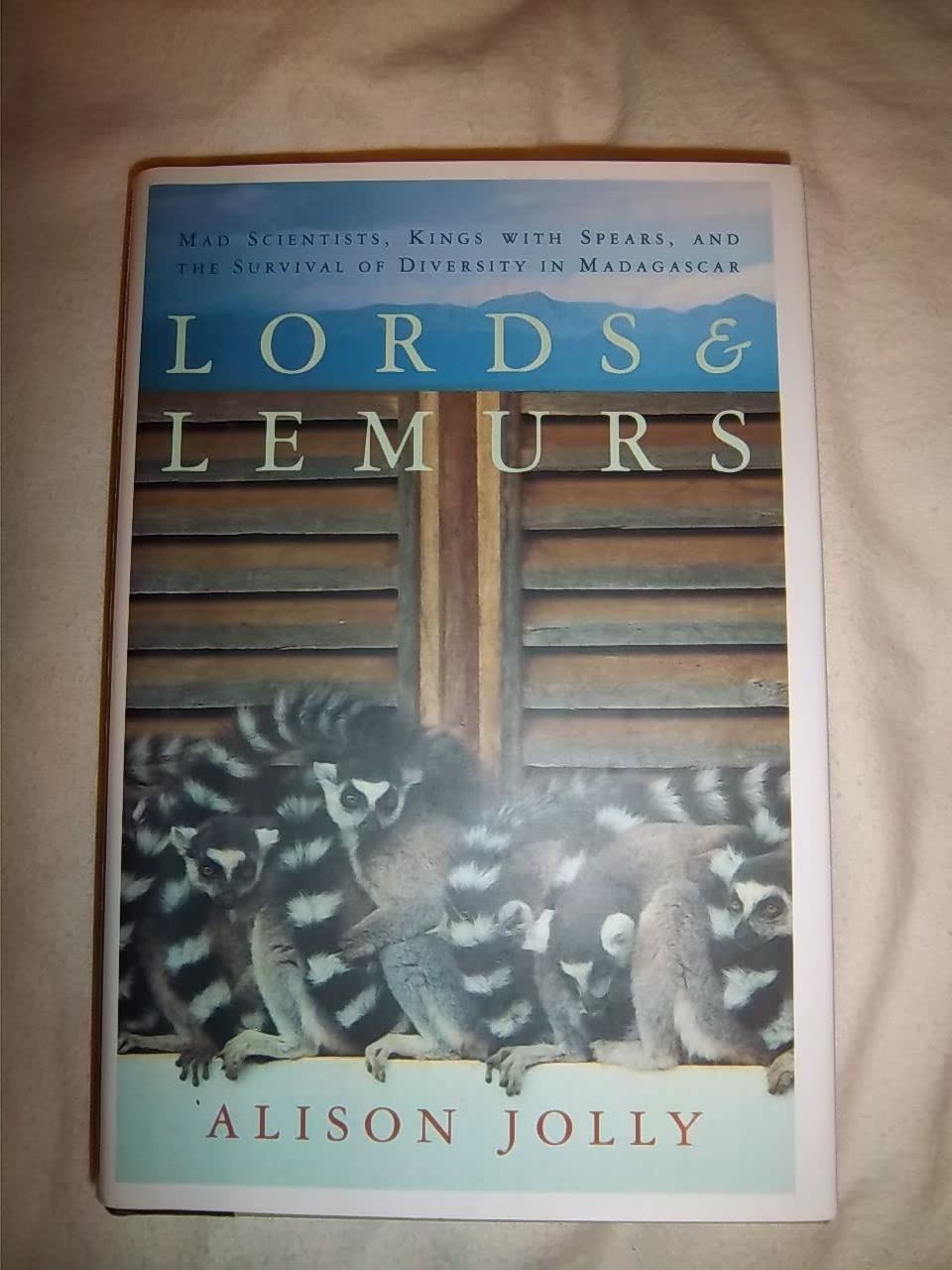
Lords and Lemurs: Mad Scientists, Kings with Spears, and the Survival of Diversity in Madagascar
$24.13
by Alison Jolly



Jolly, Alison Jolly, a pioneer in the study of primate behavior, first went to Madagascar to observe lemurs 40 years ago. Her research site was at Berenty, a private wildlife refuge that was part of the plantation of an aristocratic French family. The de Heaulmes had come to Berenty in 1928. As they developed their plantation over the years, they also set aside a large area of it for lemurs and other animals and helped the native Tandroy tribe preserve their traditions. At the beginning of the 21st century, Berenty and its lemurs still flourish because the de Heaulme family are still there--and vice versa. "Forest and family saved each other," Jolly says. The plantation no longer produces sisal commercially; together with the preserved forest and its lemurs, it has become a destination for eco-tourists. Woven around the life of the de Heaulme family is the entire history of Madagascar--its geology, its animals and its colonization by humans, beginning with Indonesians and Africans in around A.D. 500. It is an unexpectedly enthralling story, told with great flair. Editors of Scientific American Madagascar, one of the world's poorest countries, became a political pawn during World War II, and since then has fought famine, a battle for independence, and, most recently, a civil war over a disputed presidential election. At the island's extreme southern end is Berenty, a private wildlife refuge founded by French aristocrats and home to an uncommon and inspiring coexistence of Western culture, nature, and native traditions. Jolly first came to Berenty as a 25-year-old "with a brand-new Ph.D and a Sputnik-era research grant" to study lemurs, and upon her arrival met the site's owner, Jean de Heaulme, a sisal farmer. Unlike other colonialists, the de Heaulmes recognized the importance of their surrounding environment and its history, and they forged a strong bond with the Tandroy, local tribespeople who still lived in traditional villages surrounded by thorn walls. The de Heaulmes, in fact, supported the move for independence from the French, and when Jean de Heaulme was jailed, the Tandroy marched on the prison, demanding his release. Jolly tells the story of Berenty with wit and surprise. Andy Boynton Copyright © American Library Association. All rights reserved ALISON JOLLY has a Ph.D. in zoology from Yale. A recipient of numerous fellowships, she has taught at Princeton and the University of Sussex. She is the author of Lucy’s Legacy. Used Book in Good Condition