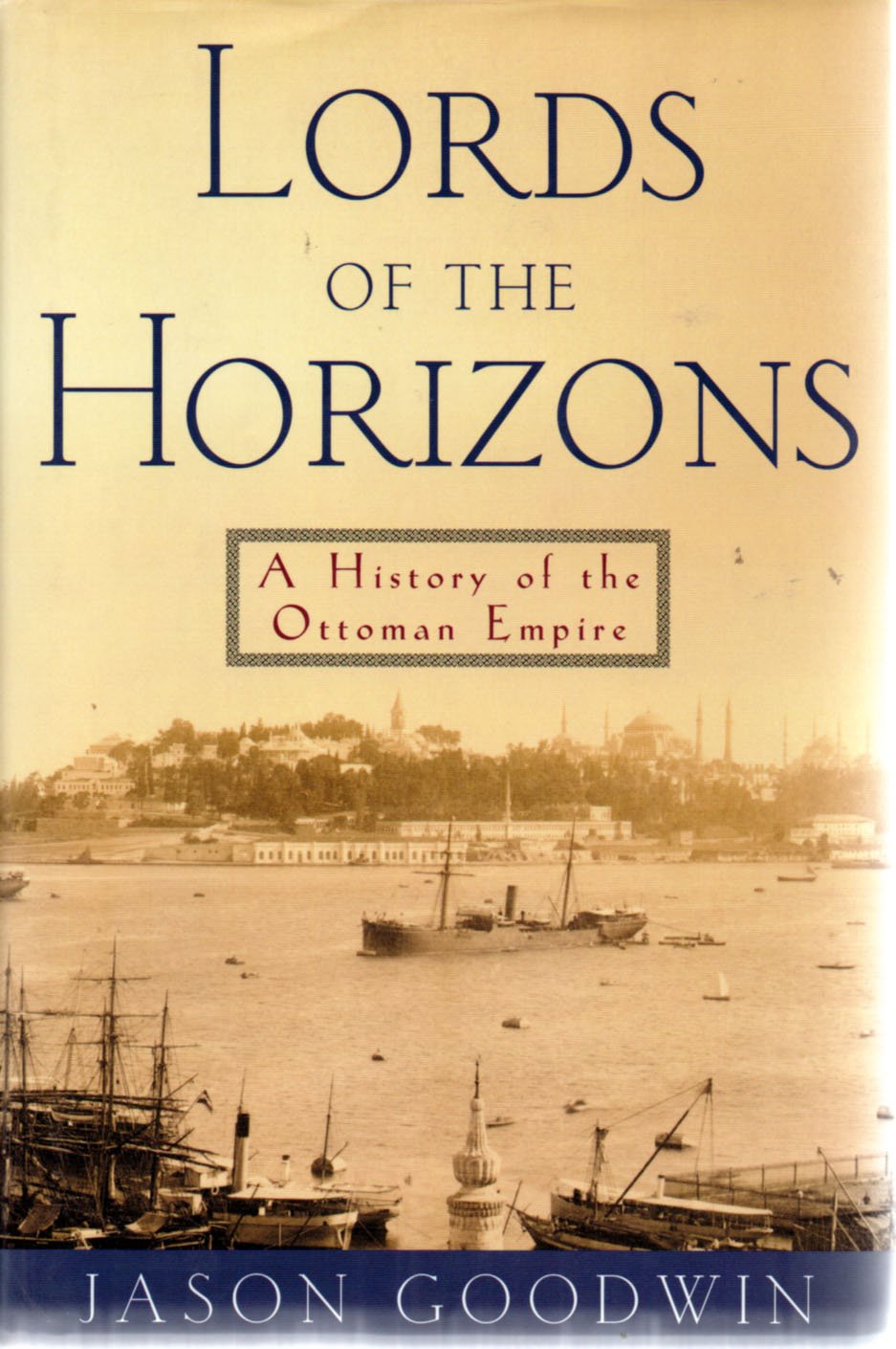



Since the Turks first shattered the glory of the French crusaders in 1396, the Ottoman Empire has exerted a long, strong pull on Western minds. For six hundred years, the Empire swelled and declined. Islamic, martial, civilized, and tolerant, in three centuries it advanced from the dusty foothills of Anatolia to rule on the Danube and the Nile; at the Empire's height, Indian rajahs and the kings of France beseeched its aid. For the next three hundred years the Empire seemed ready to collapse, a prodigy of survival and decay. Early in the twentieth century it fell. In this dazzling evocation of its power, Jason Goodwin explores how the Ottomans rose and how, against all odds, they lingered on. In the process he unfolds a sequence of mysteries, triumphs, treasures, and terrors unknown to most American readers. This was a place where pillows spoke and birds were fed in the snow; where time itself unfolded at a different rate and clocks were banned; where sounds were different, and even the hyacinths too strong to sniff. Dramatic and passionate, comic and gruesome, Lords of the Horizons is a history, a travel book, and a vision of a lost world all in one. Jason Goodwin, a young English journalist, writes history as if it were today's breaking news, and with Lords of the Horizon , he delivers an anecdote-filled and breezy account of the long, troubled career of the Ottoman Empire. That empire endured for nearly 600 years and embraced not only a large territory--stretching, at one point, from the border of Iran to the gates of Vienna--but also hundreds of ethnic groups and three dozen nations. United under the banner of a tolerant form of Islam, the Ottoman Turks forged a culture that, Goodwin writes, "was such a prodigy of pep, such a miracle of human ingenuity, that contemporaries felt it was helped into being by powers not quite human--diabolical or divine, depending on their point of view." Drawing on memoirs by European visitors as well as standard histories of the era, Goodwin traces the Ottoman Empire from its origins in the 14th-century collapse of the Byzantine state to its centuries-long decline and final collapse at the end of World War I. Along the way, he writes of the Ottomans' addiction to wealth (and to hiding their gold in fabulous hoards), the pleasure they took in holding picnics in their lush cemeteries, and the prowess of their elite military both in battle and in organized crime. ("The janissaries were magnificent extortionists," Goodwin notes. "People paid them not to burn their homes and business, then they paid them to come and put the fires out.") Full of vivid detail, Goodwin's narrative makes for an enjoyable introduction to this historically influential, but little understood, culture. --Gregory McNamee British travel writer Goodwin, whose previous books include A Time for Tea (1991. o.p.) and On Foot to the Golden Horn (1995. o.p.), explores the long and tumultuous history of the Ottoman Empire, examining the political upheavals and military actions that continually engaged the empire. Goodwin also reveals many fascinating details of daily life: e.g., common people would insert waste paper into the cracks of walls, believing the paper would protect their feet on the fiery path to heaven. The most absorbing chapter concerns the defeat of the Ottomans in Vienna in 1683, presenting in lively style the events leading up to that crucial battle. This volume is comparable to Andrew Wheatcroft's The Ottomans (LJ 4/15/94) and belongs in academic and larger public libraries.ANorman Malwitz, Queens Borough P.L., NY Copyright 1999 Reed Business Information, Inc. A delightfully picaresque history, brimming with memorable anecdotes and outrageous personalities. English travel writer Goodwin (A Cup of Tea: Travels Through China and India in Search of Tea, 1991) guides us on a highly impressionistic journey. We begin in the foothills of Turkey, where the Ottoman Turks revered the horse and reveled in making war. (They also helped to destroy the Christian crusaders of the 14th century.) The Ottomans were Sunni Muslims, relatively tolerant of religious diversity. In 1453, under Sultan Mehmet, they seized Constantinople, making it their capital. Goodwin writes brilliantly about the siege of that Byzantine city, describing its complex defensive fortifications and how Mehmet breached them with a revolutionary weapon, the cannon. Under Suleyman the Magnificent, Ottoman power reached its zenith. Suleyman's army overran Belgrade in 1521 and later assaulted Vienna. Finally, the European powers united to stop the ``infidel'' Ottoman onslaught. In 1571, the Ottomans suffered their first major defeat at the Battle of Lepanto. Nevertheless, they consolidated their power in the Balkans, Egypt, Persia, Russia, and all over Central Asia. Goodwin argues convincingly that the key to Ottoman success, besides an obvious skill at war, was their open-mindedness regarding cultures and institutions: The Ottoman umbrel