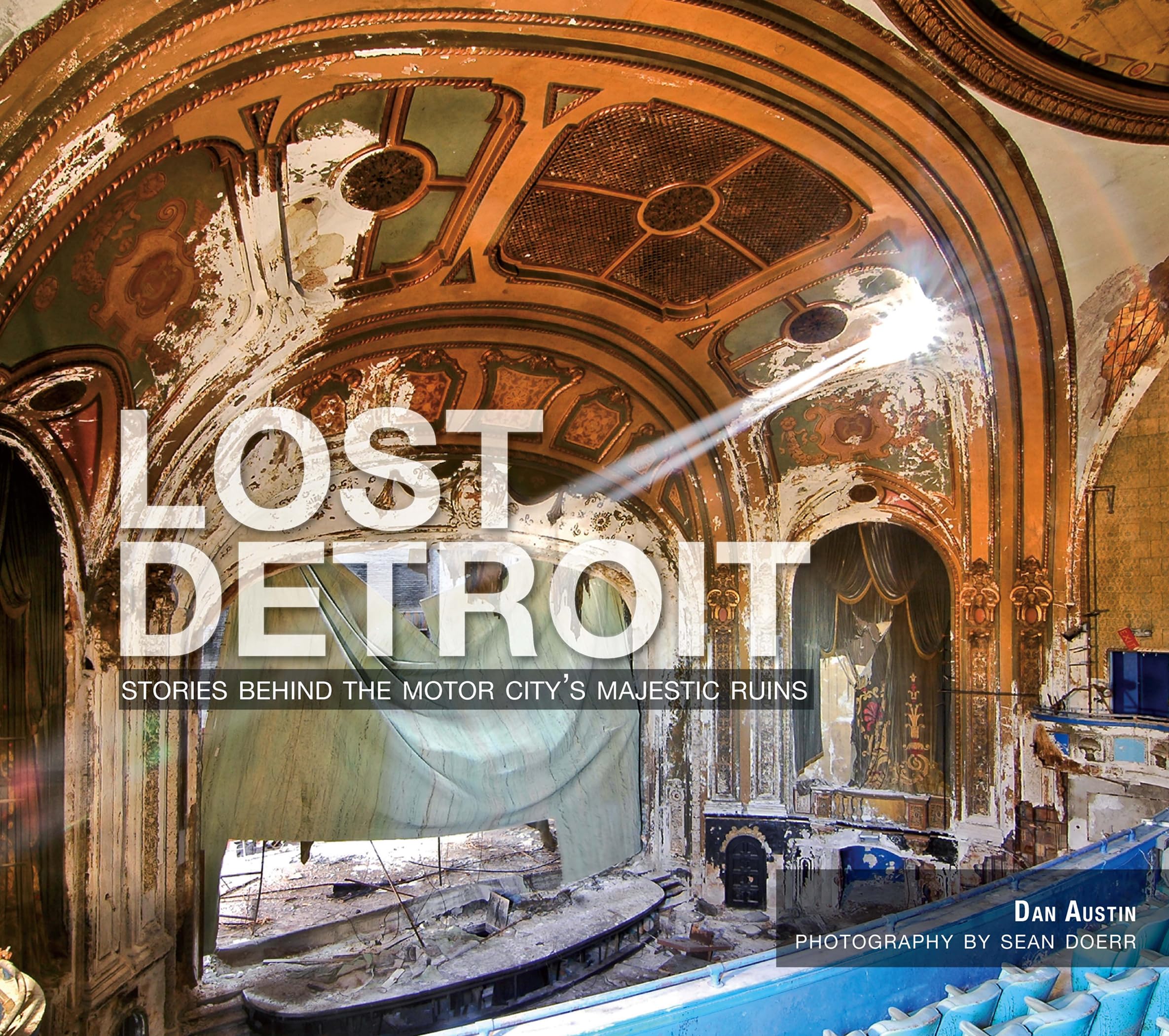



Lost Detroit tells the stories behind 12 of the city's most beautiful, all-but-forgotten landmarks and of the people behind them, from the day they opened to the day they closed. While these buildings might stand as ghosts of the past today, their stories live on within these pages. The team behind BuildingsofDetroit.com brings you the memories of those who caught trains out of the majestic Michigan Central Station, necked with girlfriends in the balcony of the palatial Michigan Theatre, danced the night away at the Vanity Ballroom and kicked out the jams at the Grande Ballroom. As Detroit Free Press Architecture Critic John Gallagher said, the buildings in these pages held a central place in the story of Detroit's Auto Century. It was America's story, too. Detroiters lived, loved, toiled, played, celebrated and dreamed great dreams in these buildings and thereby helped shape a nation." "Every building in Detroit has a story." And, thankfully, Dan Austin and Sean Doerr are the storytellers. ... This amazing book tells the tales of 12 of Detroit's most stately structures. --Time magazine's Detroit Blog "Every chapter attempts to tug on the hearts of its readers with narratives brief enough to hold readers' attention, but long enough to explain the journey." --The South End Of Dan Austin, "a colleague calls him encyclopedic." --Michigannow.org With Detroit's buildings, "some is gorgeously intact, some isn't. But the duo shows equal passion for all of it." --Model D "I was absolutely glued to the book. Glued . It captures the spirit of so many of Detroit's buildings." --DetroitLives.org Dan Austin is a journalist at the Detroit Free Press and a historian of the city's landmarks. He began researching and writing about Detroit's architectural wonders in 2006. His first book, Lost Detroit: Stories Behind the Motor City's Majestic Ruins, "? tells the stories behind the boarded-up windows of Detroit's most spectacular abandoned buildings. He runs HistoricDetroit.org." Lost Detroit Stories Behind the Motor City's Majestic Ruins By Dan Austin, Sean Doerr The History Press Copyright © 2010 Dan Austin and Sean Doerr All rights reserved. ISBN: 978-1-59629-940-5 Contents Foreword, by John Gallagher, Broderick Tower, Cass Technical High School, Eastown Theatre, Grand Army of the Republic Building, Grande Ballroom, Lee Plaza, Metropolitan Building, Michigan Central Station, Michigan Theatre, United Artists Theatre, The Vanity Ballroom, Woodward Avenue Presbyterian Church, Special Thanks, About the Author, About the Photographer, CHAPTER 1 BRODERICK TOWER Thousands of Detroiters once got their teeth drilled high in the sky above the bustling streets of downtown. The Broderick Tower, one of the city's most recognizable skyscrapers, opened in 1927 as the Eaton Tower, named for what was then one of Detroit's most recognizable families. Theodore H. Eaton came to Detroit in 1838 and invested his savings in a run-down drugstore that had folded in the Panic of 1837. At the time, Detroit was just an out-of-the-way frontier town of about eight thousand, but the twenty-three-year-old Eaton had pioneering in his blood: He was a direct descendant of Thomas Eaton, who helped settle the New World in 1660. Eaton bought the Riley and Ackerly drugstore, a bet on Detroit that would pay off. He stockpiled paints, soaps and other supplies for the ships that came sailing into Detroit, often staying open late into the night so as to not miss a ship coming in, the Detroit Free Press noted in 1953. Eaton adapted his firm to Detroit's changing business climate. As wool mills opened in the city, Eaton started selling them chemicals, dyes and machinery. He taught his son, Theodore H. Eaton Jr., the family trade, and the younger Eaton oversaw the company switch to selling dry cleaning supplies and heavy chemicals for the city's booming auto industry. But it was Berrien C. Eaton, the grandson of the company's founder, who would build a lasting monument to his family's legacy. BUILDING A BEHEMOTH Berrien Eaton took over the company in 1920 and also was a trustee of the Eaton estate. His father bought the site of the Broderick on May 25, 1904, then home to the Gladwin Building, a six-story structure built in 1896. The parcel is located on the southeastern corner of Grand Circus Park and Woodward Avenue, the city's main thoroughfare. Before the Gladwin, the land had been home to everything from the Grand Circus Hotel to Turkish baths. On July 10, 1926, Berrien Eaton announced that the estate would build a thirty-four-story, classically inspired shaft with elaborate Baroque-style ornamentation at the top. The family tapped architect Louis Kamper for the job, and his son Paul L. Kamper served as associate architect. The tab for the building came in at about $1.75 million (about $21.5 million today, when adjusted for inflation). Work started on the 370-foot behemoth of Indiana limestone on September