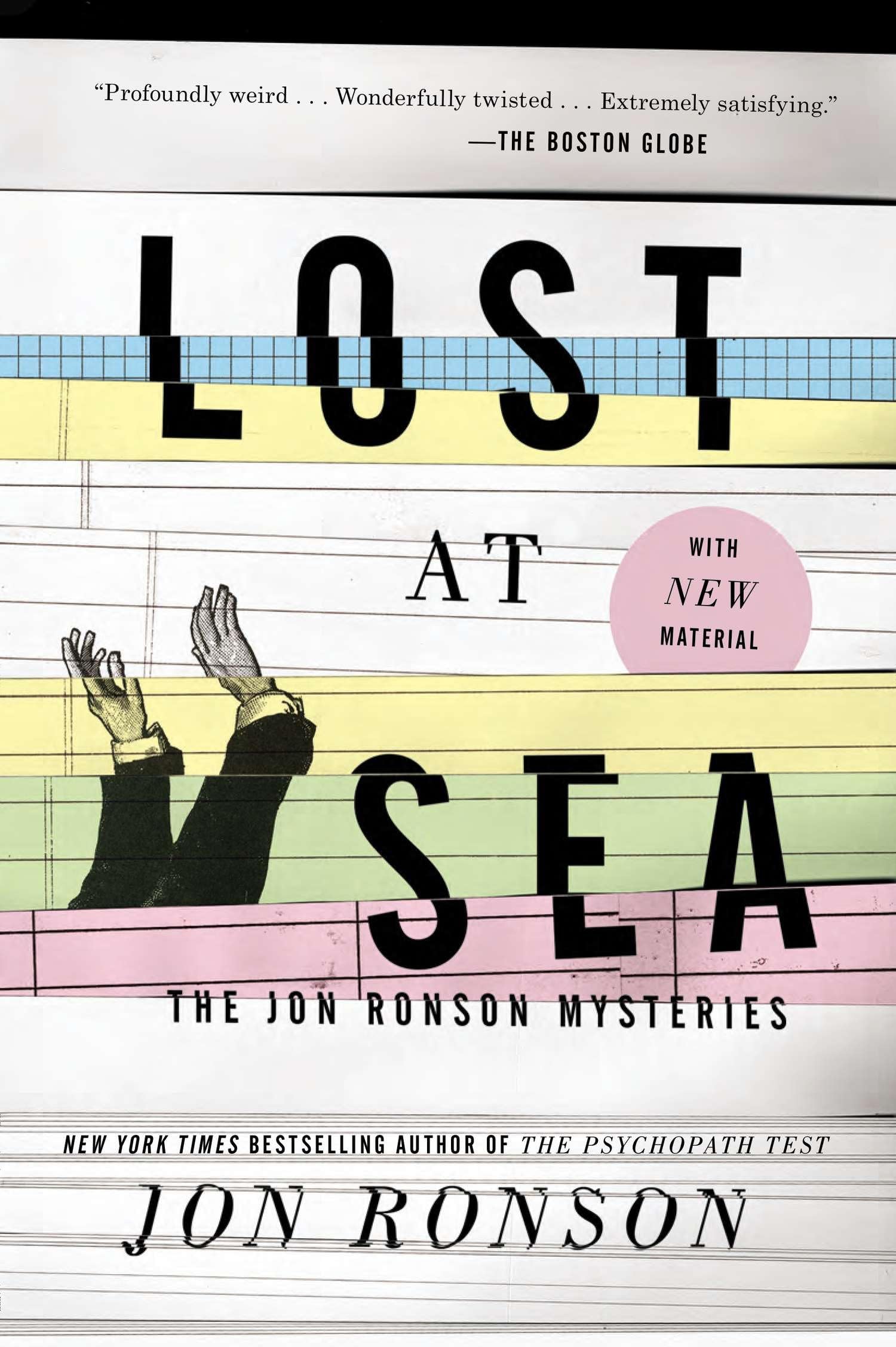



New York Times –bestselling author of The Psychopath Test Jon Ronson writes about the dark, uncanny sides of humanity with clarity and humor. Lost at Sea —now with new material—reveals how deep our collective craziness lies, even in the most mundane circumstances. Ronson investigates the strange things we’re willing to believe in, from robots programmed with our loved ones’ personalities to indigo children to the Insane Clown Posse’s juggalo fans. He looks at ordinary lives that take on extraordinary perspectives. Among them: a pop singer whose greatest passion is the coming alien invasion, assisted-suicide practitioners, and an Alaskan town’s Christmas-induced high school mass-murder plot. He explores all these tales with a sense of higher purpose and universality, yet they are stories not about the fringe of society. They are about all of us. Incisive and hilarious, poignant and maddening, revealing and disturbing—Ronson writes about our modern world, and reveals how deep our collective craziness lies, and the chaos stirring at the edge of our daily lives. “Profoundly weird...wonderfully twisted...extremely satisfying.”— Boston Globe “Initially, it seems that oddities are what...Jon Ronson is after. He’s actually really just trying to understand the irrational hopes and desires that drive us all.” —The Daily Beast “Eclectic and fascinating...Ronson treats his subjects fairly but skeptically...his view always framed by an appropriately cocked eyebrow.”— Entertainment Weekly “Absurdly entertaining.”— Publishers Weekly (starred review) “A sterling collection of amazing stories from an offbeat journalist at the top of his game.”— Kirkus Reviews Jon Ronson’s books include the New York Times bestseller The Psychopath Test , and Them: Adventures with Extremists and The Men Who Stare at Goats —both international bestsellers. The Men Who Stare at Goats was adapted as a major motion picture, released in 2009 and starring George Clooney. Ronson lives in London and New York City. Who Killed Richard Cullen? (This story was published in the Guardian on July 16, 2005, two years before the global financial crash that began with the subprime mortgage crisis of July 2007.) It is a wet February day in a very smoky room in a terraced cottage in Trowbridge, Wiltshire. A portable TV in an alcove plays the news. Everything in here is quite old. No spending spree has taken place in this house. There are wedding and baby and school photographs scattered around. Six children, now all grown up, were raised here. There’s a framed child’s painting in the toilet, a picture of Wendy Cullen. It reads “Supergran.” When I phoned Wendy a week ago she said I was welcome to visit, “Just as long as you don’t mind cigarette smoke. I’m smoking myself to death here.” The “Congratulations! You have been pre-approved for a loan”– type junk mail is still pouring through their letterbox. Wendy has just thrown another batch in the bin. “You know what the post is like,” she says. “I don’t get all that much credit-card junk mail,” I say. “I get some, I suppose, but not nearly as much as you do.” “Really?” says Wendy. “I assumed everyone was constantly bombarded.” “Not me,” I say. We both shrug as if to say, “That’s a mystery.” IT WAS A month ago today that Wendy’s husband, Richard, committed suicide. It was the end of what had been an ordinary twenty-five-year marriage. They met when Wendy owned a B and B on the other side of Trowbridge. He turned up one day and rented a room. Richard had trained to be an electrical engineer but he ended up as a mechanic. “He loved repairing people’s cars,” Wendy says. Then she narrows her eyes at my line of questioning and makes me promise that I am not here to write “a slushy horrible mawky love story.” “I’m really not,” I say. So Wendy continues. Everything was normal until six years ago, when she needed an operation. “I couldn’t face the Royal United Hospital in Bath,” she says, “so I went private. I took out a four-thousand-pound loan.” She says she remembers a time when it was hard for people like them to get loans, but this was easy. Companies were practically throwing money at them. “Richard handled all the finances. He said, ‘I can get you one with nought percent interest and after six months we’ll switch you to another one.’ ” But then, a few months after the first operation, Wendy was diagnosed with breast cancer and Richard had to take six weeks off to drive her to radiotherapy. The bills needed paying and so, once again, he did that peculiarly modern British thing. He began signing up for credit cards, behaving like a company, thinking he could beat the lenders at their own game by cleverly rolling the debts over from account to account. There are currently eight million more credit cards in circulation in Britain than there are people: sixty-seven million credit cards, fifty-nine million people. He signed up with Mint: “Apply for your Mint Card. You