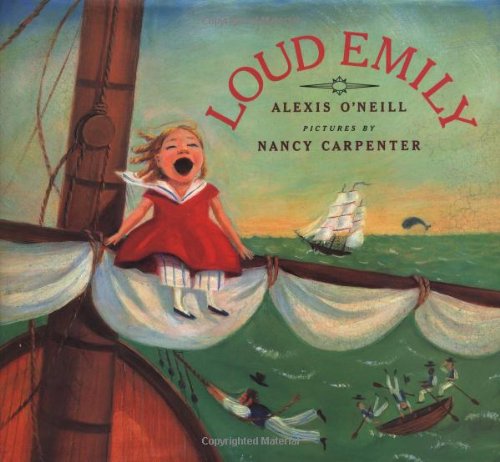



Every time Emily opens her mouth windows crack, plates shatter, and objects go flying, and just as she is about to be sent to Miss Meekmeister's School for Soft-Spoken Girls, she sees a ship with a sign saying, LOUD HELP NEEDED, leading her on an adventure that proves a loud voice can be invaluable. PreSchool-Grade 2-Set in a 19th-century New England whaling town, this picture book champions the cause of loud children and the resourcefulness of little girls. When Emily is born, her booming "GOO GOO BA BA" startles the midwife and frightens away the birds. As she grows older, she grows louder. Rather than be carted off to Miss Meekmeister's School for Soft-Spoken Girls, Emily gets herself a job calling orders on a whaling ship. This is just the place for the boisterous child, and she blasts commands to the crew and even saves the ship during a storm. In the satisfying conclusion, Emily returns to live with her family, but this time in a lighthouse where she warns passing vessels of dangerous rocks. "And nobody there in that house by the sea ever complains of the noise." The oil paintings are styled after 19th-century folk art and successfully pull the story together. Much of the text is set against embroidery cloth, giving the book a charming, homespun look. The endpapers provide the words for several sea chanteys, along with scrimshaw-style illustrations that show Emily, her mouth open wide, hard at work with the sailors. A rollicking tale with a likable heroine that attests to the irrepressible nature of children. Christy Norris Blanchette, Valley Cottage Library, NY Copyright 1998 Reed Business Information, Inc. Ages 4^-8. Part tall tale, part stage show, this boisterous picture book set in a mid-nineteenth-century whaling town combines elements of Upstairs, Downstairs with a wild sea-adventure. From the day she is born, Emily's booming voice shatters the peace of her parents' stately mansion, but she finds acceptance in the happy din with the servants downstairs, where the cook likes "a lass who speaks up." To avoid her fate in a school for "Softspoken Girls," Emily runs away to sea, where the captain uses her trumpeting voice to call all hands on deck, and even the whales listen to her wild tunes. Then, in a storm, she takes over the damaged lighthouse and shouts to warn the ships of danger; her voice rings out loud and true, and she's a hero. Carpenter's exuberant oil paintings are in the folk-art styles of the period. From the opening scene with the bellowing, big-mouthed infant bursting out of a world too small for her, this is akin to the 1995 Caldecott Honor Books, Anne Isaacs' Swamp Angel and Julius Lester's John Henry except that this hero doesn't grow into a giant: she's a small child and she's powerful. At first, Emily's mother holds embroidered pillows over her ears as Emily's voice shatters the crystal and throws the plates in the drawing room; but by the end, everyone moves in step to Emily's command: the servants in the house, the sailors on the ship, and the whales in the sea. Hazel Rochman Seven-year-old Emily, a petite child with stentorian pipes, takes ship with whispery Captain Baroo and his ``kind but luckless'' crew rather than enroll in Miss Meekmeister's School for Soft-Spoken Girls. Soon she's indispensable, bellowing orders into the gale`` `AVAST! LUFF HER UP BEFORE WE'RE STOVE!' ''and summoning up friendly whales to steer the ship away from rocks. Ultimately, she finds an even worthier use for her talent, as a human foghorn for her New England hometown. Evoking American Primitive conventions, Carpenter poses stiff, comic wincing figures, clad in early 19th-century dress, in carefully appointed interiors and bustling outdoor scenes. An appealing nautical tale, this will have reflective readers wondering why whales would come to the rescue of a whaling ship, but O'Neill's language has a roll and verve that captures her young heroine's spirit perfectly. (Picture book. 5-8) -- Copyright ©1998, Kirkus Associates, LP. All rights reserved. Used Book in Good Condition