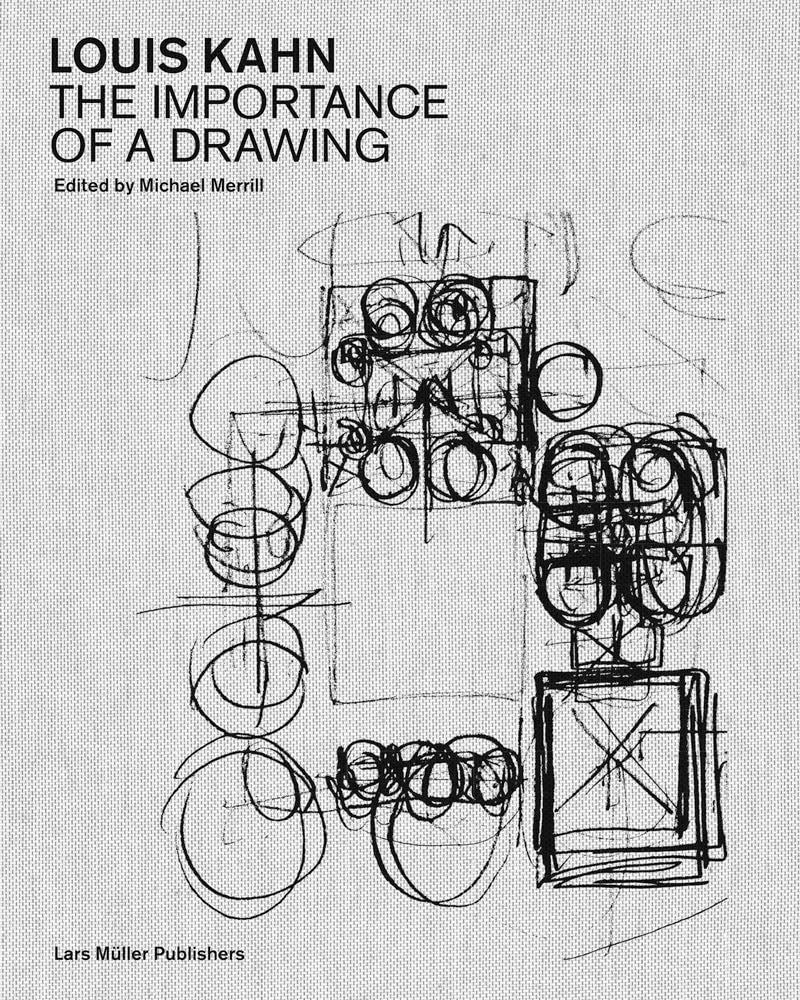



An intimate guided journey into Louis Kahn´s craft and imagination, this book weaves its texts around the drawings of Kahn and his associates to accompany this master architect on his creative search “The importance of a drawing is immense, because it’s the architect’s language,” said the architect Louis Kahn to his masterclass in 1967. While most studies of Kahn focus on his built works or theory and use drawings mainly to illustrate these, this publication chooses to focus on Kahn's drawings as primary sources of insight into his architectural intelligence and imagination. Lavishly illustrated with over 900 high-quality reproductions of work by Kahn and his associates, incisively presented by a group of acclaimed architectural experts, The Importance of a Drawing is a deep immersion into Kahn’s work and his design process. A testament to Kahn’s masterly craft, this volume also makes a provocative primer on architectural representation by posing timely questions on how architects use drawings to see, learn, conjecture and reveal. Destined to become a standard reference on Kahn, this book is an essential addition to the libraries of established designers as well as students of architecture. The result of years of extensive research, The Importance of a Drawing contains original contributions and historical texts from Michael Merrill, Michael Benedikt, Michael B. Cadwell, Louis I. Kahn, Nathaniel Kahn, Sue Ann Kahn, David Leatherbarrow, Michael J. Lewis, Robert McCarter, Marshall D. Meyers, Jane Murphy, Harriet Pattison, Gina Pollara, Colin Rowe, David Van Zanten, Richard Wesley and William Whitaker. Louis Kahn (1901–74) was an Estonian-born American architect who called Philadelphia his home. Trained in the tradition of the École des Beaux-Arts, Kahn was later able to fuse a progressive modern agenda with the poise of ancient monuments into a work of seminal and lasting importance. His major works include the National Parliament in Dhaka, Bangladesh; the Salk Institute in La Jolla, California; the Kimbell Art Museum in Fort Worth Texas; and the posthumously realized Four Freedoms Park on Roosevelt Island in New York City. Kahn was a revered educator, teaching at the Yale School of Architecture from 1947 to 1957 and then at the University of Pennsylvania until his death. What a treasure trove Kahn produced, waiting in the archive for someone with Merrill ' s bent and skill to come along.... Merrill offers an exemplary sequence of chapters devoted to Kahn ' s use of architecture ' s fundamental drawing modalities — plan, section, elevation, perspective, and axonometric. These present architectural history and analysis at its finest.... Merrill ' s quiet but insistent mission goes well beyond illuminating Kahn ' s artistic process — which he does in many cases brilliantly — to advance a more general set of reasons why drawing by hand still matters. Merrill ' s argument, at once correct and profound, is one every architect and architectural historian needs to hear. - Sarah Goldhagen, Journal of the Society of Architectural Historians In Louis Kahn: The Importance of a Drawing we meet this foremost architect through his drawings. While Kahn himself is a rich and worthy subject, this intimate encounter is also intended as a point of departure for anyone interested in the broader realms of representation and design thinking.... This new and significant contribution to the field earns a place in every library. - Paul Emmons, author of Drawing Imagining Building: Embodiment in Architectural Design Practices This beautiful book stands apart from the profusion of publications on Louis Kahn's life and work. Distilling years of research and working together with a group of distinguished experts, editor Michael Merrill has curated a rich trove of archival drawings in a series of thought-provoking and eminently readable essays exploring the relationship of drawing to building in Kahn´s work. The writing of Merrill and his coauthors breathes fresh air into the often stale atmosphere of Kahn scholarship, providing deep insights into Kahn's methods of making. - John Cava, architect, educator, and editor of Studies in Tectonic Culture Louis Kahn: The Importance of a Drawing is one of those rare studies that simultaneously reframes our understanding of an historical topic—Louis Kahn's design methods—and holds immediate relevance for present-day architectural practice. An innovative and timely work, it bears on matters of scholarship, representation, and design process, and raises a host of questions about the making of architecture that are only more pressing in our own digital age, even as its subject concerns a master of analog methods. - Sandy Isenstadt, Chair, History of Modern Architecture at the University of Delaware Painstakingly researched, lavishly illustrated, and beautifully crafted, Louis Kahn: The Importance of a Drawing transcends a traditional art historical analysis of drawings to themati