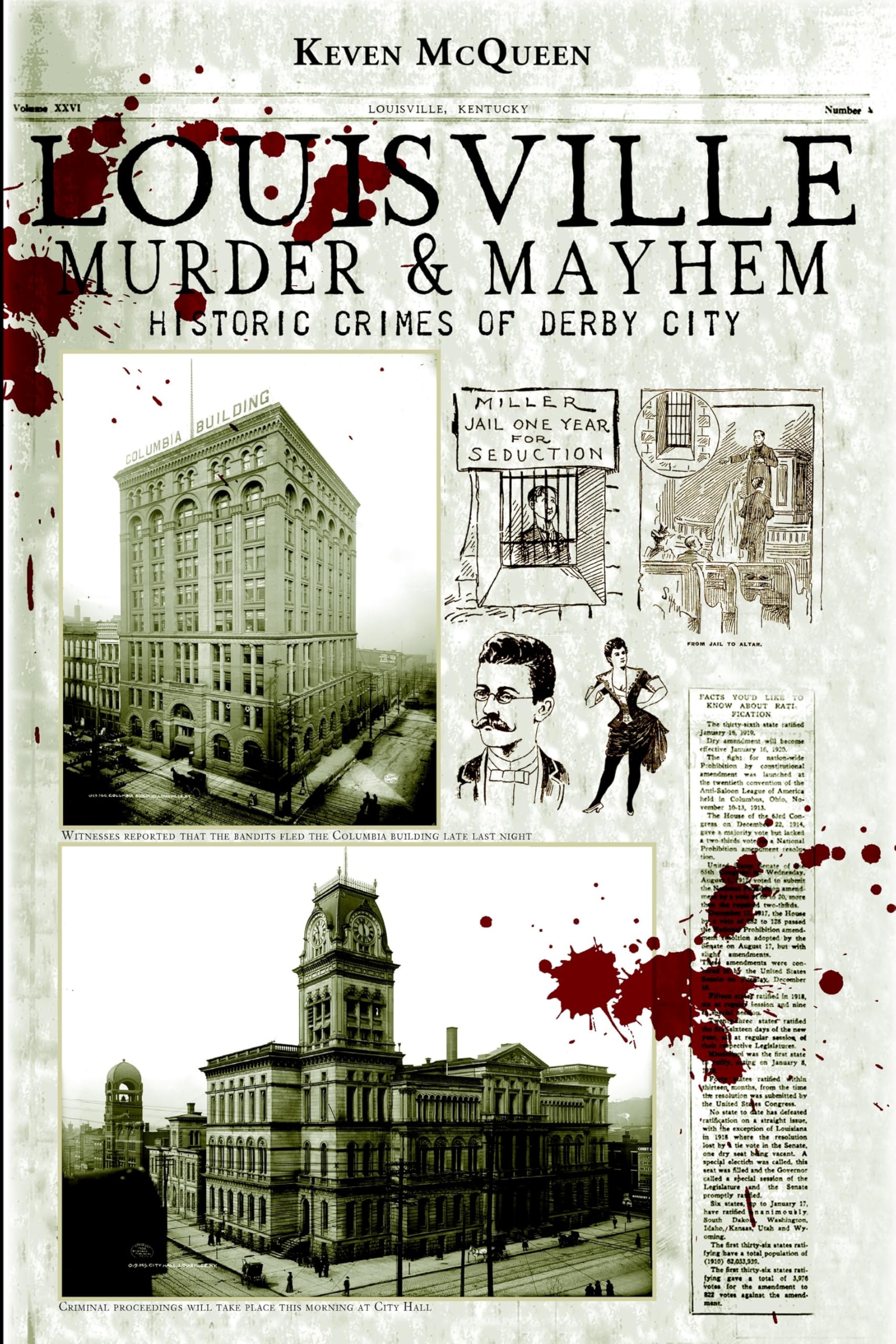



Life in Louisville in the years following the Civil War, and through the turn of the century, was as exciting as it was dangerous. The city continued to grow as important urban hub of culture and commerce, connecting the South with the Midwest and Northern states. As Keven McQueen proves in this collection of morbid tales of crime and depravity, life in Louisville certainly had a darker side. Journey back to a time when Louisville's streets were filled with rail cars, its alleys populated by thieves, and its brothels hummed with activity. Whether it's the tale of the marriage of a convicted murderer to a notorious prostitute, or the exploits the criminal duo dubbed Louisville's Bonnie and Clyde, this is a true crime collection that is truly hard to believe. Keven McQueen is an instructor in the Department of English at Eastern Kentucky University. He is the author of twelve books on biography, history, folklore, ghost lore, natural disasters and historical true crime. Louisville Murder & Mayhem Historic Crimes of the Derby City By Keven McQueen The History Press Copyright © 2012 Keven McQueen All rights reserved. ISBN: 978-1-60949-566-4 Contents 1. The Hanged Butcher's Alleged Rejuvenation, 2. The Dizzy Blondes Come to Town, 3. Chestnut Street's House of Horrors, 4. Carrie McBride, the Pugilistic Prostitute, 5. Murder Will Not Always Out, 6. Your Friendly Neighborhood Pornographer, 7. What Came of a Marriage between a Murderer and a Prostitute, 8. Louisville's Bonnie and Clyde, 9. The Course of True Love, Etc., 10. Striking a Blow for the Workingman, Acknowledgements, Bibliography, About the Author, CHAPTER 1 The Hanged Butcher's Alleged Rejuvenation William Kriel, a rough-and-tumble butcher who lived in Louisville just after the Civil War, might have been as rich as a Vanderbilt had he spent as much time working as he spent drinking and beating his wife, Margaret Evans Kriel. She is described in various reports as being "delicate" and "one of the most amiable of women." The couple had been married fifteen years and had a son. William's butcher shop was on Green Street, and he was well known in town for his honesty. Clearly, he had a private side that few saw. Early in March 1868, thirty-two-year-old Mrs. Kriel, who was suffering from an illness, decided that she had had enough of her husband's violence. She left him and moved in with her mother on Main Street. William responded with an alcoholic binge of several days' duration that was prodigious even by his degraded standards. On March 5, he dropped by for a visit, which means that he "abused her shamefully," as a press report phrased it. He came back on Saturday, March 7, and demanded to know if she was really going to leave him. "No, I am not going to leave you," Mrs. Kriel replied, no doubt choosing her words carefully. "The doctor has told me I must go off [to the country] or I will never get well." This was not the answer he sought, and he protested his wife's show of independence by throttling her. A light bulb appeared over Kriel's head — or would have, had Thomas Edison developed it yet. He produced a gun and shot her two inches above the left ear. She died instantly in her elderly mother's arms and went on to a much greater reward than being the spouse of William Kriel. The drunken butcher sat on the floor and had a first-rate idea: he pressed the gun to his own head and pulled the trigger. A glancing shot tore off his scalp. At this unpleasant juncture, the dead woman's sister, Mrs. Rosa Tolbert, came downstairs to see what all the noise was about. A few weeks before, she had said in confidence that if she had a husband like William Kriel, she would kill him. Somehow, Kriel had gotten wind of the remark, and although the reproof was not unjust, he had been offended. When Mrs. Tolbert entered the room, he shot at her. She ran outside, and he gave chase, firing a second time at the side gate. Luckily, both bullets missed. Kriel's gun was a six-shooter. Realizing that he had two bullets left, and not wishing to waste them, he shot himself twice more in the head. Thanks to the blind luck of the drunken — or perhaps because Fate wanted to save him for a far worse end — both bullets merely grazed his scalp. Soused though he was, the assassin knew he was in trouble when he saw a crowd gathering outside. He fled, but neighbors followed him and captured him at a pork house on Beargrass Creek. Strange to say, but Kriel appears to have been the only murderer in the entire history of nineteenth-century Kentucky who wasn't threatened with lynching. He was delivered to a jail cell, where it took him over a week to dry out. The two major city dailies, the Courier and the Journal — it was in the days just before they merged — ran repeated announcements stating that his death from delirium tremens was expected at any time. As late as March 19, twelve days after the murder, it was reported, "The condition of the pr