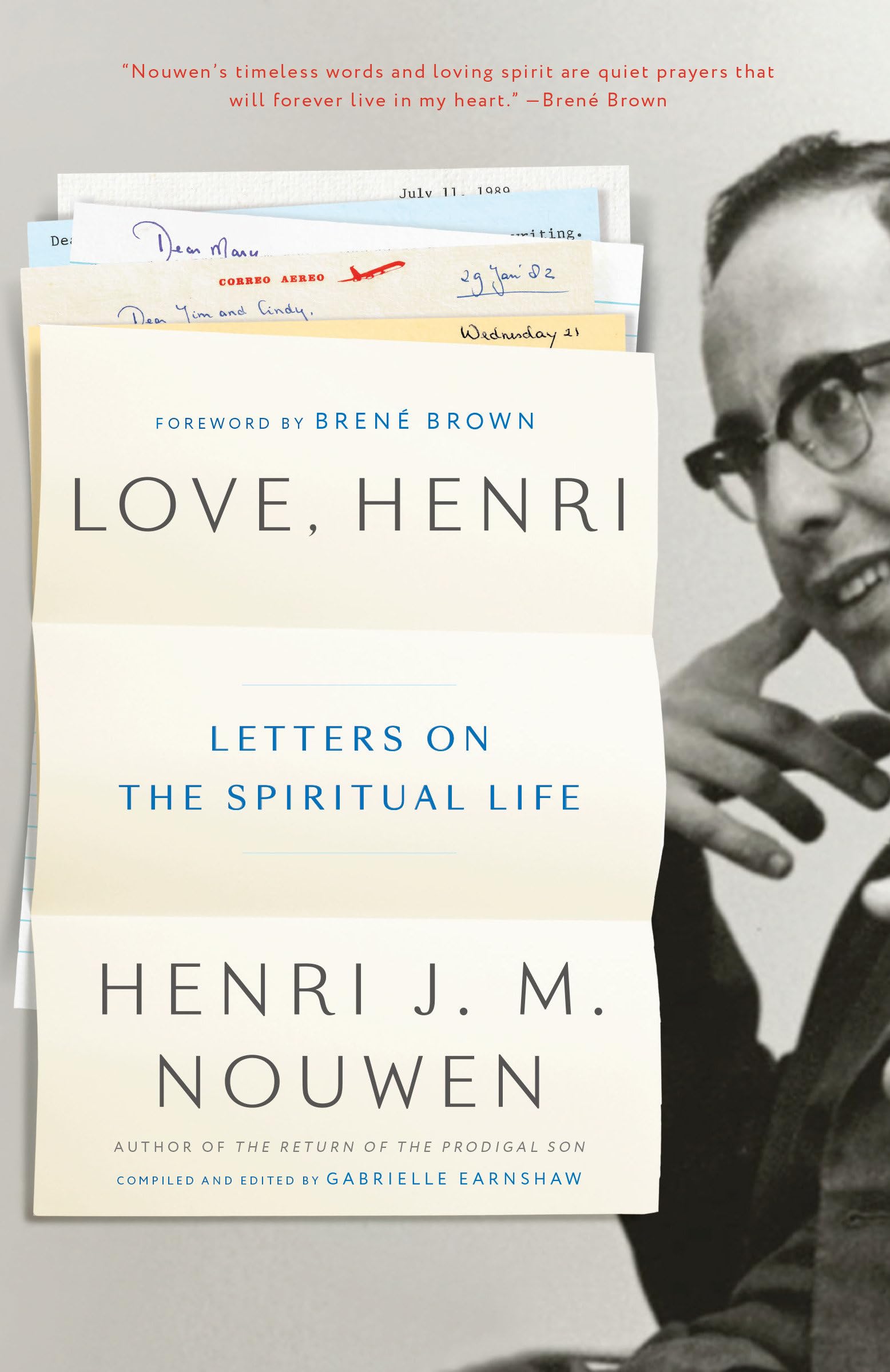



Seven million copies of his books in print! This collection of over 100 unpublished letters from the bestselling author of such spiritual classics as The Return of the Prodigal Son and The Wounded Healer offers deep spiritual insight into human experience, intimacy, brokeness, and mercy . Over the course of his life, Henri Nouwen wrote thousands of letters to friends, acquaintances, parishioners, students, and readers of his work all around the world. He corresponded in English, Dutch, German, French, and Spanish, and took great care to store and archive the letters decade after decade. He believed that a thoughtful letter written in love could truly change someone's life. Many people looked to Nouwen as a long distance spiritual advisor. Love, Henri consists of over a hundred letters that stretch from the earliest years of Henri's career up through his last 10 years at L'Arche Daybreak. Rich in spiritual insights the letters highlight a number themes that emerged in both Henri's work over the years, including vocation, solitude, prayer, suffering, and perseverance in difficult times. These deeply spiritual letters, sometimes poignant, sometimes funny, ulimately demonstrate the rich value of communicating with God through others. "Dear Henri, Your timeless words and loving spirit are quiet prayers that will forever live in my heart. Love, Brené." –Brené Brown, from her Foreword "I love this collection. It is for me, a spiritual autobiography. Henri's letters reveal the ever-evolving, ever-deepening, ever-struggling heart of my strong yet vulnerable friend." –Sue Mosteller, from her Epilogue HENRI NOUWEN was a Dutch-born Catholic priest, professor, and pastor, who gained international renown as the author of over 30 books on the spiritual life, including such classics as The Wounded Healer , The Inner Voice of Love , and The Return of the Prodigal Son . Nouwen's books have been translated into more than 30 languages and have sold upwards of seven million copies worldwide, resonating with people across the religious, spiritual, cultural, and political spectrum. Since his death in 1996, ever-increasing numbers of readers, writers, teachers, and seekers have been guided by his literary legacy. Part I December 1973–1985 The letters begin in late 1973, just weeks before Henri’s forty-second birthday. By that time Henri had been a priest for sixteen years. He was teaching at Yale Divinity School, and beginning to emerge as a widely read writer on spirituality. The chapter concludes more than a decade later, in 1985, when--now at Harvard Divinity School--he experienced his first stirrings of attraction to L’Arche and the path he would follow for the rest of his life. Henri’s early life had been one of privilege and opportunity. He had grown up in the Netherlands within a loving and cultured family, traveled extensively, and circulated easily within Holland’s important social and intellectual circles. After his ordination in 1957, he was sent to the University of Nijmegen to study psychology. This was followed by a two-year graduate training program in theology and psychiatric theory at the Menninger Foundation in Topeka, Kansas, where he distinguished himself among the leading minds in the emerging disciplines of pastoral psychology and clinical pastoral education. The time spent at the Menninger Foundation was Henri’s first extensive stay in the United States and, as he describes it, the place where he grew up: It was here that my life came into focus. For the first time I was dealt with as someone who also had something to say. For the first time I had to think for myself, and people took what I said critically. There I came in touch with myself as a separate human being.* He also became aware of wider political events. He learned of the civil rights movement and the work of Dr. Martin Luther King, Jr. He participated in the march from Selma to Montgomery, Alabama, in 1965 and was introduced to the voices of conscientious objectors to the Vietnam War and anti–nuclear war protestors in the US peace movement. His emerging confidence and bold integration of psychology with pastoral care began to draw attention. After completing the certificate program in 1966, he was offered a teaching position in the newly established psychology department at the University of Notre Dame, Indiana. He accepted, and for two years taught courses there including “Psychology of Religion,” “The Psychology of Personality,” and “Abnormal Psychology.” Henri’s ambitions, however, didn’t lie in the United States. He assumed that he would return to Holland and find his place in Dutch society. He left Notre Dame in 1968, returned home and taught first at the Amsterdam Joint Pastoral Institute and then at the Catholic Theological Institute in Utrecht, two new Catholic schools set up to integrate psychology into pastoral education. Henri became popular with the students, but his “American” teaching style and focus on the methodolo