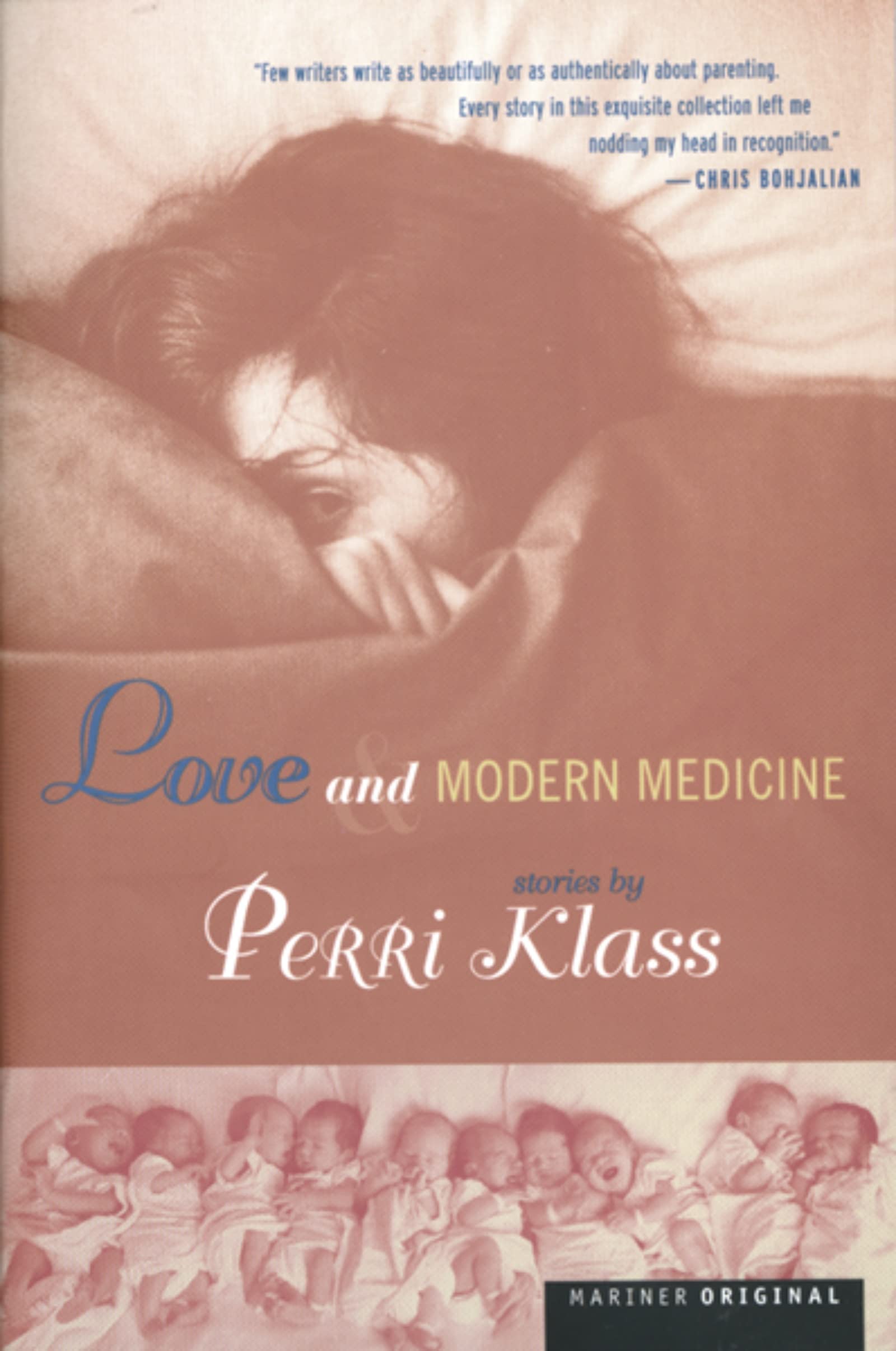
Love And Modern Medicine: An O. Henry Award-Winning Short Story Anthology―Literary Tales of Contemporary Domesticity
$10.69
by Perri Klass



The New York Times has described Perri Klass's short stories as "subtly astonishing and very funny. Klass writes stories that sound true. She's a medical school graduate, a passionate traveler, a mother, a writer. Her preoccupations come forth in her stories. She has plenty to say about love in a science-drunk world, how the brain works, and the heart. And how the sparks fly when the two collide." Sparks fly again in her new collection, LOVE AND MODERN MEDICINE, a literary tapesty of the beauties and terrors of contemporary domesticity. Instantly recognizable, the appealing characters in these stories are the able sort who can cope with any crisis at work but are often undone by the complexities of life at home. They are parents, doctors, patients, friends, and lovers, who encounter one another in sickness and in health, for better or for worse, in a world in which professional expertise -- even the finest medical expertise -- cannot always ward off threats to everyday happiness. In "Freedom Fighter," a pregnant obstetrician steals a getaway weekend with an old friend among the outlet malls of northern New England. A fruit-fly geneticist in "The Trouble with Sophie" struggles to contend with her daughter's jargon-spouting kindergarten teacher. In "Intimacy," a high school biology teacher, exhausted by new motherhood, listens bleary-eyed to the details of her coworker's "intimacy counseling" with her latest boyfriend. And in "Necessary Risks," an anesthesiologist balks at spending two weeks alone with her energetic and precocious four-year-old. Including three O. Henry Award -- winning stories, LOVE AND MODERN MEDICINE is full of small wonders and large satisfactions. Klass, a pediatrician and author of nonfiction as well as novels, has gathered 11 sparkling short stories sharing the theme of domestic life. The mothers are generally practical, scientific types struggling with the messy reality of mixing children and work. Three of the stories were O. Henry award winners, and there isn't a clunker in the bunch. Among the best is "The Trouble with Sophie," in which the tall, thin, dark parents of rambunctious golden-haired Sophie are sent reeling when the teacher at her carefully selected private kindergarten suggests therapy for their emotionally disturbed daughter. In another fine story, "Freedom Fighter," a very pregnant doctor and mother of two sets off on an escape weekend to Maine with a college friend whose one son is grown. Very, very good work. Ann H. Fisher, Radford P.L., VA Copyright 2001 Reed Business Information, Inc. Most of these enjoyable stories concern young couples, families, and either fetuses or babies involved in relationships that Klass presents sympathetically and realistically. Many characters work in professional or academic fields that Klass has already skillfully portrayed. In "Necessary Risks," for example, Caroline is an anesthesiologist faced with two weeks at home with her four-year-old, Emilie, while husband Steve, a mathematician, and son Gary head off to two weeks at a dude ranch. Emilie, a bundle of energy, sings and creates confusion while Caroline tries to think through some of her case plans. But the results of her efforts are often best indicated by her exasperated comment, "Every damn morning is some version of this." This is all perfectly normal, but it is neatly thought out and written. So is "Exact Change," in which group medical practice coordinator Elaine ruminates, convincing us that we know someone just like her. All 11 stories are good reading. William Beatty Copyright © American Library Association. All rights reserved DR. PERRI KLASS is the award-winning author of eleven works of fiction and nonfiction, including Love and Modern Medicine and Other Women’s Children. She is a pediatrician and teaches journalism and pediatrics at New York University. Klass is also the medical director of the national literacy program Reach Out and Read, dedicated to promoting literacy as part of pediatric primary care. She lives in New York. For Women Everywhere Alison, in her ninth month, finds she can no longer turn over in bed at night without waking up. The hydraulics of shifting her belly are just too complex, and to get from her left side to her right, she has to maneuver herself delicately, tucking her elbow under and using it as a lever, swinging her abdomen over the top. Turning over the other way, belly down, is not possible; if she could, she imagines, she would look like a circus seal balancing on a huge ball. When her best friend from high school arrives to keep her company and wait for the birth, Alison hopes to be distracted; lately, she thinks of nothing but the advent of labor. When will this baby come out, when will the pains start that will be unmistakably something new, something she has never felt before? Her obstetrician suggested that they might feel like bad menstrual cramps, which Alison has never had. And she is now accustomed to the small tighten