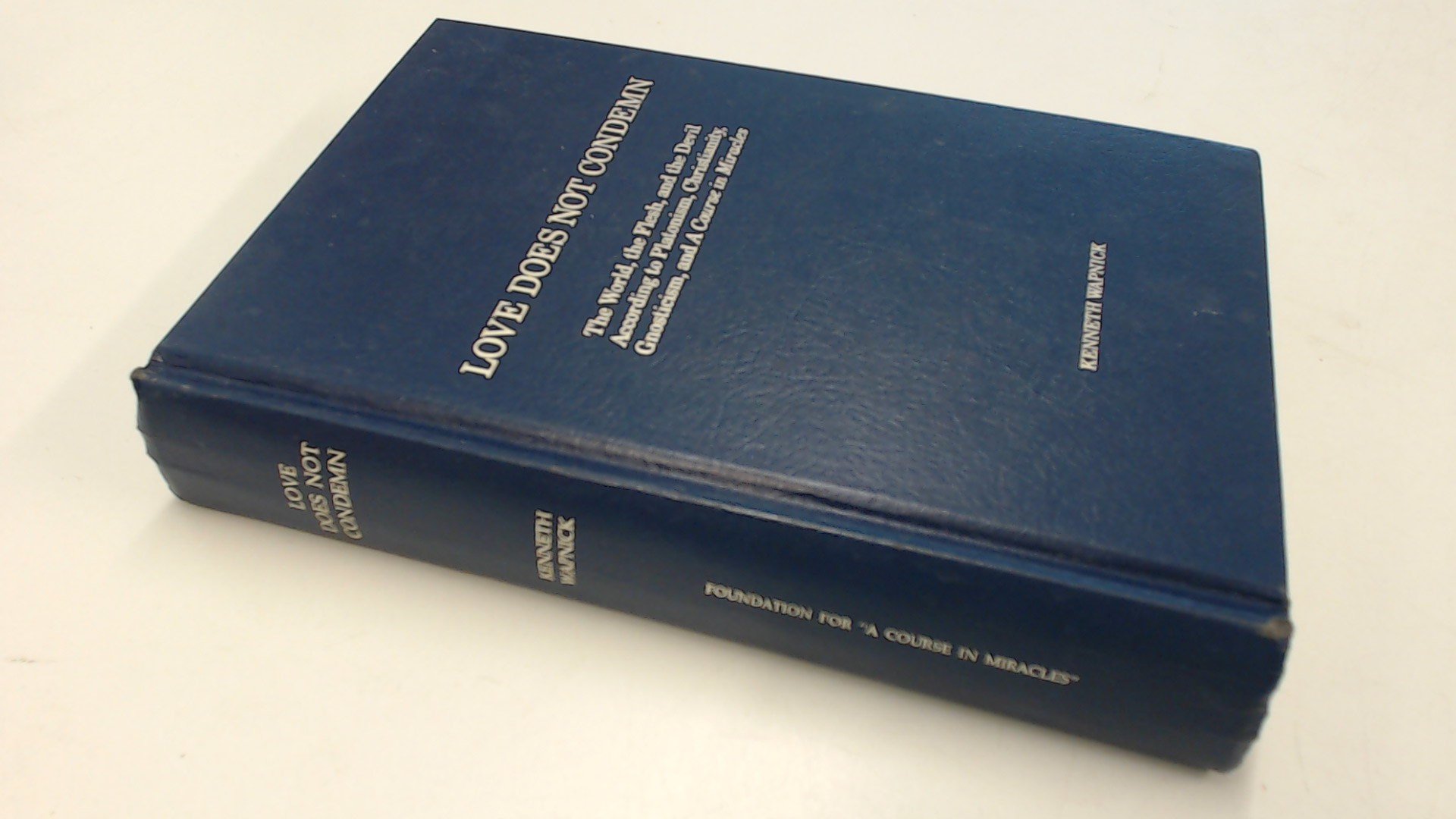
Love Does Not Condemn: The World, the Flesh, and the Devil According to Platonism, Christianity, Gnosticism, and 'A Course in Miracles'
$25.00
by Kenneth Wapnick



'The body was not made by love. Yet love does not condemn it and can use it lovingly, respecting what the Son of God has made and using it to save him from illusions.' (Text, Chapter 18). 'By declaring the phenomenal universe to be the work of the illusory ego, though not inherently evil or sinful, the Course gently resolves the great Platonic paradox of living in an imperfect, visible, and material world, yet knowing of a spiritual world whose Source is perfect and good.' (From the Preface) This book is an in-depth exploration of the non-dualistic metaphysics of 'A Course in Miracles,' and its integration with living in this fundamentally illusory world. It discusses how the Course resolves the God-world paradox that has existed in the Western world since the time of Plato namely, how an imperfect material universe could result from a perfect immaterial Creator. Thus, the context of this exploration is the Platonic and Gnostic themes that have run through Western intellectual and religious history, and the similarities and contrasts between these and the Course. Love Does Not Condemn is in three parts: the first part introduces the Gnostics, Platonists, and the Church-Gnostic conflict of the first two centuries A.D.; the second discusses a seven-stage myth, as understood by Platonism, Christianity, Gnosticism, and A Course in Miracles; the third compares and contrasts the four approaches in light of the God-world paradox, and concludes with a discussion of the errors common to the Gnostics and many students of the Course. The appendix includes the complete text of the important Gnostic document "The Gospel of Truth," glossary of terms, table of dates, bibliography, subject and name index, and an index of Course references. Kenneth Wapnick, Ph.D. is a clinical psychologist and one of the foremost teachers of A Course in Miracles, which he has been working with since 1973, when he joined Dr. Helen Schucman, scribe of the Course, and Dr. William Thetford at the Columbia-Presbyterian Medical Center in New York. He has written more than 25 books on the Course, including Love Does Not Condemn, Absence from Felicity: The Story of Helen Schucman and Her Scribing of 'A Course in Miracles,' The Message of 'A Course in Miracles,' and many others. He has also produced over 150 audio and video titles discussing the principles of the Course. He is President and co-founder, with his wife Gloria, of the Foundation for A Course in Miracles in Temecula, California. From the Preface: A litany from the seventeenth-century Book of Common Prayer of the Church of England contains this petition: "From fornication, and all other deadly sin; and from all the deceits of the world, the flesh, and the devil, Good Lord, deliver us"..."The world, the flesh, and the devil" have been preoccupations of world religions ever since people began reflecting on their existential situation of feeling alone and vulnerable in a world that could be perceived as harmful, evil, and uncaring. Religions, thus, can be seen as attempts to render sensible this otherwise inexplicable and meaningless phenomenal world. They have sought answers to the question of how a separated and physical world, apparently under the benevolent guidance of a loving and non-physical God, can arise in the first place, and then continually manifest pain and suffering. They address the problem of how one is to live in a world of the body, while trying to recall and identify with one's spiritual Self. In the Western philosophical world, this problem has been addressed since the time of the pre-Socratics in ancient Greece, with Plato being the first to develop an elaborate cosmogony (study of the origin of the world) and cosmology (study of the nature of the world), and then an ethical system and theory of society that was derived from this. His work became the foundation for over two thousand years of theoretical speculation about the nature of spiritual reality and its relation to the world of the body, not to mention having presented a problem that has perplexed Platonists for centuries and centuries.... It is my contention that concurrent with the rise and spread of Christianity ran a strong thread of truth, closer to the message of the living Jesus and counter to the orthodox Christian position. The roots of this thread in the Western world are traceable back to Plato and before, and extend through the great Gnostic and Neoplatonic thinkers to the present day, where A Course in Miracles is among its clearest and purest exponents. This thread reflects a unified spirit, despite its disparate voices. It is the spirit of a wisdom that recognizes the alienation of living in a world that does not correspond to the pure oneness of God, the voice of one experiencing the paradox of the un-bridgeable gulf between the perfection of God and His creation, set against the obvious imperfections of this world that are so foreign to one's true Self. And yet it is a voice that sees salvatio