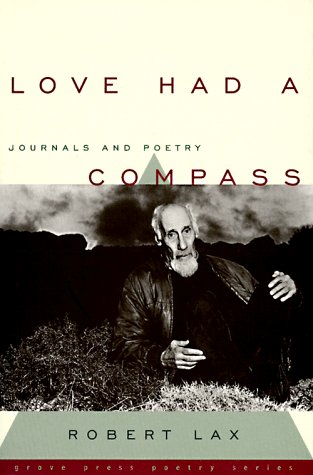



Ever generation of poets seems to harbor its own hidden genius, one whose stature and brilliance come to light after his talent has already been achieved and exercised. The same drama of obscurity and nuance that attended the discovery of Emily Dickinson and Wallace Stevens is suggested by the career of Robert Lax. An expatriate American whose work to date more than forty books has been published mostly in Europe, this 85-year-old poet built a following in the U.S. among figures as widespread as Mark Van Doren, e. e. cummings, Jack Kerouac, and Sun Ra. The works in Love Had a Compass represent every stage of Lax's development as a poet, from his early years in the 1940s as a staff writer for The New Yorker to his present life on the Greek Island of Patmos. An inveterate wanderer, Lax's own sense of himself as both exile and pilgrim is carefully evoked in his prose journals and informs the pages of the Marseille Diaries, published here for the first time. Together with the poems, they provide the best portrait available to date of one of the most striking and original poets of our age. A contemporary of Thomas Merton and John Berryman, Lax is meticulous, quiet, and deeply spiritual. He holds court in a self-induced vacuum (in this case, a small Greek island): "looking and naming: not doing very much more." Lax, who once traveled with a circus, discovers the perfect blend of sacred and profane in the 45-page cycle "The Circus of the Sun." "Can this have been built in one day?" he asks, seeing the billowing tents. Lax's ability to pinpoint individuality carries over to the book's other long poetic cycle, "Port City: The Marseilles Diaries." Not nearly as grandiose or imagistic as the circus cycle, these poems point toward his minimalist (or "concrete") pieces?perhaps the only work by Lax widely published in America. The volume concludes with a long prose journal, shedding light not so much on the poems as on Lax's well-honed process. Recommended for larger collections.?Rochelle Ratner, formerly with "Soho Weekly News," New York Copyright 1996 Reed Business Information, Inc. The elusive Lax was a friend of the religious writer and fellow Catholic convert Thomas Merton (1915^-68). Instead of the stream of American publications that kept Merton before the public despite becoming a Trappist monk, Lax opted to roam Mediterranean Europe, live among poor working people (he settled on the Greek island Patmos), and produce some of the sparest imagist poetry in English with no thought about publishing where the literary high and mighty would read him. Lax dispenses with metaphor and largely with ego (in the occasional concrete poem, even with syntax) to present what he sees with elemental forcefulness, as if in strong Mediterranean sunlight. Furthermore, because Lax's vocabulary is biblically small and biblically allusive, individual poems register as prayers and, more often, mystical visions, albeit Lax's visions are of things anyone would see were they in his shoes. To occupy those shoes via his poems (even the journal excerpted here has much verse in it) is to have the lenses of perception cleansed and to see earth, sea, and sky as if newly made. Ray Olson Every generation of poets seems to harbor its own hidden genius, one whose stature and brilliance come to light after his talent has already been achieved and exercised. The same drama of obscurity and nuance that attended the discovery of Emily Dickinson and Wallace Stevens is suggested by the career of Robert Lax. An expatriate American whose work to date--more than forty books--has been published mostly in Europe, this eighty-five-year-old poet built a following in this country among figures as widespread as Mark Van Doren, E. E. Cummings, Jack Kerouac, and Sun Ra. The works in Love Had a Compass represent every stage of Lax's development as a poet, from his early years in the 1940s as a staff writer for the New Yorker to his present life on the Greek Island of Patmos. An inveterate wanderer, Lax's own sense of himself as both exile and pilgrim is carefully evoked in his prose journals and informs the pages of the Marseille Diaries, published here for the first time. Together with the poems, they provide the best portrait available to date of one of the most striking and original poets of our age. "Among America's greatest poets, a true minimalist who can weave awesome poems from remarkably few words."--Richard Kostelanetz, The New York Times Book Review "In my opinion, [Lax's Circus of the Sun] is, in all probability, the finest volume of poems published by an English-speaking poet of the generation which comes in T. S. Eliot's wake."--R. C. Kenedy, Victoria & Albert Museum, London "Lax remains the last unacknowledged major poet of his post-60s generation."--The New York Times Book Review "In the beginning, a long time ago, we were colleagues at the New Yorker. We meet, at infrequent intervals, and invariably go on talking where we left off, about wha