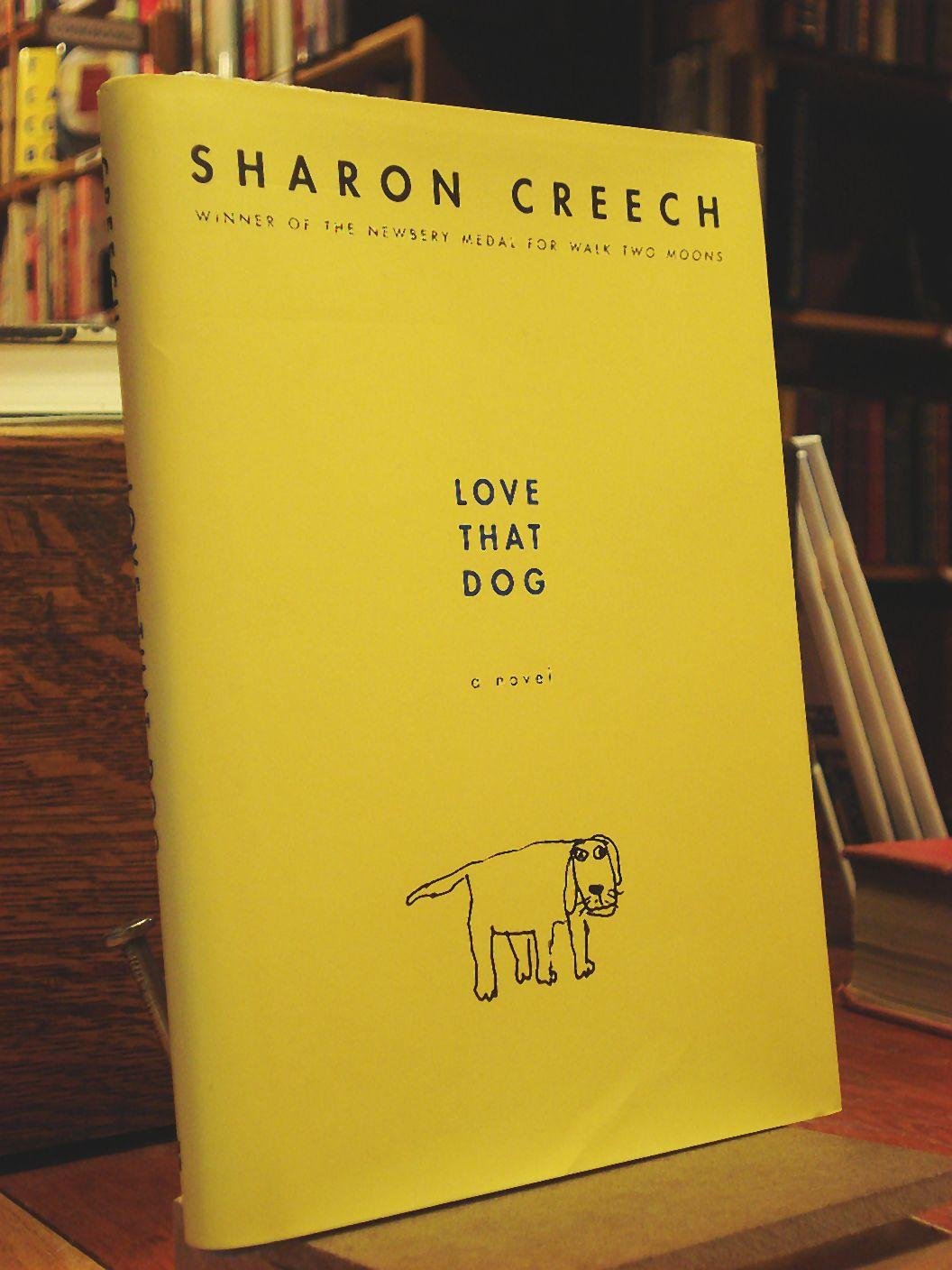



The Newbery Medal-winning author of Walk Two Moons, Sharon Creech , brings readers a story with enormous heart. Love That Dog shows how one boy named Jack finds his voice with the help of a teacher, a pencil, some yellow paper, and of course, a dog. Written as a series of free-verse poems from Jack's point of view, and with classic poetry included in the back matter, this novel is perfect for kids and teachers, too. Jack hates poetry. Only girls write it and every time he tries to, his brain feels empty. But his teacher, Miss Stretchberry, won't stop giving her class poetry assignments—and Jack can't avoid them. But then something amazing happens. The more he writes, the more he learns that he does have something to say. "I guess it does look like a poem when you see it typed up like that." Newbery Medal winner Sharon Creech's Love That Dog , a funny, sweet, original short novel written in free verse, introduces us to an endearingly unassuming, straight-talking boy who discovers the powers and pleasures of poetry. Against his will. After all, "boys don't write poetry. Girls do." What does he say of the famous poem "Stopping by Woods on a Snowy Evening"? "I think Mr. Robert Frost / has a little / too / much / time / on his / hands." As his teacher, Ms. Stretchberry, introduces the canon to the class, however, he starts to see the light. Poetry is not so bad, it's not just for girls, and it's not even that hard to write. Take William Carlos Williams, for example: "If that is a poem / about the red wheelbarrow / and the white chickens / then any words / can be a poem. / You've just got to / make / short / lines." He becomes more and more discerning as the days go by, and readers' spirits will rise with Jack's as he begins to find his own voice through his own poetry and through that of others. His favorite poem of all is a short, rhythmic one by Walter Dean Myers called "Love That Boy" (included at the end of the book with all the rest of Ms. Stretchberry's assignments). The words completely captivate him, reminding him of the loving way his dad calls him in the morning and of the way he used to call his yellow dog, Sky. Jack's reverence for the poem ultimately leads to meeting the poet himself, an experience he will never forget. This winning, accessible book is truly remarkable in that Creech lets us witness firsthand how words can open doors to the soul. And this from a boy who asks, "Why doesn't the person just / keep going if he's got / so many miles to go / before he sleeps?" (Ages 8 to 12) --Karin Snelson Gr 4-8-Jack keeps a journal for his teacher, a charming, spare free-verse monologue that begins: "I don't want to/because boys/don't write poetry./Girls do." But his curiosity grows quickly as Miss Stretchberry feeds the class a varied menu of intriguing poems starting with William Carlos Williams's "The Red Wheelbarrow," which confuses Jack at first. Gradually, he begins to see connections between his personal experiences and the poetry of William Blake, Robert Frost, and others, and Creech's compellingly simple plot about love and loss begins to emerge. Jack is timid about the first poems he writes, but with the obvious encouragement and prodding of his masterful teacher, he gains the courage to claim them as his own in the classroom displays. When he is introduced to "Love That Boy" by Walter Dean Myers, he makes an exuberant leap of understanding. "MARCH 14/That was the best best BEST/poem/you read yesterday/by Mr. Walter Dean Myers/the best best BEST/poem/ever./I am sorry/I took the book home/without asking./I only got/one spot/on it./That's why/the page is torn./I tried to get/the spot/out." All the threads of the story are pulled together in Jack's final poem, "Love That Dog (Inspired by Walter Dean Myers)." Creech has created a poignant, funny picture of a child's encounter with the power of poetry. Readers may have a similar experience because all of the selections mentioned in the story are included at the end. This book is a tiny treasure. Lee Bock, Glenbrook Elementary School, Pulaski, WI Copyright 2001 Cahners Business Information, Inc. Gr. 3-6. In simple free verse, Jack tells his teacher that he cares nothing about poetry and sees no point in that snowy woods stuff: "Why doesn't the person just / keep going if he's got / so many miles to go before he sleeps?". But despite himself, he's enraptured by what his teacher is reading: the beat of "Tiger, tiger burning bright" just won't go away. At the same time, he's writing poetry in his own voice about himself, culminating in a breathtaking poem about what happened to his beloved dog. At the end, Creech overdoes Jack's fawning adoration of author Walter Dean Myers, who comes to school at Jack's behest, but that won't stop kids from recognizing both Jack's new exuberance and his earlier uptight mood. Best of all, the story shows how poetry inspires reading and writing with everyday words that make personal music. This is a book for