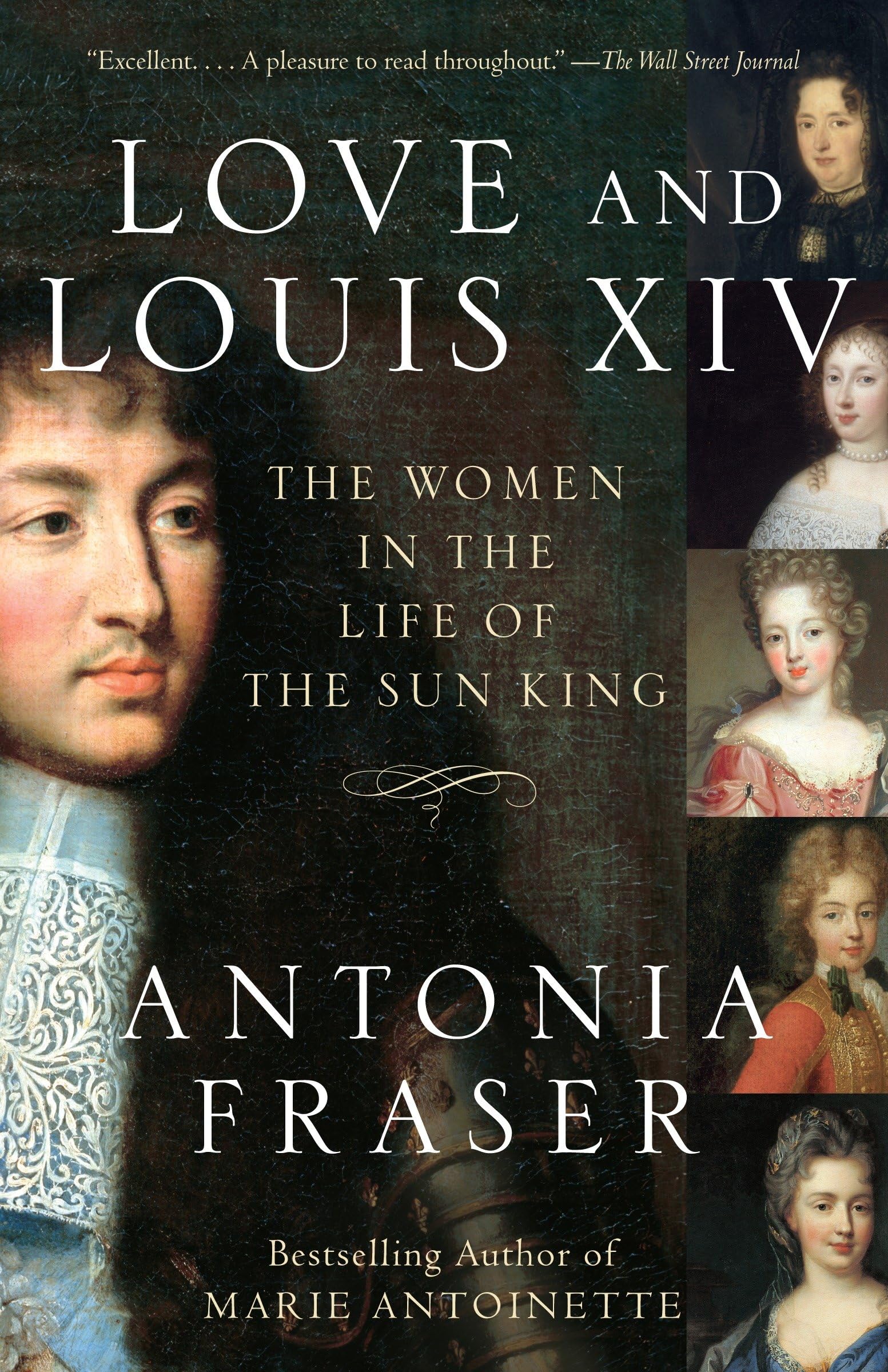



Louis XIV, the highly-feted “Sun King”, was renowned for his political and cultural influence and for raising France to a new level of prominence in seventeenth-century Europe. And yet, as Antonia Fraser keenly describes, he was equally legendary in the domestic sphere. Indeed, a panoply of women—his mother, Anne; mistresses such as Louise de la Vallière, Athénaïs de Montespan, and the puritanical Madame de Maintenon; and an array of courtesans—moved in and out of the court. The highly visible presence of these women raises many questions about their position in both Louis XIV’s life and in France at large. With careful research and vivid, engaging prose, Fraser makes the multifaceted life of one of the most famous European monarchs accessible and vibrantly current. “Excellent...a pleasure to read throughout.” — The Wall Street Journal “Highly readable....with vivid wit, Fraser demonstrates that within the edifice of the monarchy there were deep crannies of ordinary affection.” — The New Yorker “Entertaining and instructive....we must still be grateful to Antonia Fraser for devising so excellent a companion with which to lie back and think of France.” — The New York Times “Engaging...the sumptuously illustrated Love and Louis XIV focuses on the diverse array of women who ‘lit up the court of the Sun King.’” — The Washington Post Antonia Fraser is the author of many internationally bestselling historical works, including Love and Louis XIV , Marie Antoinette , which was made into a film by Sofia Coppola, The Wives of Henry VIII , Mary Queen of Scots , Faith and Treason: The Story of the Gunpowder Plot, and Perilous Question: Reform or Revolution? Britain on the Brink, 1832 . She is also the author of Must You Go? My Life with Harold Pinter . She has received the Wolfson Prize for History, the 2000 Norton Medlicott Medal of Britain’s Historical Association, and the Franco-British Society’s Enid McLeod Literary Prize. She was made a Dame of the British Empire for services to Literature in 2011. Chapter 1 Gift from Heaven They saw in the arms of this princess whom they had watched suffer great persecutions with so much staunchness, their child-King, like a gift given by Heaven in answer to their prayers. —Madame de Motteville, Mémoires The first woman in the life of Louis XIV — and probably the most important — was his mother, Anne of Austria. When Louis, her first child, was born on 5 September 1638 the Spanish-born Queen of France was just short of her thirty-seventh birthday. This was an age at which a royal princess might well expect to be a grandmother (Anne herself had been married at fourteen). The Queen had on the contrary endured twenty-two years of childless union. Anne, as she told a confidante, had even feared the annulment of her marriage, since childlessness was one possible ground for repudiation according to the Catholic Church. In which case the former Spanish Princess, daughter of Philip III, would either have been returned to her native country or possibly dispatched to govern the so-called ‘Spanish’ Netherlands (approximately modern Belgium), as other princesses of her royal house had done, most recently her pious aunt, Isabella Clara Eugenia. The birth of a child, and that child a son — females could not inherit in France under the fourteenth-century Salic Law — meant that the whole position of his royal mother was transformed. It was not only the obvious delight of a woman confronted with ‘a marvel when it was least expected’, as the official newspaper Gazette de France put it. It was also the traditionally strong position of any Queen of France who had produced a Dauphin, an interesting paradox in the land of the Salic Law. This strength derived from the claim of such a Queen to act as Regent should her husband die during the minority of her son; a rule which had applied to Louis XIII’s mother when Henri IV had died, and the dominating Catherine de Médicis in the previous century. It was a situation that had already been envisaged at the time of Anne of Austria’s betrothal in 1612. In poetical language the future Queen was described as the moon to her husband’s sun: ‘Just as the moon borrows its light from the sun . . .’ the monarch’s death means that ‘the setting sun gives way to the moon and confers on it the power of shedding light in its absence’. (The potential bride and bridegroom were then both ten years old.) A quarter of a century later, the reality was less poetical. Louis XIII was not in good health and a Regency in the next thirteen years — the age at which a French King reached his majority — was more likely than not. How long would it be before Anne, like Catherine de Médicis, was promoting herself as an image of revered maternality at the heart of government? Furthermore the dynastic map of Europe was transformed. The heir presumptive to the throne of France, the King’s younger brother Gaston Duc d’Orléans, on being shown ‘physical proofs’ of the baby’