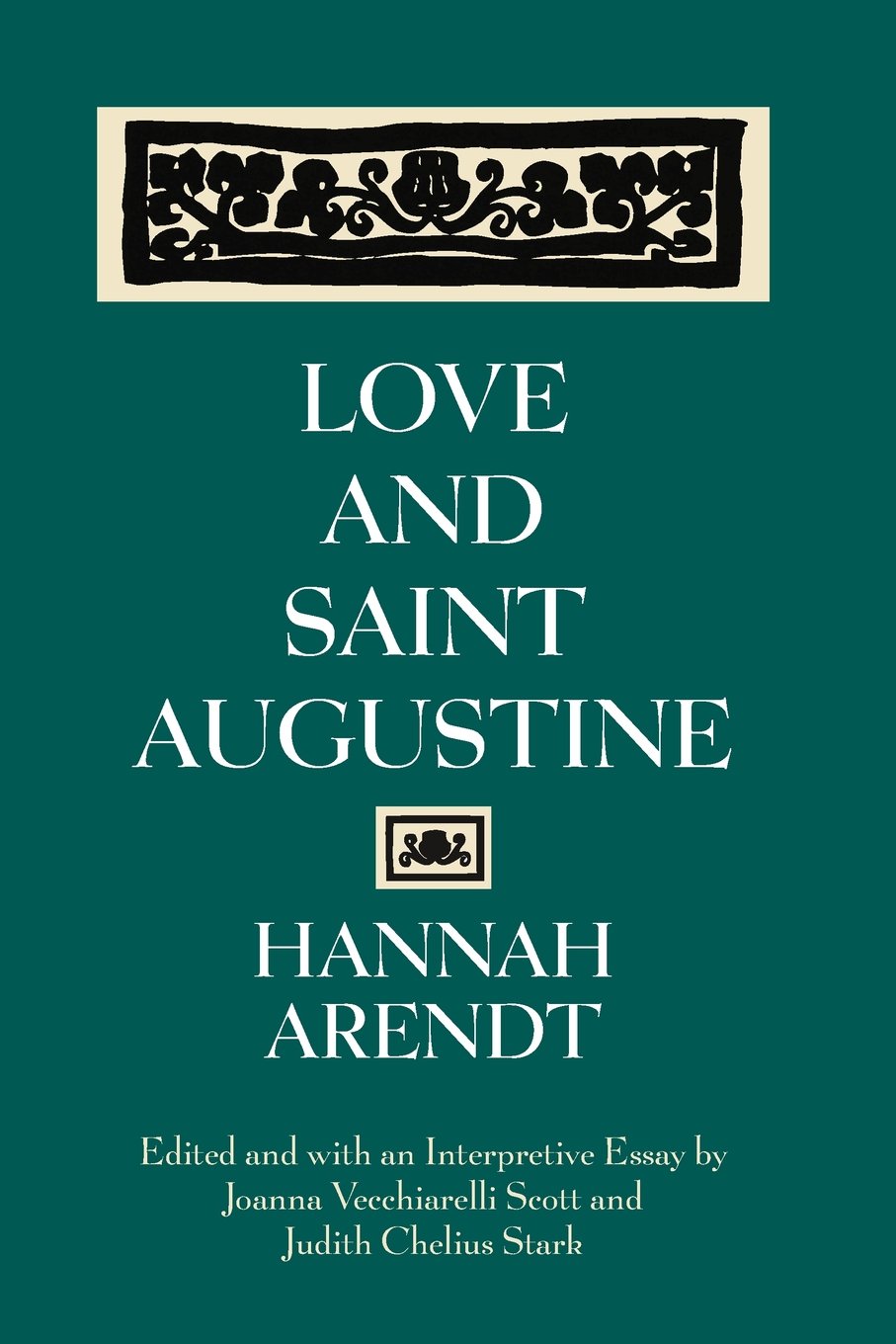



Hannah Arendt began her scholarly career with an exploration of Saint Augustine's concept of caritas , or neighborly love, written under the direction of Karl Jaspers and the influence of Martin Heidegger. After her German academic life came to a halt in 1933, Arendt carried her dissertation into exile in France, and years later took the same battered and stained copy to New York. During the late 1950s and early 1960s, as she was completing or reworking her most influential studies of political life, Arendt was simultaneously annotating and revising her dissertation on Augustine, amplifying its argument with terms and concepts she was using in her political works of the same period. The disseration became a bridge over which Arendt traveled back and forth between 1929 Heidelberg and 1960s New York, carrying with her Augustine's question about the possibility of social life in an age of rapid political and moral change. In Love and Saint Augustine , Joanna Vecchiarelli Scott and Judith Chelius Stark make this important early work accessible for the first time. Here is a completely corrected and revised English translation that incorporates Arendt's own substantial revisions and provides additional notes based on letters, contracts, and other documents as well as the recollections of Arendt's friends and colleagues during her later years. Love and Saint Augustine By Hannah Arendt, Joanna Vecchiarelli Scott, Judith Chelius Stark The University of Chicago Press Copyright © 1996 Joanna Vecchiarelli Scott and Judith Chelius Stark All rights reserved. ISBN: 978-0-226-02597-1 Contents Preface: Rediscovering Love and Saint Augustine, Acknowledgments, LOVE AND SAINT AUGUSTINE, Introduction, PART I. Love as Craving: The Anticipated Future, 1. The Structure of Craving (Appetitus), 2. Caritas and Cupiditas, 3. The Order of Love, PART II. Creator and Creature: The Remembered Past, 1. The Origin, 2. Caritas and Cupiditas, 3. Love of Neighbor, PART III. Social Life, REDISCOVERING HANNAH ARENDT, 1. Introduction: "New Beginnings", 2. "Thought Trains", 3. Heidegger: Arendt between Past and Future, 4. Jaspers: Arendt and Existenz Philosophy, Notes, References, Index, CHAPTER 1 The Structure of Craving ( Appetitus ) [B:033131] Augustine writes that "to love is indeed nothing else than to crave something for its own sake," and further on he comments that "love is a kind of craving." Every craving ( appetitus ) is tied to a definite object, and it takes this object to spark the craving itself, thus providing an aim for it. Craving is determined by the definitely given thing it seeks, just as a movement is set by the goal toward which it moves. For, as Augustine writes, love is "a kind of motion, and all motion is toward something." What determines the motion of desire is always previously given. Our craving aims at a world we know; it does not discover anything new. The thing we know and desire is a "good" ( bonum ), otherwise we would not seek it for its own sake. All the goods we desire in our questing love are independent objects, unrelated to other objects. Each of them represents nothing but its isolated goodness. The distinctive trait of this good that we desire is that we do not have it. Once we have the object our desire ends, unless we are threatened with its loss. In that case the desire to have ( appetitus habendi ) turns into a fear of losing ( metus amittendi ). As a quest for the particular good rather than for things at random, desire is a combination of "aiming at" and "referring back to." It refers back to the individual who knows the world's good and evil and seeks to live happily ( beate vivere ). It is because we know happiness that we want to be happy, and since nothing is more certain than our wanting to be happy ( beatum esse velle ), our notion of happiness guides us in determining the respective goods that then became objects of our desires. Craving, or love, is a human being's possibility of gaining possession of the good that will make him happy, that is, of gaining possession of what is most his own. This love can turn into fear: "None will doubt that the only causes of fear are either loss of what we love and have gained, or failure to gain what we love and [B:033132] have hoped for." Craving, as the will to have and to hold, gives rise in the moment of possession to a fear of losing. As craving seeks some good, fear dreads some evil ( malum ), and "he who fears something must necessarily shun it." The evil that fear makes us shun is whatever threatens our happiness, which consists in possession of the good. So long as we desire temporal things, we are constantly under this threat, and our fear of losing always corresponds to our desire to have. Temporal goods originate and perish independently of man, who is tied to them by his desire. Constantly bound by craving and fear to a future full of uncertainties, we strip each present moment of its cal