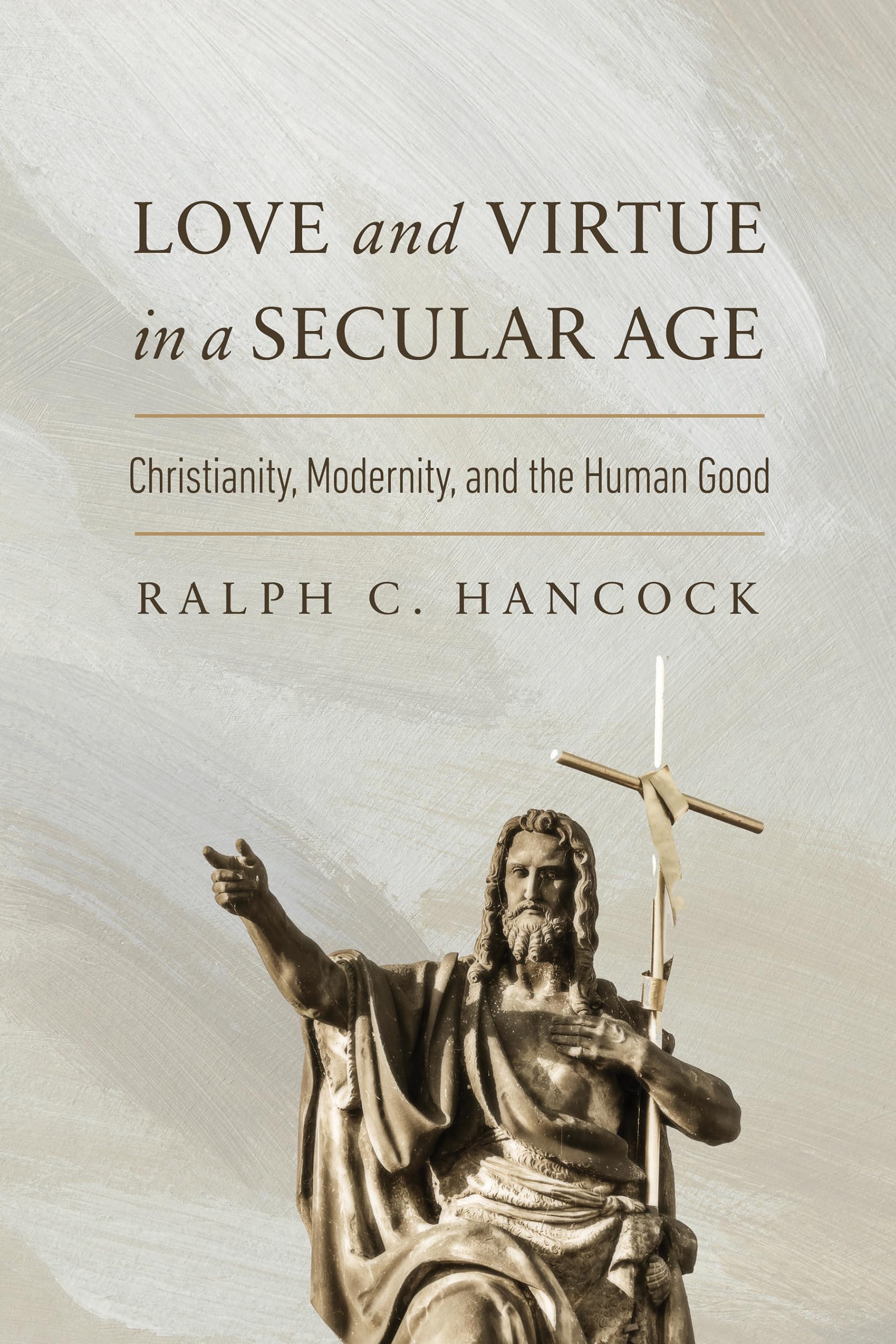
Love and Virtue in a Secular Age: Christianity, Modernity, and the Human Good (The Beginning and the Beyond of Politics)
$40.00
by Ralph C. Hancock



In a comprehensive meditation on freedom and reason, Ralph Hancock reveals the pressing need for renewed confidence in virtue and agency. With an emphasis on reclaiming the moral preconditions of Christian love, Love and Virtue in a Secular Age offers a thought-provoking study on the effects of secularism on Christian morality. Ralph Hancock brings eminent scholars of the Christian Aristotelian tradition, such as Thomas Aquinas and Pierre Manent, into conversation with insights from Leo Strauss’s critique of Christianity. Love and Virtue in a Secular Age sheds light on the various ways in which the increasing prevalence of secular humanitarian sensibility has voided the idea of humanity of its natural substance. In a probing reflection poised at the intersection of the theological and the political, Hancock outlines a new theological ethic according to which faith must redeem a certain pride and particularism on behalf of real Christian communities and the virtues they enact. "Ralph Hancock has given himself a most intimidating task: to recover human agency, with its accompanying confidence in the primacy of the Good. He convincingly shows why our post-Christian souls, in order to understand themselves, need a full and accurate engagement with the Christian proposition. This book is a major achievement." ―Pierre Manent, author of Natural Law and Human Rights and Challenging Modern Atheism and Indifference "Drawing on the best classical, Christian, and contemporary wisdom, Hancock brilliantly rescues Christian love from its thoughtless identification with mere sentimentality and shows that authentic virtue is inseparable from the proud cultivation of moral and political responsibility.” ―Daniel J. Mahoney, author of Recovering Politics, Civilization, and the Soul "Is pride the root of sin or a spur to virtue? With careful attention to Christian theology as well as political philosophy, Ralph Hancock guides the reader through this question and offers a bracing defense of political liberty against progressive humanitarianism." ―James R. Stoner, author of Common-Law Liberty Ralph C. Hancock is professor of political science at Brigham Young University. Progressive liberalism claims the authority of reason and of openness to a “diversity” of views and ways of life. But the Love Wins mantra reveals the sacred dogma that underlies the pose of open-minded rationalism: “Love,” understood as boundless acceptance and empathy, excluding all moral judgment, is the new, unquestioned standard of moral judgment. And the prestige of this secular love, impatient with all boundaries and standards, is clearly a residue (however distorted and misapplied) of the very Christianity that secularism must overcome. Secularism is the secularized residue of Christianity . And this residue, in the form of the ideology of “love,” wields amazing dogmatic authority in our supposedly free-thinking secular age. Question every authority, progressive liberalism entices us, but do not even think about questioning “love,” understood as absolute acceptance and non-judgmental empathy, as the sole standard of human goodness. Never in the darkest of Christian “Dark Ages” did an ideological authority envision such a total domination over the human mind and heart as that asserted by the post-Christian humanistic religion of “love.” The idea that exerts the greatest power over an age is invisible to that age; it defines its horizon and implicitly grounds its judgments. The ruling idea is necessarily sacred and unspeakable in itself, though its moral and intellectual ramifications are on everyone’s lips, and its effects pervade our individual and collective lives. Our indignant refusal of the notion of a sacred ground of action and understanding is by no means evidence of its absence; on the contrary, our flattering self-understanding as infinitely open to other ideas and other ways, as defined by nothing but our freedom from definition, seals our sacred truth in a holy of holies more hidden and more secure than the sacred places of any earlier religion. More than thirty years ago, Allan Bloom, author of The Closing of the American Mind , secured his status as an academic pariah by pointing out the moral and intellectual trap of “openness” as “our virtue.” No one is more closed, he argued, than a professor or intellectual who brandishes “openness” as his chief virtue – no one except, perhaps, the student or follower who basks in its borrowed glory. Prof. Bloom’s analysis still rings largely true today, but the banner of “openness” has yielded much to the cause of “social justice.” Social justice has, for many, become a religious mission. Bloom was addressing a world in which traditional religious belief still stood as an obstacle to the total sway of the virtue of “openness.” The virtuous elites targeted by Bloom’s critique despised biblical belief too much to address an argument to it, except for the all-purpose formula of “openness.”