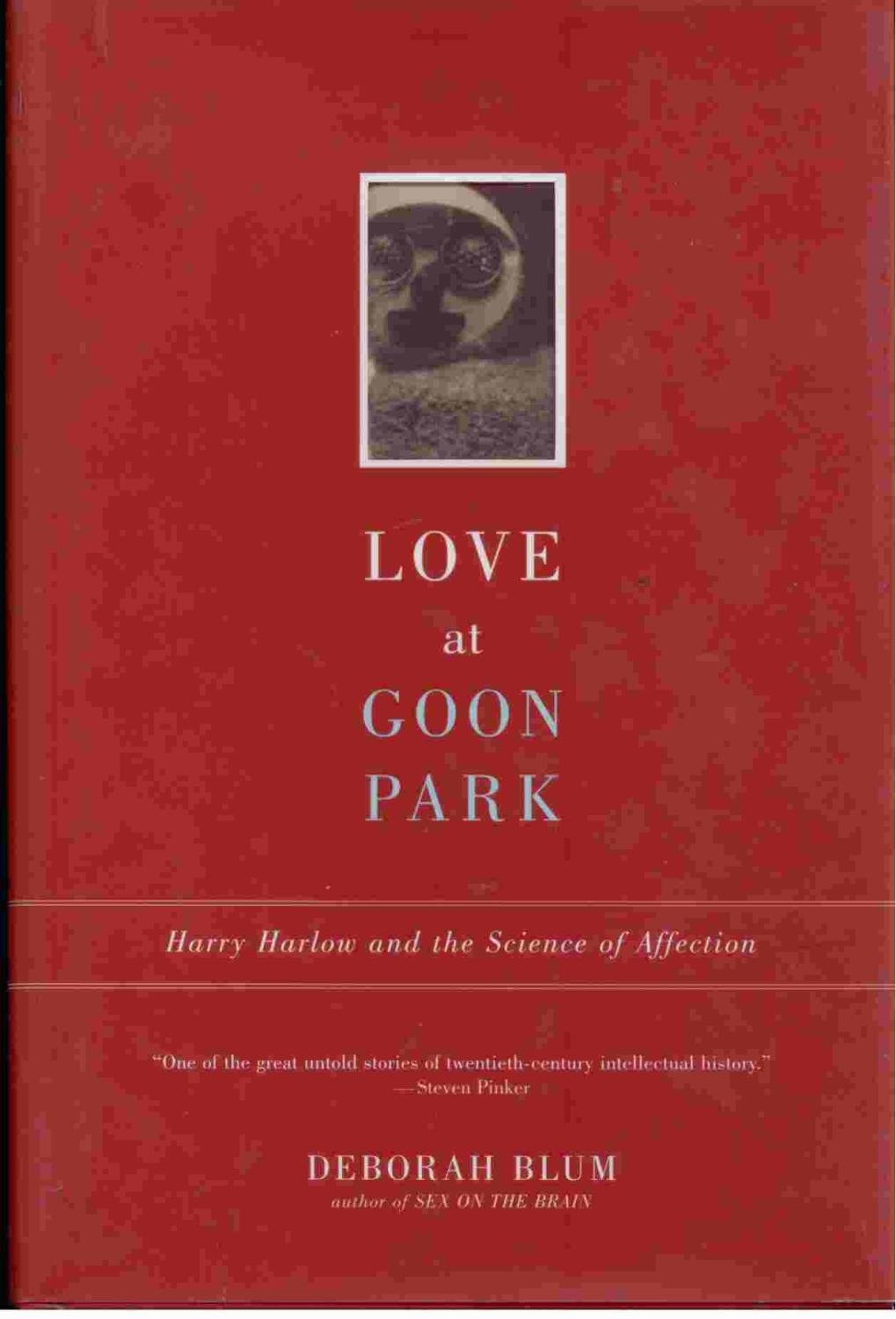



In this meticulously researched and masterfully written book, Pulitzer Prize-winner Deborah Blum examines the history of love through the lens of its strangest unsung hero: a brilliant, fearless, alcoholic psychologist named Harry Frederick Harlow. Pursuing the idea that human affection could be understood, studied, even measured, Harlow (1905-1981) arrived at his conclusions by conducting research-sometimes beautiful, sometimes horrible-on the primates in his University of Wisconsin laboratory. Paradoxically, his darkest experiments may have the brightest legacy, for by studying "neglect" and its life-altering consequences, Harlow confirmed love's central role in shaping not only how we feel but also how we think. His work sparked a psychological revolution. The more children experience affection, he discovered, the more curious they become about the world: Love makes people smarter. The biography of both a man and an idea, The Measure of Love is a powerful and at times disturbing narrative that will forever alter our understanding of human relationships. Not too long ago, the predominant paradigm maintained that infants should be denied love or even physical contact lest they be threatened with infectious microbes. Countering the authority of reigning behavioral psychologists like B.F. Skinner and John Watson, the brilliant renegade Harry Harlow attempted to find the essence of mother love and its influence on child development. Rather than work with rats, Harlow studied primate affection using his classical inanimate surrogate mothers. Pulitzer Prize-winning journalist Blum (The Monkey Wars) rivetingly recounts Harlow's work while examining the man himself. Harlow argued that mother-child bonding was crucial for normal development, and his experiments with monkeys showed that social organisms cannot survive isolation. But as Blum reveals, Harlow was an enigma, brilliant but distant from his own children, and his work raised ethical and controversial dilemmas concerning the research treatment of animals. Harlow had a major impact on psychologists like Abraham Maslow (who happened to be his graduate student), yet he is little known today outside the scientific community. Blum's excellent biography, the first major new work devoted to him, should change that. Highly recommended for public and academic libraries. Rita Hoots, Woodland Coll. Lib., CA Copyright 2002 Reed Business Information, Inc. It's one of the iconic images in psychology. Two "surrogate" primate mothers sit side by side. One is made of chicken wire with a milk bottle sticking out of the torso. The other, milkless, is swathed in terry cloth. And there is the infant rhesus monkey, clinging like mad, squeezing every bit of comfort and attachment it can out of the cloth mother. The work was revolutionary: it overturned remarkably damaging dogma about love and attachment in the 1940s and 1950s, and it was carried out by a contrarian psychologist with a troubled personal life, one in ironic contrast to what his science was demonstrating. In her 1994 book, The Monkey Wars, Pulitzer Prize-winning journalist Deborah Blum superbly balanced opposing views of the incendiary issue of primate vivisection. In Love at Goon Park, Blum does an equally skillful job balancing the pictures of that psychologist, Harry Harlow, as troubled soul and brutal abuser of his experimental subjects versus helper of humankind through brilliant science. Harlow's career, mostly at the University of Wisconsin, had a unifying theme--tilting against the then dominant paradigm in psychology, the ideology of mindless behaviorism. In the first of three phases of his work, he demolished the behaviorist view that animal learning is rudimentary and solely motivated by reward. Instead Harlow showed animals strategizing, learning to learn, demonstrating curiosity and mastering tasks for their own sake, rather than for food reward. Nice, and preparatory for the brilliant second phase of his work. Why do infants become attached to their mothers? Savants agreed: because Mom supplies food. For behaviorists, this was obvious: attachment was thought to arise solely from the positive reinforcement of food. For Freudians, it was also obvious: infants were thought to lack the "ego development" to form a relationship with anything or anyone other than Mom's breast. For physicians, it was obvious and convenient: no need for mothers to visit hospitalized infants; anyone with a bottle would supply attachment needs. No need to worry about preemies kept antiseptically isolated in incubators: regular feeding suffices for human contact. No need for children in orphanages to be touched, held, noted as individuals. What's love got to do with healthy development? Everything, and when some scientists suggested this in the 1940s and 1950s, Harlow's study of surrogates was the irrefutable, scientific battering ram that they cited. Infant monkeys chose the cloth mothers. Attachment had nothing to do with ha