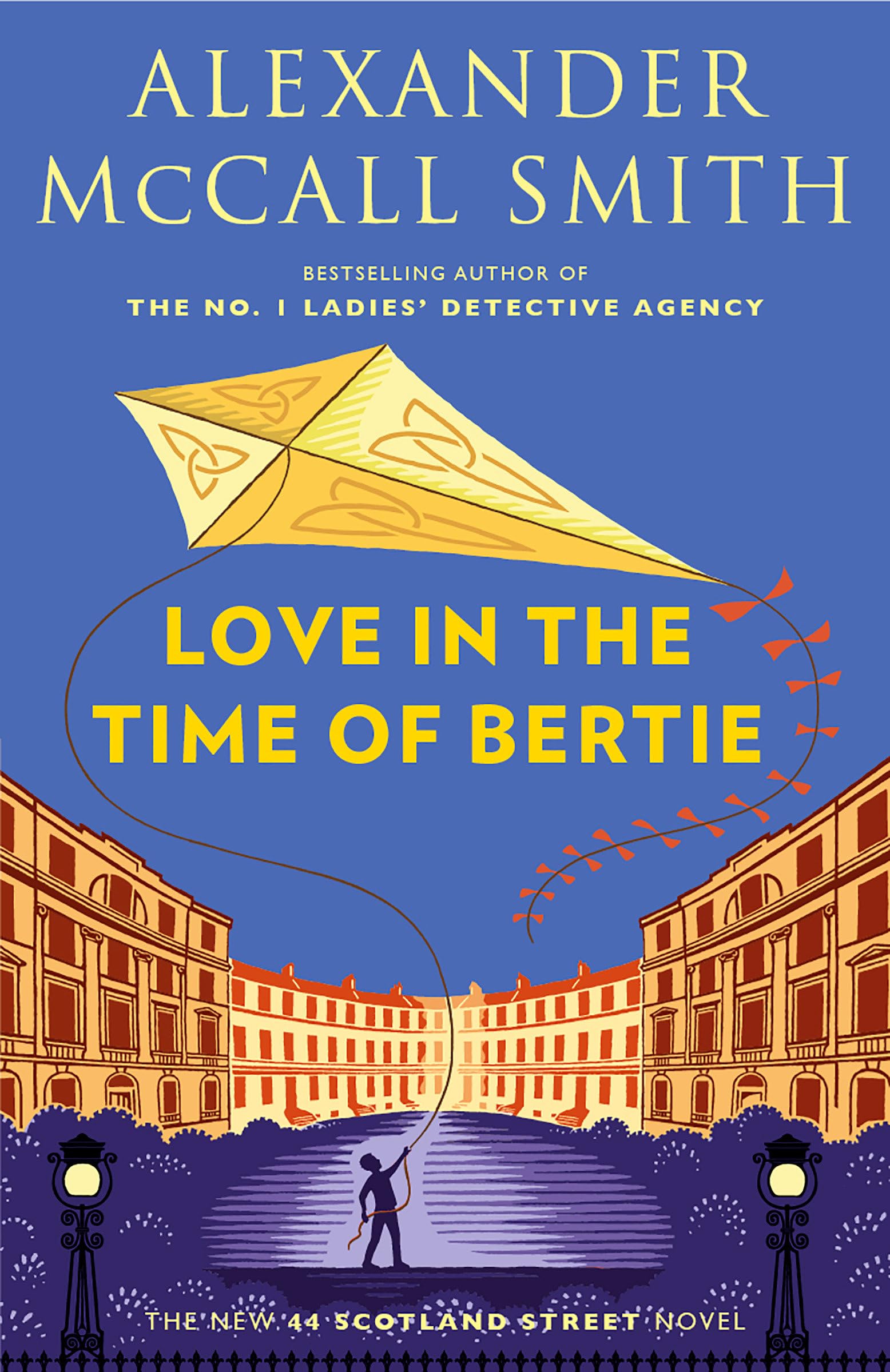



The latest installment in the delightful 44 Scotland Street series finds all our favorite residents up to their usual hilarious hijinks. In the microcosm of 44 Scotland Street, all of life’s richness is found in the glorious goings-on of its residents. There’s Domenica, whose anthropological training has honed her observations of her neighbors; Matthew, whose growing triplets are more than a handful; Bruce, whose challenge as ever is thinking of anything but himself; and Big Lou, who may just have found her shot at romance. And of course, there’s young Bertie Pollock, whose starry-eyed explorations of Edinburgh’s New Town are a touching reminder that life itself is an adventure and there’s joy to be found wherever you choose to look. Praise for Alexander McCall Smith's 44 Scotland Street series: • "McCall Smith's charming, quirky and exasperating characters make you smile in spite of yourself." -- The Independent • "Powerfully addicting fiction. . . . Delightful. . . . [A] graceful and always amusing depiction of the pleasures and problems of everyday life." -- Entertainment Weekly • "Very special. . . . Underpinned by a guiding moral intelligence. . . . Sense and humor fuse absolutely." -- The Scotsman ALEXANDER McCALL SMITH is the author of the No. 1 Ladies’ Detective Agency novels and a number of other series and stand-alone books. His works have been translated into more than forty languages and have been best sellers throughout the world. He lives in Scotland. Belgian Shoes Angus Lordie, portrait painter, citizen of Edinburgh, husband of Domenica Macdonald and owner (custodian, perhaps, according to modern sensibilities) of Cyril, the only dog in Scotland to have a gold tooth; that Angus Lordie stood in a room of his flat at 44 Scotland Street, wondering what to wear. All the clothing he possessed was either hanging from a number of wooden hangers or was neatly folded and stacked away in a series of drawers within a large wardrobe, called in the second-hand trade, brown furniture. Nobody, apparently, wanted brown furniture any longer, as it was considered too cumbersome, not to say too dull, for contemporary tastes. If the Scottish diet had become Mediterranean, then Scottish furniture had become Scandinavian – light and minimalist, consigned to its owners in flat boxes and requiring to be assembled before use – and then reassembled, once the instruction booklet had been read. This was the very opposite of Angus Lordie’s wardrobe, as gloriously over-engineered, in its way, as the Forth Railway Bridge, and of similar vintage. This wardrobe consisted of a series of drawers in which Angus kept what he called his accoutrements: his shirts and socks, handkerchiefs, ties, vests and so on, while jackets and trousers were hung from a railing on the opposite side. His kilt, along with his sporran, hose, kilt pin and sgian dubh, were also in one of the drawers, protected, ineffectively, by moth-repelling balls of cedar. He had two suits – a dark one that had been made for him twenty-two years ago and that was described by Domenica as his kirk suit, and a three-piece, tweedy outfit that Domenica had disparagingly labelled his bookie’s suit. Neither of these descriptions was entirely helpful: the kirk suit was well-made and discreet, rather than Calvinist; the bookie’s suit was not in the least bit flashy, being made of Harris tweed and designed to withstand Hebridean weather – the horizontal rain and Atlantic gusts that beset the West of Scotland, and the North, South, and East for that matter. There was nothing wrong with these suits, although Angus seldom wore them. Suits, he thought, might be going the way of men’s hats and ties – both of which were now seen only infrequently on any man under forty. This was a matter of regret, Angus felt, even if he himself was doing nothing to stem that particular tide of fashion. Alongside the suits were hung four jackets, all of them in frequent use. Two of these were linen, and formed the core of his summer garb, while the others were of an unidentified fabric that Angus referred to as one hundred per cent un-natural. They were comfortable enough, though, and went with virtually anything, but particularly with the crushed strawberry corduroy trousers by which Angus signalled his status as a resident of the Georgian New Town, as a member of the Scottish Arts Club, and as a man of artistic bent. If these trousers raised eyebrows amongst the ranks of the staid, then Angus did not care in the slightest. There was no fixed ordinance stipulating that men should wear sober trousers: fund managers, lawyers and accountants could dress in grey and black if they wished – he, as an artist, preferred something livelier. On the floor of the wardrobe was the shoe rack on which Angus kept shoes other than those in regular use. His regular shoes – described by Domenica as his daily boots – were a pair of brown brogues made by the Northampton shoe-maker, Joseph C