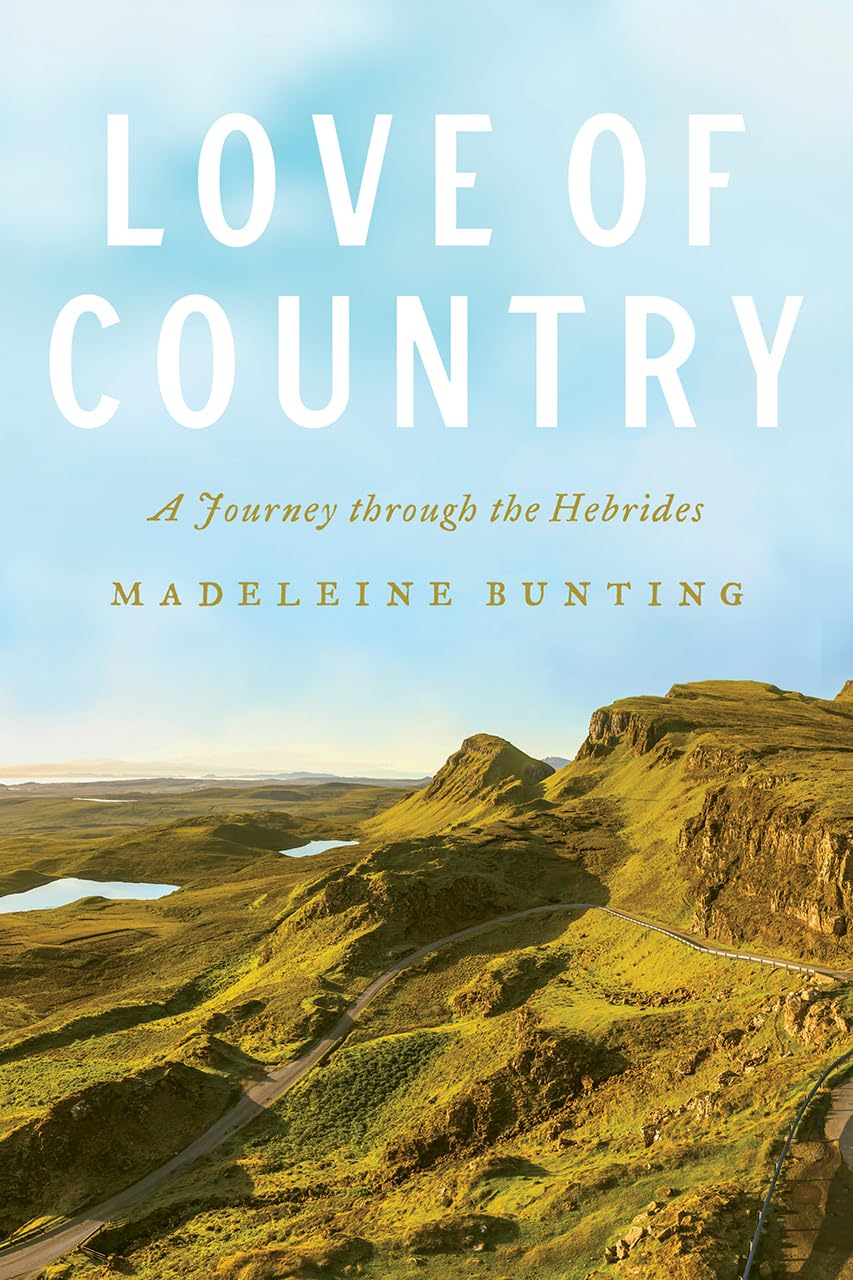



Few landscapes are as striking as that of the Hebrides, the hundreds of small islands that speckle the waters off Scotland’s northwest coast. The jagged, rocky cliffs and roiling waves serve as a reminder of the islands’ dramatic geological history, inspiring awe and dread in those drawn there. With Britain at their back and facing the Atlantic, the Hebrides were at the center of ancient shipping routes and have a remarkable cultural history as well, as a meeting place for countless cultures that interacted with a long, rich Gaelic tradition. After years of hearing about Scotland as a place deeply interwoven with the story of her family, Madeleine Bunting was driven to see for herself this place so symbolic and full of history. Most people travel in search of the unfamiliar, to leave behind the comfort of what’s known to explore some suitably far-flung corner of the globe. From the first pages, it’s clear that Madeleine Bunting’s Love of Country marks a different kind of journey—one where all paths lead to a closer understanding of home, but a home bigger than Bunting’s corner of Britain, the drizzly, busy streets of London with their scream of sirens and high-rise developments crowding the sky. Over six years, Bunting returned again and again to the Hebrides, fascinated by the question of what it means to belong there, a question that on these islands has been fraught with tenacious resistance and sometimes tragedy. With great sensitivity, she takes readers through the Hebrides’ history of dispossession and displacement, a history that can be understand only in the context of Britain’s imperial past, and she shows how the Hebrides have been repeatedly used to define and imagine Britain. In recent years, the relationship between Britain and Scotland has been subject to its most testing scrutiny, and Bunting’s travels became a way to reflect on what might be lost and what new possibilities might lie ahead. For all who have wondered how it might feel to stand face-out at the edge of home , Love of Country is a revelatory journey through one of the world’s most remote, beautiful landscapes that encourages us to think of the many identities we wear as we walk our paths, and how it is possible to belong to many places while at the same time not wholly belonging to any. “A remarkably thorough digest of the many histories of the Hebrides. . . . Bunting shows us that our feelings of home can be as ambiguous and multifaceted as the heritage of the place.” ― Wall Street Journal Published On: 2017-05-01 “As she writes of juxtaposed cultures and historical associations, Bunting is aware not only of the ethnic and social diversity of these places, but also of the many travelers who have preceded her, including poets and writers such as Auden and Orwell. Even today, as she recounts, the places of the northwest can offer cultural surprises: an early stop was to a place once thick with monks, once Christian hermits but now Tibetan Buddhists. And thick with tourists, too; . . . Bunting journeyed to St Kilda, once the most remote of the islands but now heavily visited by people seemingly in need of crossing it off a life list. Ever bookish, Bunting, in the company of a former player in the Buzzcocks, ponders such matters. . . . In the end, it is clear from Bunting’s lively, literate book why, in the words of an Irish poet, the Hebrides might become part of one’s ‘soul territory.’” ― Kirkus Published On: 2017-05-01 “ Love of Country elucidates the importance of one of Britain’s edge communities, the Hebrides, in the formation of national identity. [The book] performs this difficult intellectual labor while also serving as a wildly entertaining travelogue. . . . Reading [Bunting’s] evocative prose conjures the peaty campfire taste of an Islay malt whisky or the stiff, salty sea breeze of a jagged Skye peninsula.” ― Spectrum Culture “[A] moving and wonderful journey through both the geography and history of the Hebrides. . . . As much as it offers intellectual insight, Love of Country is readable and full of empathy. . . . Both the author and reader of this book end up losing themselves not just in politics and history and the details of nature, but a sense of wonder” ― Guardian “[Bunting] explores the history and culture of the islands and, through them, the nature of home and what it means to belong to a place.” ― Observer “[This] is a luminous enquiry into love of islands, their romance and their history chafing in the long-inhabited islands of the Hebrides, their myth and peoples; an exquisite and realistic account of life at the edge and at the edges of identity for this part-Catholic, part-Jewish writer. Her powers of concretion are poetic; she is hawkeyed amid nature, lucid of thought, a shining companion through the tangle of the isles.” ― Herald, Best Books of the Year “A skillful exercise in weaving, drawing together the memories of childhood holidays in the Highlands, the literature