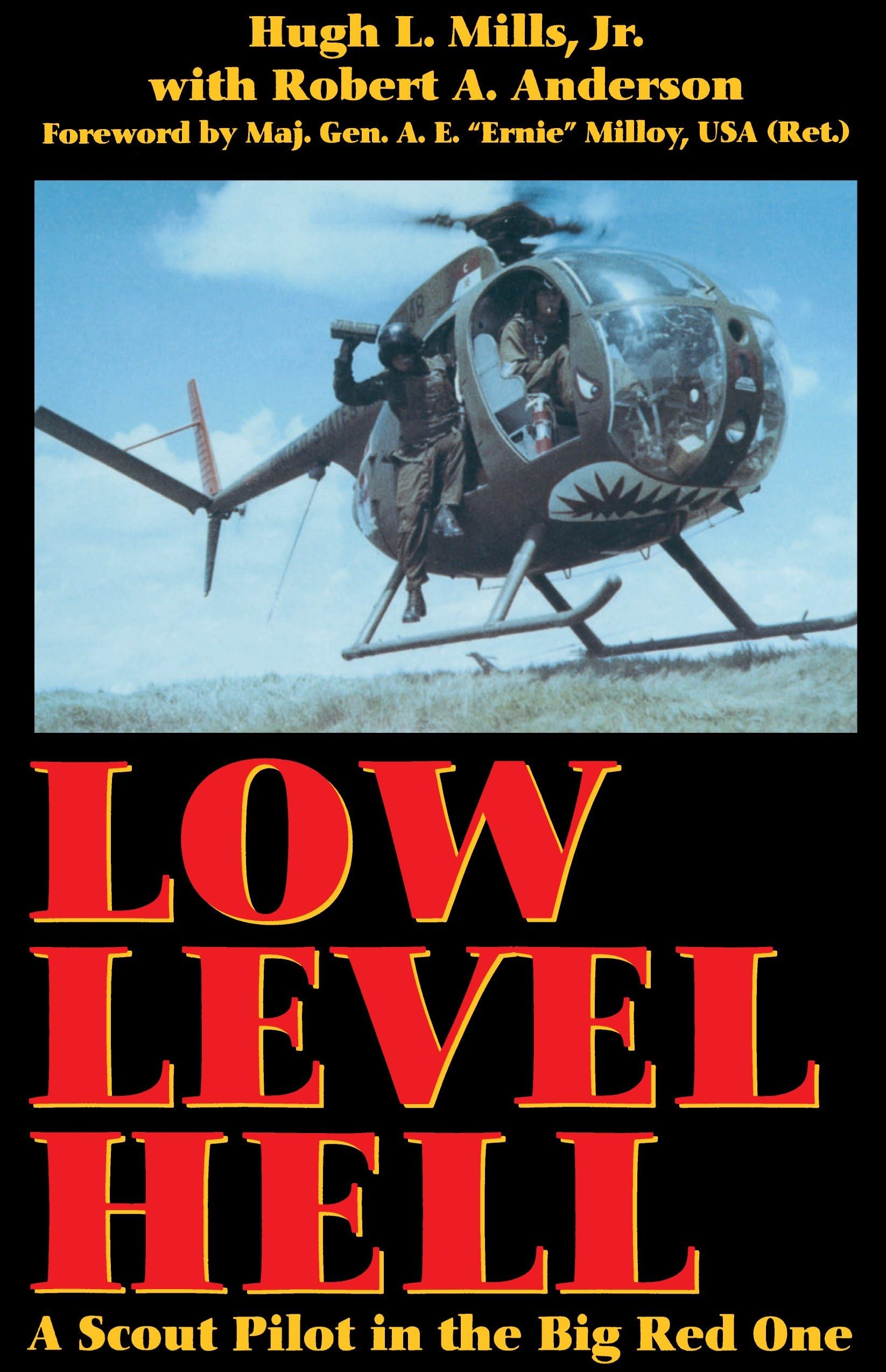



The aeroscouts of the 1st Infantry Division had three words emblazoned on their unit patch: Low Level Hell. It was then and continues today as the perfect concise definition of what these intrepid aviators experienced as they ranged the skies of Vietnam from the Cambodian border to the Iron Triangle. The Outcasts, as they were known, flew low and slow, aerial eyes of the division in search of the enemy. Too often for longevity’s sake they found the Viet Cong and the fight was on. These young pilots (19-22 years old) “invented” the book as they went along. Praise for Low Level Hell “An absolutely splendid and engrossing book. The most compelling part is the accounts of his many air-to-ground engagements. There were moments when I literally held my breath.” —Dr. Charles H. Cureton, Chief Historian, U.S. Army Training and Doctrine (TRADOC) Command “ Low Level Hell is the best ‘bird’s eye view’ of the helicopter war in Vietnam in print today. No volume better describes the feelings from the cockpit. Mills has captured the realities of a select group of aviators who shot craps with death on every mission.” —R.S. Maxham, Director, U.S. Army Aviation Museum Low Level Hell is the true story of the "Outcasts" Aero Scouts of the 1st Infantry Division's 4th US Cavalry in operations in Vietnams III Corps in 1969. The people are real, the action is as it happened. Some live and some die fighting a determined enemy. These are the officers and troopers who blazed a trial from aerial mounts like their forefathers of the Old West. Hold on to your Stetsons! CHAPTER 1 THUNDER ROAD South Vietnam, July 1969 “Phu Loi tower, this is Darkhorse One Six. I've got a hunter-killer team on the cav pad. North departure to Lai Khe.” “Roger, Darkhorse One Six flight of two. You're cleared to hover.” Cobra pilot Dean Sinor (Three One) and I were heading up to Thunder Road to provide aerial cover to a heavy northbound supply convoy. A scout and gun team ran ahead of convoys coming out of Lai Khe to run a low-level inspection of the entire road up to An Loc. Even though dismounted engineer and infantry swept the highway for mines every morning at first light, this stretch of road had proved highly susceptible to ambush attack. With Sinor at altitude, I put my Loach down low and slow, to pick up anything out of place on or along the road. It was possible for the enemy to get in and plant a few mines between the time it was swept by the engineers and the arrival of the convoy. Early in the morning, once the highway had been swept by the engineers, civilian traffic was always bustling along Thunder Road—motorcycles, mopeds, carts, Cushman-type vehicles, little buses, and small trucks. But never before the U.S. Army had cleared the road for mines. It was far too dangerous. Working about a mile ahead of the convoy, I headed straight down the highway, banked to the east, then back south to check the cleared area on the column's right flank. I cut west over the last vehicle and headed back north to check out the left side of the convoy, creating a boxlike search pattern. On my first run back along the east side of the road, I saw evidence of recent heavy foot traffic, enough to make me feel very uneasy. I didn't see any enemy, so I headed across the tail end of the convoy to make my run back north on the west flank. As I got about six hundred yards out ahead of the column, I picked up heavy foot trails again. There wasn't any good reason for people to have been out in the Rome-plowed area next to the highway, so I decided to follow one of the trails to see where it took me. It led to a drainage ditch that stretched for nearly a mile—right along the side of the highway! But, again, not a single person in sight. Circling over the area, I keyed the intercom to my crew chief. “Parker, do you see anything? Something's damned screwy about this. What do you make of it?” “Don't see anything but footprints, Lieutenant. Not a soul, sir!” About that time I made a sharp turn over a thick clump of tall grass on the west side of the road near the drainage ditch, about ten feet from the side of the highway. Not more than four to five feet below me, I glimpsed a slight movement and something dark lying on the ground. “Son of a bitch, Jim! Did you see that?” I hollered into the intercom. I hauled the Loach around to hover right above the spot. Then Parker and I saw the two dark brown eyes staring up at us from a hole dug into the ground under an area of pushed-up dirt created by the Rome plow months before. Without me saying a word, Jim Parker opened up. I winced at the explosion of the M-60 right behind my head. The enemy soldier jerked violently and slumped over in his hole. I got on the radio to Sinor. “Three One, One Six. We got a dink. The gunner shot a dink dug into the grass up under a Rome plow mound, not more than ten feet off the west side of the highway. I think they're all