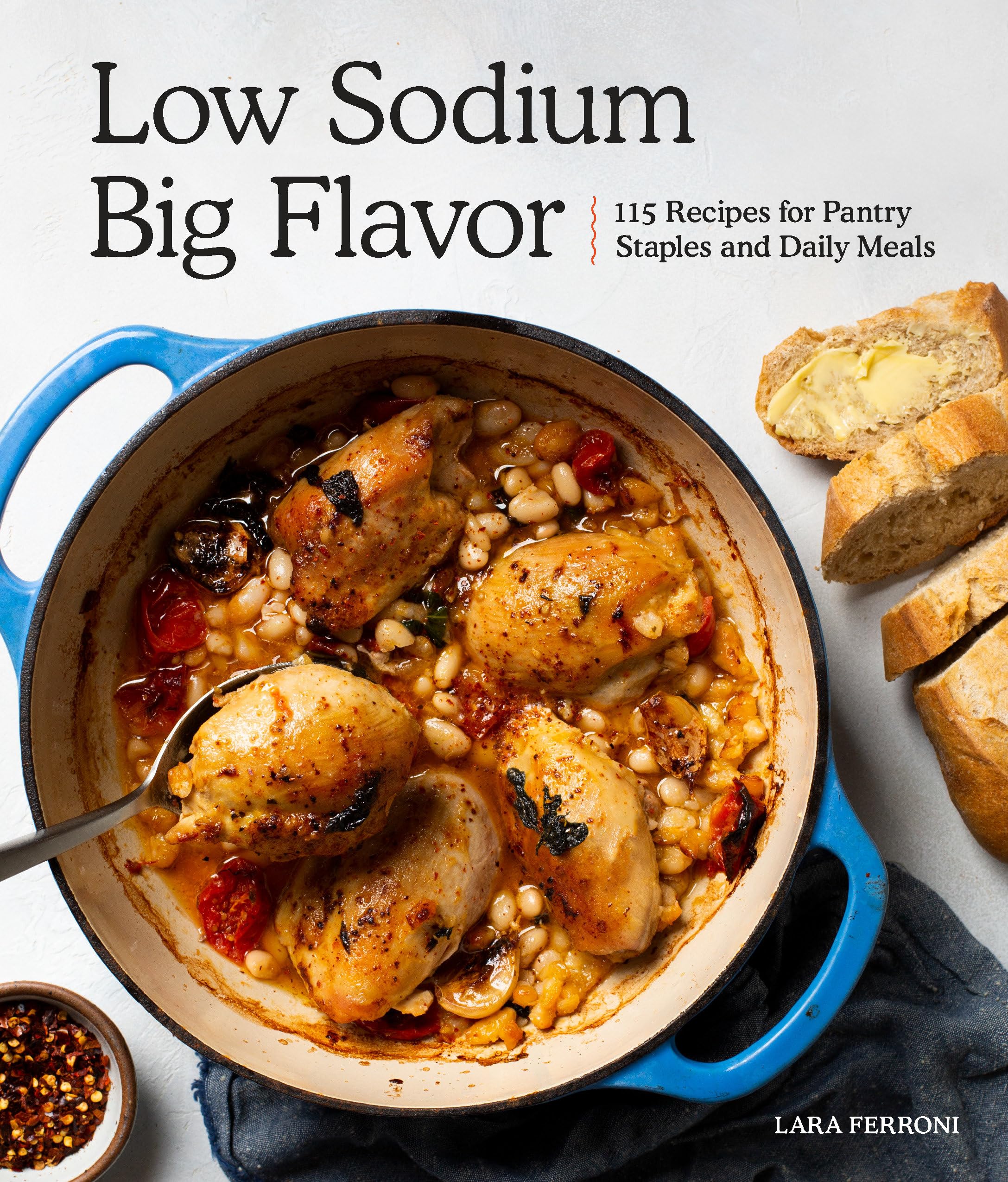



"Cooks who are watching their sodium but looking to spice up their lives should give this book a look. Recommended to readers of all cooking levels who are looking to bring healthy but delicious foods into their lives." —Booklist These low-sodium but flavor-packed 115 recipes plus daily meal plans will improve cardiac health without sacrificing taste. A lack of salt often means that food tastes ho-hum, which can ruin your appetite and adversely affect your quality of life. Yet the reality is that sodium levels in packaged and processed foods--such as ketchup, canned broths, and soups, to name just a few--are shockingly high. To stick with a low-sodium diet long-term you want to savor the food you're eating (so important!), which means finding new ways to replace the flavors that salt naturally highlights. Author Lara Ferroni, who adheres to a low-sodium diet herself, has spent years creating naturally flavorful recipes everyone will love. In this book, you will find 115 recipes for homemade condiments, spice blends, dressings, cheeses, breads, prepared meats, and other foods. In addition, she offers daily meal plans--breakfast, lunch, dinner, and even dessert!--which contain less than a total of 2,000 mg of sodium, typically the daily amount allowed on a low-sodium diet. Ferroni, who is also a food photographer, has filled the book with enticing photos and shares her experiences of maintaining (and making peace with) a low-sodium diet. There is no need to feel deprived on a low-sodium diet. These recipes will help you love the food you eat while at the same time feel good about taking care of your health. "Cooks who are watching their sodium but looking to spice up their lives should give this book a look. Recommended to readers of all cooking levels who are looking to bring healthy but delicious foods into their lives." —Booklist LARA FERRONI is a tech geek turned food geek who spends her days exploring food and cocktail culture. As a writer and photographer, she can be found learning to make kimchi in the back room of a local church, foraging for wild berries or snapping away in some of the finest kitchens and bars. She is the author of five cookbooks, including Doughnuts, An Avocado a Day, Real Snacks and Put an Egg on It. Several years ago, I was diagnosed with M.ni.re’s disease, a syndrome most known for a combination of hearing loss and drop attacks (sudden vertigo where the world goes topsy-turvy). My diagnosis came after two years of intermittent hearing loss and tinnitus in one ear. So far, I’m one of the lucky ones who hasn’t had any drop attacks (yes, that’s wood you hear me knocking on). Still, my balance is not what it used to be, and I have associated BPPV (benign paroxysmal positional vertigo) attacks, along with some serious brain fog during my episodes. The good news is that, while it can be incredibly debilitating, M.ni.re’s isn’t fatal. Many sufferers can control it with diet and lifestyle changes: eliminating caffeine, cutting back significantly on alcohol, and keeping daily sodium to 1,500 milligrams or less. I’m a food writer, recipe developer, and photographer, and I really love to eat good food. Until my diagnosis, I always had the luxury of consuming what I wanted without having to think about it. Now I had to make changes, and my first thought was, What the @#!%$ am I going to eat? I realized I had no idea how much sodium was in my food, so I did what most people do: I googled. My first question was, How much sodium is in a teaspoon of salt? Google’s answer didn’t make me happy. In turns out that a single teaspoon of table salt contains 2,325 milligrams of sodium—30 percent more than I was aiming to consume in a day! Doesn’t every recipe call for about a teaspoon of salt? OK, I reasoned, I can just cut way down on the salt in recipes. That should do it, right? Unfortunately, there are all sorts of sneaky sodium sources that I never even realized. While the recommended daily sodium allowance for a healthy person is 2,500 milligrams, I’ve come to seriously doubt that most people consume anywhere near that number. Just one slice of cheese pizza contains about 1,500 milligrams. A plain bagel has 400. That blueberry muffin that doesn’t taste salty at all? It probably has about 500 milligrams, thanks to the baking powder in it. Heck, a few cups of kale contains 50 milligrams, and even celery, which is like eating crunchy air, has 32 milligrams per stalk. My guess is that I was previously consuming 4,000 to 6,000 milligrams a day. The first time I went grocery shopping after committing to a reduced-sodium diet, I found myself standing in the aisle, in shock, thinking I’d never be able to eat anything good again. Everything I picked up seemed to have more sodium than I expected. Trying to figure out what I could eat was overwhelming. I managed to pick up a few random things and made myself a dinner that tasted like . . . well, like it needed salt. I spent about a week wallowing i