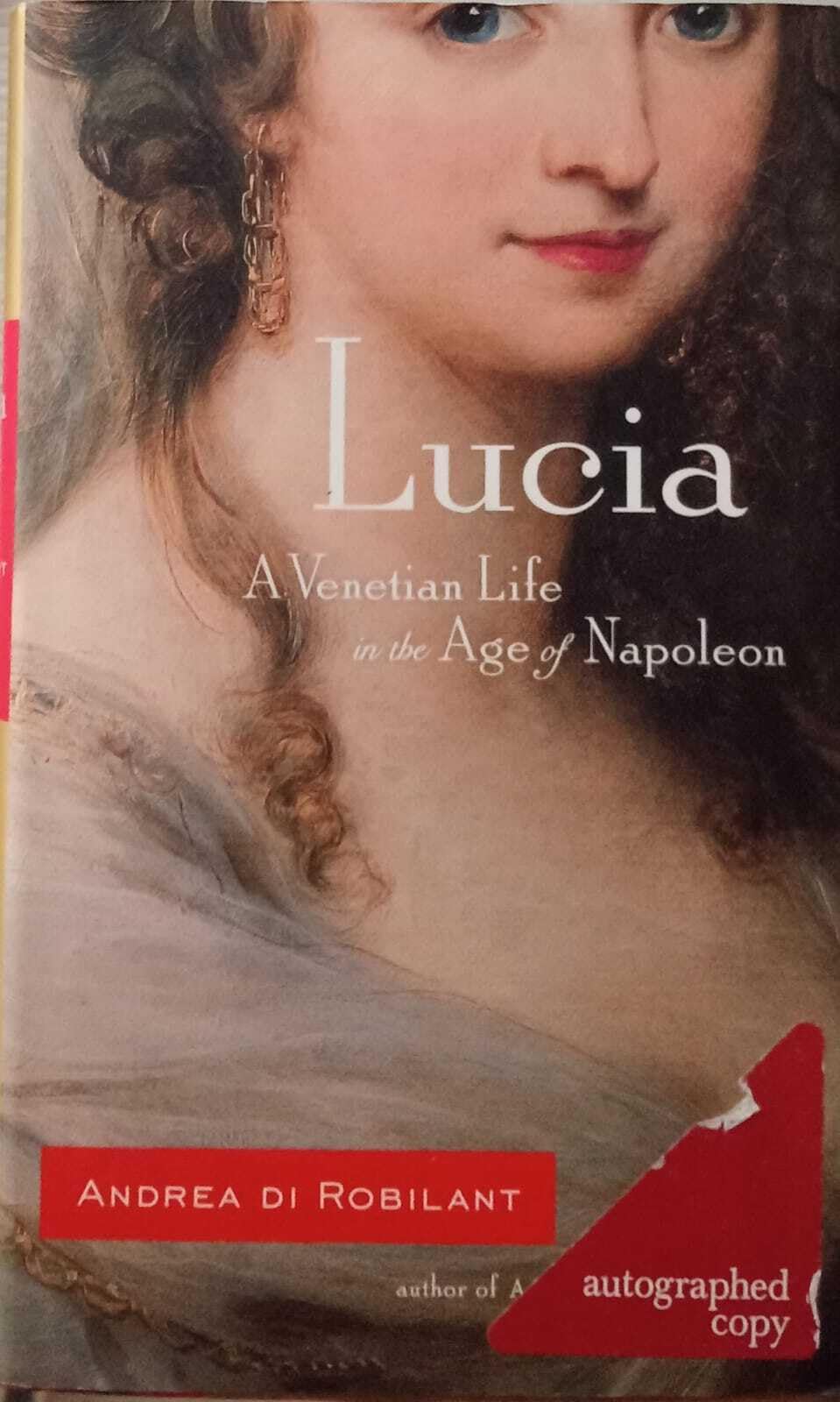



From the acclaimed author of A Venetian Affair comes the vivid and dramatic story of the fall of Venice and the rise of a new age during the tumultuous Napoleonic period, as seen through the eyes of his great-great-great-great-grandmother. In 1787, Lucia, the beautiful sixteen-year-old daughter of a prominent Venetian statesman, is married off to Alvise Mocenigo, scion of one of the most powerful Venetian families. But their life as a golden couple will be suddenly transformed when Venice falls to Bonaparte. As the larger events unfolding around Lucia mingle with her most personal concerns, we witness—through her letters to her sister and other primary sources—her painful series of miscarriages and the pressure on her to produce an heir; her impassioned affair with an Austrian officer and its stunning results; the glamour and strain of her career as a hostess in Hapsburg Vienna and lady-in-waiting at the court of Napoleon’s stepson, Prince Eugène de Beauharnais, as well as her intimate relationship with the Empress Joséphine; and her amazing firsthand account of the defeat of Napoleon in Paris in 1814. In her later years, Lucia, regal and still beautiful and a bit battle-hardened herself, was Byron’s landlord during the poet’s stay in Venice. In a fitting finale to this sweeping drama, Lucia stands as a relic of a lost golden age: she created, in part, the aura that gave rise to the Romantic view of Italy and its culture that we still nourish today. With the brave and articulate Lucia at the center of his re-creation of this remarkable historical period, Andrea di Robilant has once again reached across the centuries, and deep into his own past, to bring history to rich and vivid life on the page. Q&A with Andrea di Robilant Q. A discovery of letters between a young beauty, Giustiniana Wynne, and your ancestor, the Venetian nobleman Andrea Memmo, inspired your first work, A Venetian Affair Drawing on the letters of his great-great-great-great-grandmother Lucia Mocenigo, a Venetian aristocrat, di Robilant paints a vivacious picture of the Napoleonic age. The fifteen-year-old Lucias correspondence with her new fiancé, the nobleman Alvise Mocenigo, includes a glissando from formality to rapture that gives an idea of the narratives pitch: "My most esteemed spouse, my good father having informed me of your favourable disposition towards me, and having told me of your worthy qualities . . . I felt such agitation in my heart that for a brief moment I even lost consciousness." Over the years, as Lucia travelled throughout Europe, this girlish enthusiasm was whittled away by a selfish, neglectful, and manipulative husband; on discovering, after Alvises death, letters from an impressive array of lovers, she filed them alphabetically by author. Back in Venice, living in an apartment where, she complained, rats were her only reliable company, Lucia became Byrons landlady. Copyright © 2008 Click here to subscribe to The New Yorker *Starred Review* Using letters and diaries found in his family home and in archives, Italian journalist di Robilant presents a vivid picture of the Napoleonic era through the life of his great-great-great-great grandmother, Lucia Mocenigo. At the age of 15, Lucia—daughter of Andrea Memmo, one of the lovers in di Robilant’s A Venetian Affair (2003)—was betrothed to Alvise, the 26-year-old scion of Casa Mocenigo in Venice. Their marriage in 1787 was happy at first, despite frequent separations as Alvise pursued his diplomatic career (and strayed from the marital bed, carelessly leaving letters from his lovers) and Lucia’s frequent miscarriages. When at last a son was born, he died before his second birthday; her later affair with Austrian officer Baron Maximilian Plunkett produced another son, eventually claimed by Alvise as his own. While France and Austria battled, the Mocenigos mixed with royalty: Lucia was a longtime close friend of Empress Josephine and served as lady-in-waiting (described as a demanding yet boring assignment) to Bavarian princess Augusta in Milan. After Napoleon’s defeat, Lucia and Alvise—then at odds—returned to Venice, where he died in 1815 and she later became Lord Byron’s landlady, renting out part of Palazzo Mocenigo. An enticing portrait of a woman and her times. --Michele Leber “What an amazing life, what a great story! And it’s so deftly told by Lucia’s great-great-great-great-grandson, who rummaged through his family’s papers and found genuine treasure.” —Carolyn See, The Washington Post “An enticing portrait of a woman and her times.” — Booklist “Fascinating . . . As with many engaging tales, this one proved elusive and complex–perfect fodder for a historian of di Robilant’s imaginative bent . . . Most stunningly perhaps, Di Robilant’s book blows the cover off a two-century-old family secret.” —Ronald Dick, W Magazine “Di Robilant paints a vivacious picture of the Napoleonic age.” — The New Yorker “ Lucia in the Age of Napoleon is le