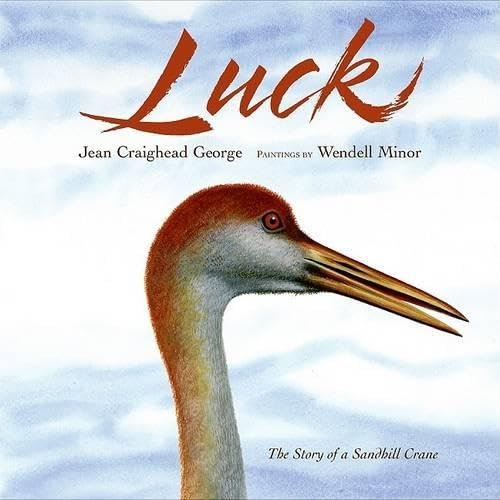



After a girl saves his life, Luck, a young sandhill crane, begins the long migration north to Siberia with his parents. Luck and his parents use a special song to find one another: Crackaarr! While his parents depend on rivers, lakes, and mountains to guide their way, Luck memorizes man-made objects -- windmills, sunglasses, and a baby carriage. Soon thousands of cranes join Luck and his family on their timeless journey. Follow Luck's challenging flight through the voice of master storyteller Jean Craighead George and the art of the critically acclaimed Wendell Minor. Grade 1-3–George focuses on a young sandhill crane to describe the birds' long migration route. A girl in Texas names the crane Luck after freeing him from a plastic six-pack holder caught around his long neck. As he follows his parents into the March sky over the marsh, he memorizes the blue sunglasses on the girl's face for he recognizes her as home. The simple story line recounts the various locations the cranes pass and note on their way north and west to Siberia, where he meets his mate. In a gently humorous turn, Luck occasionally notes human evidence instead of the natural landmarks, and, predictably, he gets lost on the return journey. Minor's skilled paintings provide richly varied perspectives of the world below the flying cranes–humans looking up at the impressive number of birds filling the sky and the watery places where they occasionally land. Maps tracing the cranes' migration appear on the endpapers. George's ending seems a bit rushed and tidy as Luck arrives back at the same marsh where the story began and is met there by his mate. This pleasant tale will be enjoyable shared reading for bird-watchers, especially those living in states in which the cranes pass by, and useful for introducing classroom units on natural science. –Margaret Bush, Simmons College, Boston Copyright © Reed Business Information, a division of Reed Elsevier Inc. All rights reserved. PreS-Gr. 2. George and Minor collaborate once again on a picture book that affirms the fragility and wonder of nature. In a Texas marsh, a girl untangles a young sandhill crane from a plastic six-pack holder and names him Luck. Captivating words and pictures follow Luck's journey with his parents across the U.S and Canada to Siberia. Subtle phrases hint at Luck's maturation (his voice changes), and in Siberia, he leaves his parents behind and finds a mate, who joins him on the return trip to Texas. The noisy bird talk ("KHARRRR!" "Crackrrrr!") will draw children immediately into Luck's world, and George creates palpable tension as Luck loses and finds his loved ones, searches for landmarks, and reunites with the girl who saved his life. Minor's beautifully painted spreads of Luck, including many pictures of the birds in flight, increase the sense of awe that the birds' miraculous journey inspires. A fine title to prompt discussion about local wildlife; suggest this for classroom units about animal conservation, migration, and the connection between humans and animals. Gillian Engberg Copyright © American Library Association. All rights reserved Jean Craighead George is the author of over eighty books for children and young adults. Her novel Julie of the Wolves won the Newbery Medal in 1973, and her novel My Side of the Mountain was a Newbery Honor Book in 1960. She has continued to write acclaimed picture books and novels that celebrate the natural world. She lives in Chappaqua, New York, and has had over 173 pets in the time she has lived there, among them geese and ducks.