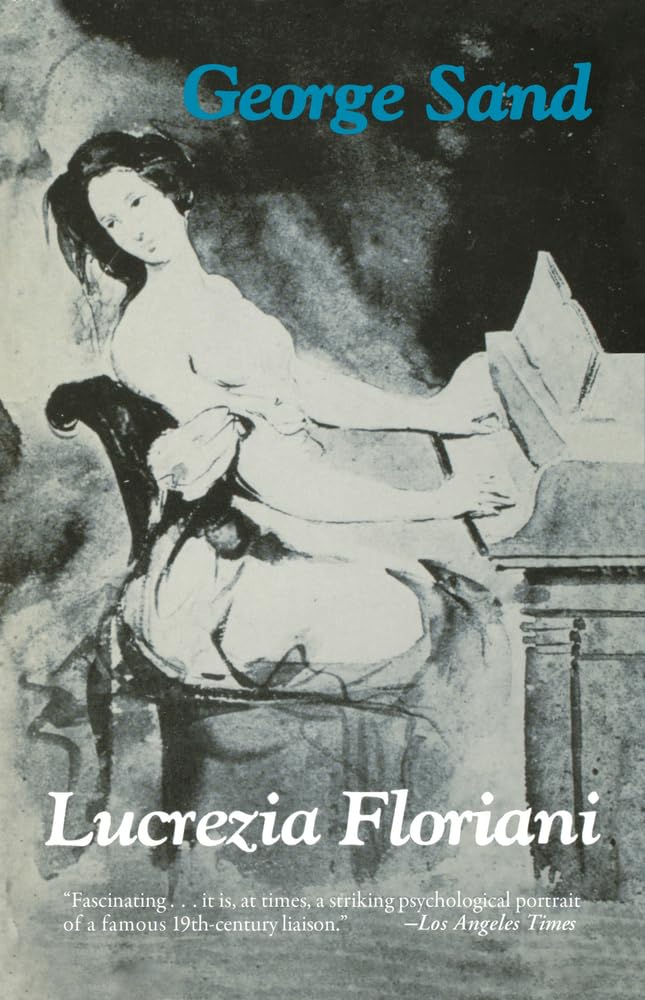



Lucrezia Floriani, a worldly 30-year-old actress and the mother of 4 children with 3 different fathers, meets and falls in love with Prince Karol, a moody, introspective aristocrat. "...intelligent analysis of every turn of the love relationship..." — Publishers Weekly George Sand is the pen name of Amantine Lucile Aurore Dupin, Baroness Dudevant, a 19th century French novelist and memoirist. Sand is best known for her novels Indiana, L'lia, and Consuelo, and for her memoir A Winter in Majorca, in which she reflects on her time on the island with Chopin in 1838-39. A champion of the poor and working classes, Sand was an early socialist who published her own newspaper using a workers' co-operative and scorned gender conventions by wearing men's clothing and smoking tobacco in public. George Sand died in France in 1876. Lucrezia Floriani By George Sand, Julius Eker Chicago Review Press Incorporated Copyright © 1985 Betsy Wing All rights reserved. ISBN: 978-0-89733-397-9 CHAPTER 1 Young Prince Karol de Roswald had just lost his mother when he first met Madame Floriani. He was still plunged in utter grief and nothing could distract him from it. Princess de Roswald had been a tender and perfect mother. As a child Karol was weak and ailing and she had lavished on him the most constant care and devotion. Brought up under the eye of this good and noble woman the young man had only one real passion in his entire life: filial love. This mutual love between son and mother had made them as it were exclusive, and possibly a little too absolute in their way of seeing and feeling things. It must be said that the Princess was highly educated and possessed a superior mind; the lessons she gave him and her conversations with him seemed capable of satisfying every one of young Karol's needs. His delicate health had resisted the toil, rigour and harshness of classical studies which in themselves are not always as valuable as the lessons of an enlightened mother, but they have the indispensable merit of teaching us to work and are, so to speak, the key to knowledge of life. Acting on the advice of her son's doctors Princess de Roswald had dismissed the idea both of tutors and books and had resolved to form the mind and heart of her son by her conversation, by the stories she narrated, by a kind of insufflation of his moral being which the young man had absorbed with great delight. Thus he had succeeded in acquiring much knowledge without ever having studied anything. But nothing can replace experience; and the box on the ear which, when I was a child, was given to youngsters to impress on their memories a great emotion, a historical fact, a notorious crime or any other example to follow or avoid, was not so stupid a practice as it appears to us nowadays. We no longer give this box on the ear to our children; they have to seek it elsewhere, and the heavy hand of experience applies it much more harshly than ours would. So young Karol de Roswald became acquainted with people and life early, possibly too early, – but only in theory. With the praiseworthy object of elevating his mind his mother only allowed the proximity of distinguished people, whose words and actions could only be salutary to him. He was fully aware that outside there existed knaves and fools, but he was only taught to avoid them, never to get to know them. Of course he had learned to succour the unfortunate; the doors of the palace where he spent his youth were always open to the needy; but while helping them he grew accustomed to despising the cause of their condition and regarding it as an affliction of humanity which was incurable. Disorderliness, idleness, ignorance or lack of judgement, – the fatal causes of aberration and destitution – struck him as being obviously beyond remedy in the individual. He had not been taught to believe that the masses must and can gradually rid themselves of these ills and that by grappling with humanity, chiding and caressing it in turn, like a beloved child, by forgiving it for many lapses so as to gain some little progress, one does more for it than by dropping the limited succour of compassion before its crippled or gangrened limbs. But it was not so in Karol's case. He learned that the giving of alms was a duty; and one which no doubt will have to be performed as long as the social order makes alms necessary. But this is only one of the duties imposed on us by our concern for this immense human family of ours. There are many others, the principal one being not to pity but to love. He fervently embraced the maxim which told him to detest evil; but he clung to the letter of the law and merely pitied those who commit evil. But again it must be said: pity is not enough. Above all one must love in order to be just and not to despair of the future. One must not be too delicate in one's sensibilities, nor be lulled to sleep by the flattery of a clear, self-satisfied conscience. This good young man was sufficie