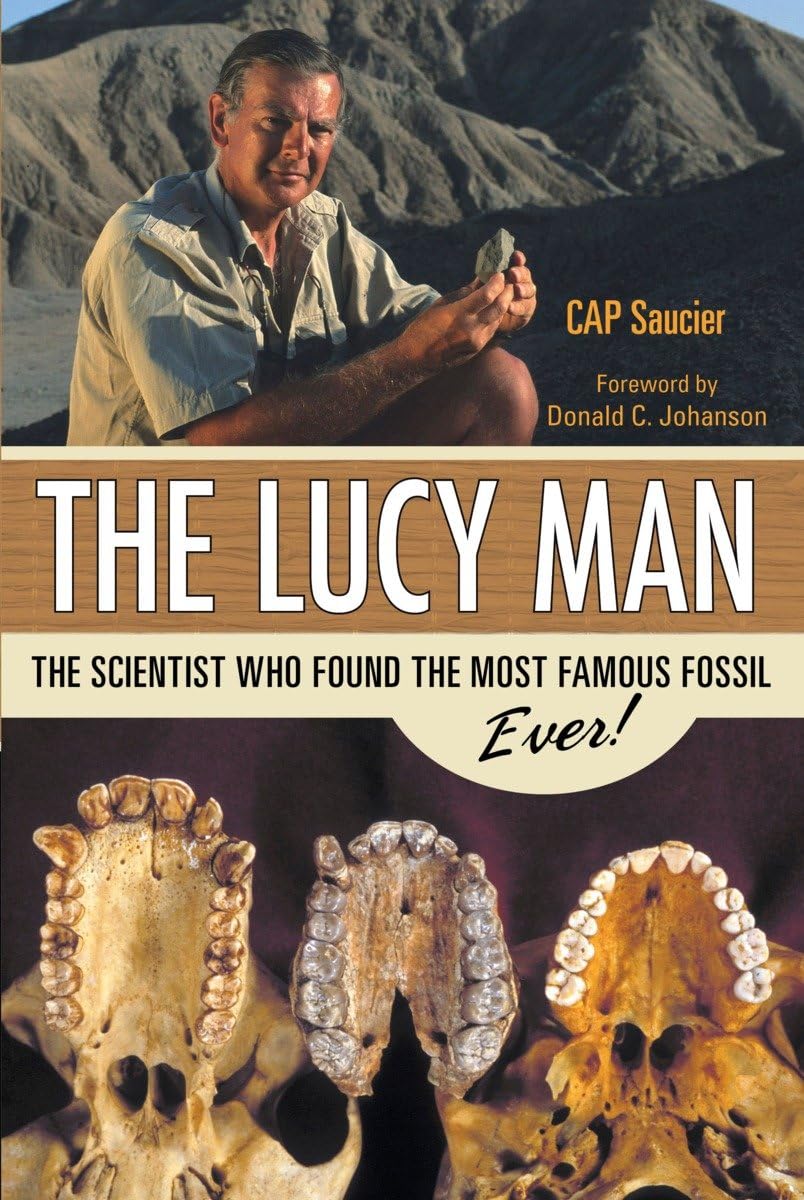



This revealing biography, written for a younger audience of school-age children, describes Donald Johanson's remarkable life and career. In 1974, Johanson discovered "Lucy" (Australopithecus afarensis)--the first skeleton of an upright-walking human ancestor that was mostly complete and well-preserved .Johanson went on to discover an entire group of Lucy's species, called the First Family. He has also co-written nine books and narrated and hosted an Emmy-nominated television series. Today, he continues to give talks around the world, and remains dedicated to educating people about how we became human. In some quarters, evolution is a controversial topic and so Johanson has devoted much time to helping people understand that human evolution is how we are connected by nature to all other life on Earth. The author presents details of the scientist's work, not just in regard to Lucy, but also other significant fossil finds, with up-to-date information on the most recent discoveries. In addition, she discusses his personal life, including his disagreement with the Leakey family and the regrettable damage it did to their friendship. As a longtime friend, the author had the opportunity to travel with Johanson and interview him on different continents, from America to Europe and Africa. For this book, he has freely answered questions and generously donated many of his own photographs to the project. Beautifully illustrated with numerous photographs of the anthropologist at every stage of his illustrious career, this book will teach students about the fascinating study of human evolution and inspire some to go on to make the next great discovery. CAP Saucier (Cockeysville, MD) is a freelance artist, illustrator, and writer. THE LUCY MAN THE SCIENTIST WHO FOUND THE MOST FAMOUS FOSSIL Ever! By C.A.P. Saucier Prometheus Books Copyright © 2011 C. A. P. Saucier All right reserved. ISBN: 978-1-61614-433-3 Contents Foreword by Dr. Donald C. Johanson...................................9Chapter 1: A Young Scientist in the Desert...........................13Chapter 2: Childhood in Connecticut..................................23Chapter 3: Chemist or Paleoanthropologist?...........................35Chapter 4: Scientist and Explorer....................................45Chapter 5: The Evolution of Monarchs and Mankind.....................67Chapter 6: Risks, Regrets, and Rewards...............................91Chapter 7: Don's Legacy..............................................101Chapter 8: The Future of Human Prehistory............................113Acknowledgments......................................................119Bibliography.........................................................121Index................................................................125 Chapter One A YOUNG SCIENTIST IN THE DESERT As the young scientist walked through the Ethiopian desert, he carefully watched where he put his feet so he would not step on something other than the sand and the stones. He was hot and tired with the noontime sun bearing down on him, and he was about ready to stop looking and return to camp. "Just one more gully to explore," he thought as he pushed himself to continue. In that gully, the young scientist found what he had spent years dreaming of—a fossilized arm bone of a long-extinct hominin. Hominins are our ancestors, near-human animals who walked upright on two feet. It was November 1974 and discovering this arm bone marked the beginning of Dr. Donald C. Johanson's distinguished career as a paleoanthropologist, a scientist who studies human origins and evolution. After finding the arm bone, Don looked around expectantly for more bone pieces. He began to wonder if the leg bone, and the pieces of a pelvis, jaw, and skull he was collecting could belong to one individual. If so, who was this creature? Whoever this used to be, Don realized that finding so many pieces of one hominin skeleton was a major discovery. Up until that time, no fossil skeleton of a human ancestor had ever been found. Don called to one of his colleagues to come see what he had discovered. His colleague Tom Gray rushed over to share Don's excitement. Both were hot, sweaty, and dirty, but they hugged each other and jumped up and down in jubilation. Everyone back at camp was equally excited and spent the evening celebrating by listening to a tape of the Beatles that included the song "Lucy in the Sky with Diamonds." After observing that the bones were in proportion to one another and that there were no duplicates, Don determined that all the bones did indeed belong to one individual. By the small size of the bones and teeth and the shape of the pelvis (hip bones), he knew that it was female. The next morning, the fossil from the desert originally designated A.L. 288-1 had a name—Lucy. WHY LUCY IS SPECIAL What is it about one set of bones that makes it more important than another? Lucy's bones have been examined,