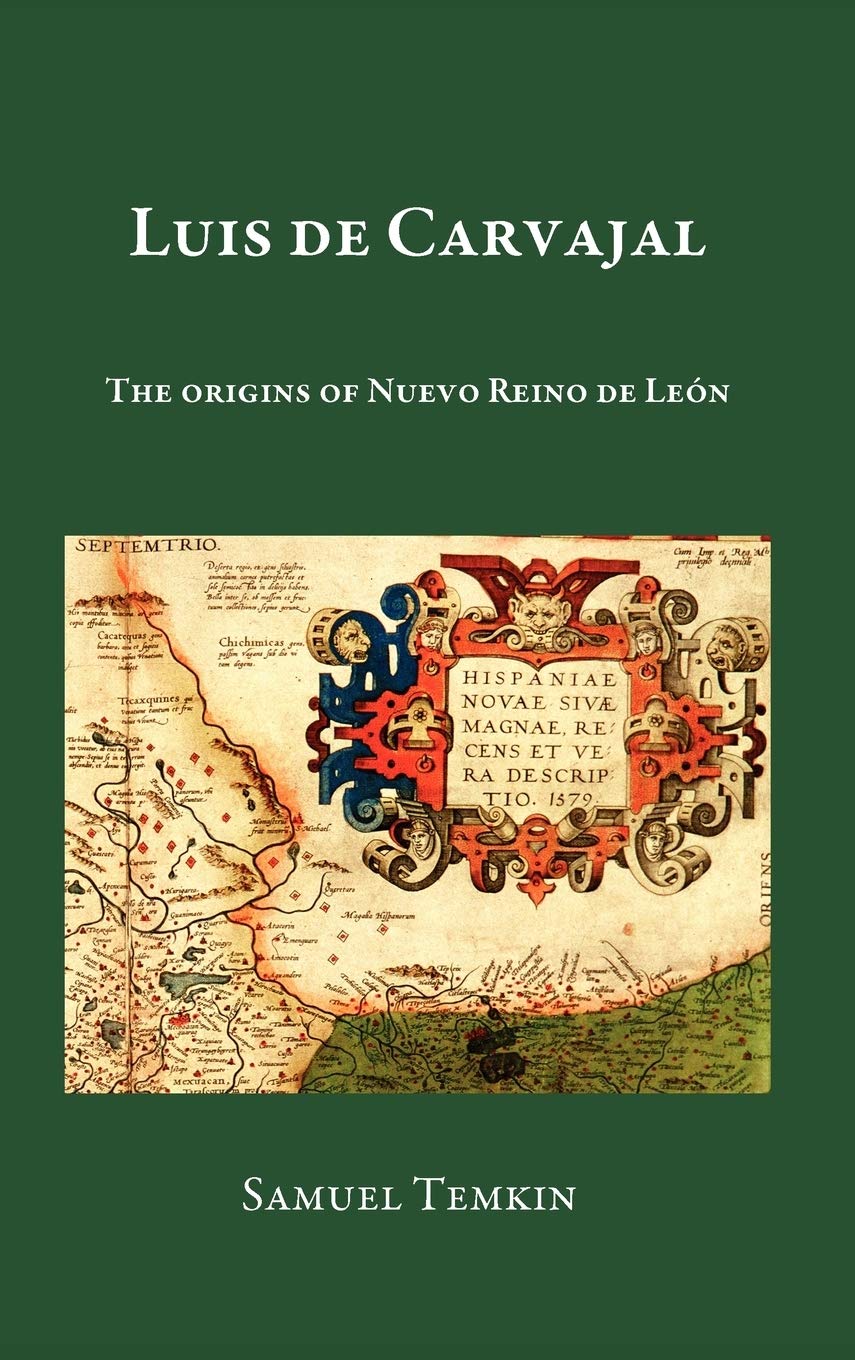



In 1579 Philip II awarded a large territory in New Spain to a Portuguese man named Luis de Carvajal. That territory included a significant portion of present day Mexico, as well as portions of Texas and New Mexico. This remarkable man discovered, conquered, and settled most of that territory. He also brought a large group of settlers from Spain and Portugal whose impact on its cultural development was very significant. Many of those settlers were of Jewish descent and some of them were tried by the Inquisition for practicing the faith of their ancestors. This book is a biography of Carvajal and is based on documents that were written during his life or soon after his death. The narrative follows him from birth to death and describes the actions he took to give rise to Nuevo Reino de Leon. These included explorations and discoveries; battles with free Indians; pacifications of Indian uprisings; and legal fights with Crown officials who were determined to eliminate him and to end his government. In the end his enemies defeated him with the help of the Inquisition, but the political entity he gave rise to did not die with him. ''In 1579 the Spanish Crown handed Luis de Carvajal a remarkable boon: the authority to invade, colonize, and govern the future New Kingdom of León. The next year, Carvajal and his followers landed on Mexico's Gulf Coast, and in the following year began their military campaigns in the interior. Had their plans come to fruition, Carvajal and his descendents would have ruled over a kingdom encompassing much of today's U.S.-Mexico border states. But events turned out otherwise: in 1591 Carvajal died, not a celebrated conqueror, but a disconsolate prisoner. This dramatic tale is enough to commend a biography on Carvajal to most readers. There is, however, far more at stake in retelling his story. Carvajal set the initial conditions of interaction between Europeans and many indigenous groups on Mexico's northeastern frontier, with important long-term consequences for the region. The tragic end of his life and enterprises also belongs to a broader family drama and cultural conflict. The Carvajals were a large and successful network of Jewish converses systematically targeted by the Inquisition in the years following Luis's captivity and death. Consequently, Samuel Temkin's book is one that matters for multiple audiences: students of Latin America, the Borderlands, and early modern Spain, as well as those interested in the Inquisition and Jewish Diaspora. Luis de Carvajal is an admiring biography, and Temkin's principal objective is to refute both contemporary and modern criticisms of his subject. He does so first by presenting a rich account of Carvajal's early service to the Crown, thus answering accusations that he secured his command by graft rather than merit. Later chapters explain the contents of the royal charters, disputes surrounding them, and the charges that led to his arrest. This is a substantial documentary history, and one that discusses its sources in minute detail. The appendixes include Carvajal's original grant and a helpful table of information on the colonizing families. The element of this book most likely to court controversy is its attempt to exonerate Carvajal from charges of mistreating Indians. Temkin views Carvajal as an exceptional ethical figure in an era of widespread cruelty. This is a minority opinion among historians, and one that may be difficult for readers to accept. Temkin is aware that Carvajal brought forty African slaves on his expeditions, that his family was involved in the slave trade, and that he captured great numbers of Indians in the interior. Earlier scholarship on the region by Eugenio del Hoyo, Israel Cavazos Garza, and Silvo Zavala has documented the widespread use of just-war claims to conceal slaving expeditions. Most students of the region and period view Spanish descriptions of Indian rebellion, and subsequent sentences of penal servitude, as thin legal fictions concealing the northern slave trade. Yet, Temkin is resolute in his defense of Carvajal, taking his reports of Indian rebellions and his accounts of punitive expeditions at face value, and ascribing most consequent moral transgressions to the conduct of Carvajal's undisciplined subordinates.'' ----Sean F. McEnroe, Southern Oregon University, New Mexico Historical Review ''Luis de Carvajal won a royal capitulation in 1579 to colonize a vast, ill-defined territory to the north of Tampico in New Spain that was christened Nuevo Reino de León. Carvajal's activities in the area between 1580 and 1586 triggered bitter jurisdictional conflicts with established authorities, who accused him of illegally enslaving indigenous peoples. They also successfully denounced him to the Inquisition for covering up the Judaic practices of his sister and her children. The image of Carvajal as a heretic enslaver subsequently dominated the writings of both colonial Mexican authors and modern historians.