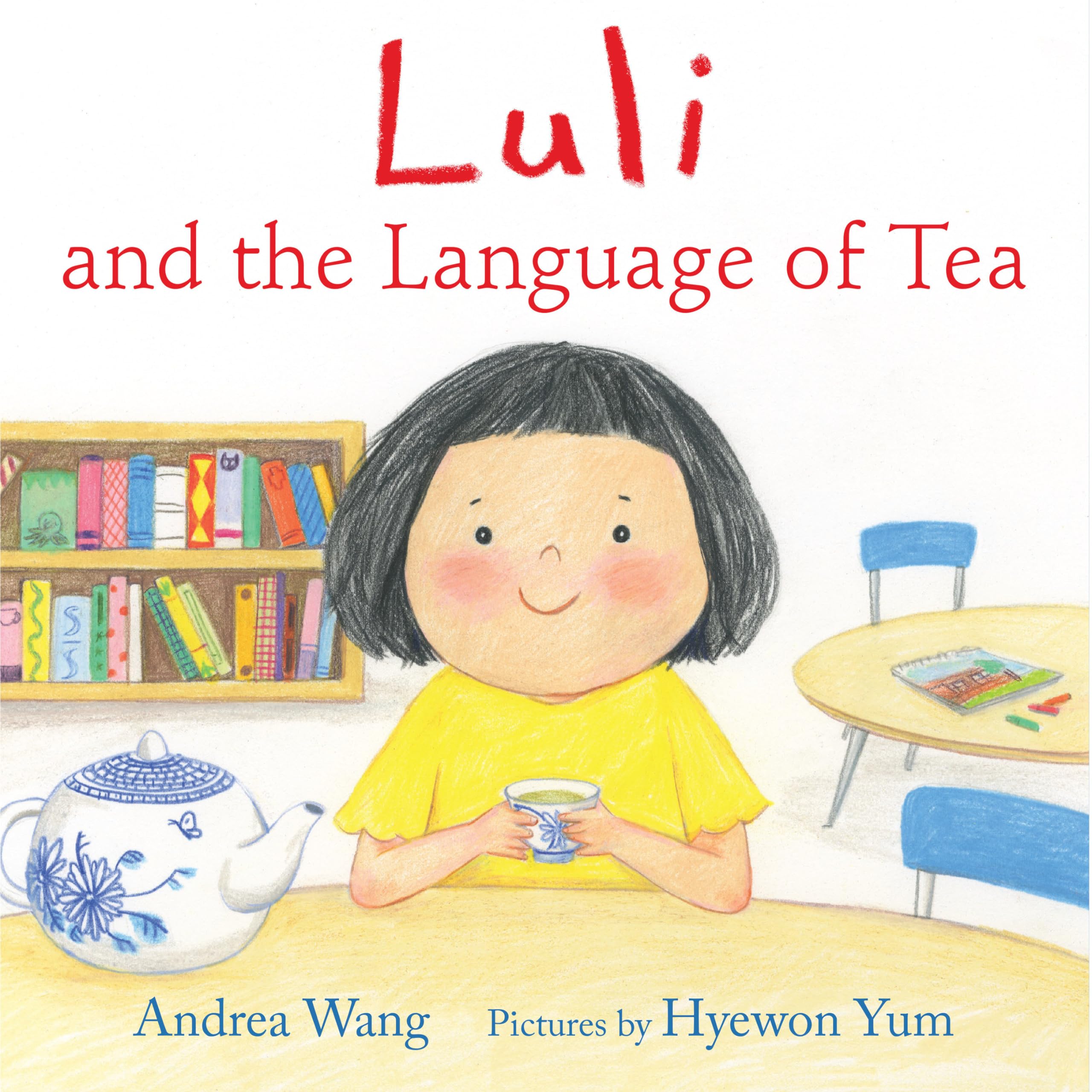



Though they may speak different languages, kids from all over the world come together to enjoy the shared pastime of tea in this delicious book for young readers. When five-year-old Luli joins her new English as a Second Language class, the playroom is quiet. Luli can’t speak English, neither can anyone else. That’s when she has a brilliant idea to host a tea party and bring them all together. Luli removes her teapot, thermos, and teacups from her bag and calls out “ Chá! ” in her native Chinese. One by one, her classmates pipe up in recognition: in Russian, Hindi, Turkish, Persian, Arabic, and Spanish, Portuguese, and Swahili. Tea is a tasty language they all know well, and it gives them a chance to share and enjoy each other’s company. When all the tea is gone and it’s time for dessert, Luli gets to use her favorite English word, cookie! After that, the playroom isn’t so quiet. Informed by her own experience as the child of Chinese immigrant parents, Andrea Wang makes the point that when you’re looking to communicate with people, you look for a common bond. The word for “tea” is similar in many languages, and tea becomes the unifying metaphor that brings a diverse group of children together. Additional material at the back of the book explores the rich and ancient history of tea drinking across cultures all around the world and contains maps, statistics, and fascinating details that will delight young readers. An American Library Association Notable Children's Book A Booklist Editors’ Choice Selection A CSMCL Best Multicultural Children's Book of the Year Gr 1–3—While parents and other adults attend ESL classes, Luli is in childcare next door. None of the children speak a common language and all play alone, but not for long because Luli has a plan. With her teacher's blessing, she brings in a thermos of hot water, a teapot, tea, and cups, then proceeds to make tea for her nine classmates (a teacher observes all of this, but the sight of small children pouring hot tea from one cup to another may need discussion at story hours). When she is done she calls to them in Chinese, "Cha!" Each child looks up in turn and replies with the word for tea in their own language including Russian, Hindi, Persian, Arabic, German, and Swahili. Despite the differences, the word is similar enough that they all understand and are soon passing cups of tea around the table, then portioning out the tea again so there is enough for Luli, who has cookies, too. All of this breaks the language barrier as the children laugh, eat, and play together. Wang's seamless text weaves the children's names, spoken language, and pronunciations into her story. Meanwhile Yum's illustrations give life and personality to the children with spot-on expressions and plenty of detail. Her dynamic perspectives not only give all the characters, who are depicted with various skin tones, a chance to stand out as individuals, but provide momentum to the story. An Author's Note explains Wang's inspiration and offers more world tea facts. VERDICT A delightful look at coming together despite differences that is centered on the immigrant experience of learning English. A great addition to all collections.—Catherine Callegari "There’s inclusion from the start. . . . No one language or culture is prioritized, and no one is left out. One of the book’s linguistic treats is that each language’s word for tea is presented both phonetically (as it sounds when uttered out loud) and in written form, giving readers a visual taste of Mandarin, Russian, Hindi, Persian and Arabic." —New York Times "Gentle, child-like art is as inviting as a cup of warm tea. With utter simplicity, this book connects disparate cultures to build natural community." —San Francisco Chronicle ★ "[A] gladdening picture book. . . . Yum demonstrates her facility with colored pencils in Luli 's classroom scenes and endpapers, in which a glorious spread captures an assortment of teacups, each decorated in a style suited to the country it represents." —Shelf Awareness, Starred Review ★ "Wang writes a simple, precise narrative that is more than the sum of its parts. Few writers could conjure up the characters' contentment as concisely. . . . Yum's sensitive colored-pencil illustrations use clean lines, rounded shapes, and soft hues to depict the setting and reveal the characters' emotions. . . . A rewarding read-aloud choice." —Booklist, Starred Review "Wang ( Watercress ) brings a group of children together via a beloved beverage in this warming picture book. . . . a bird’s-eye view emphasizes the community that accompanies sharing a cup of tea." —Publishers Weekly "Yum’s colored-pencil illustrations work alongside Wang’s simple, rhythmic text to highlight the concepts of uniqueness and similarity. . . . A warming and gentle celebration of connection." —Kirkus Reviews "Tea drinking everywhere celebrates community and togetherness; Wang ( Watercress, rev. 3/21) has clev