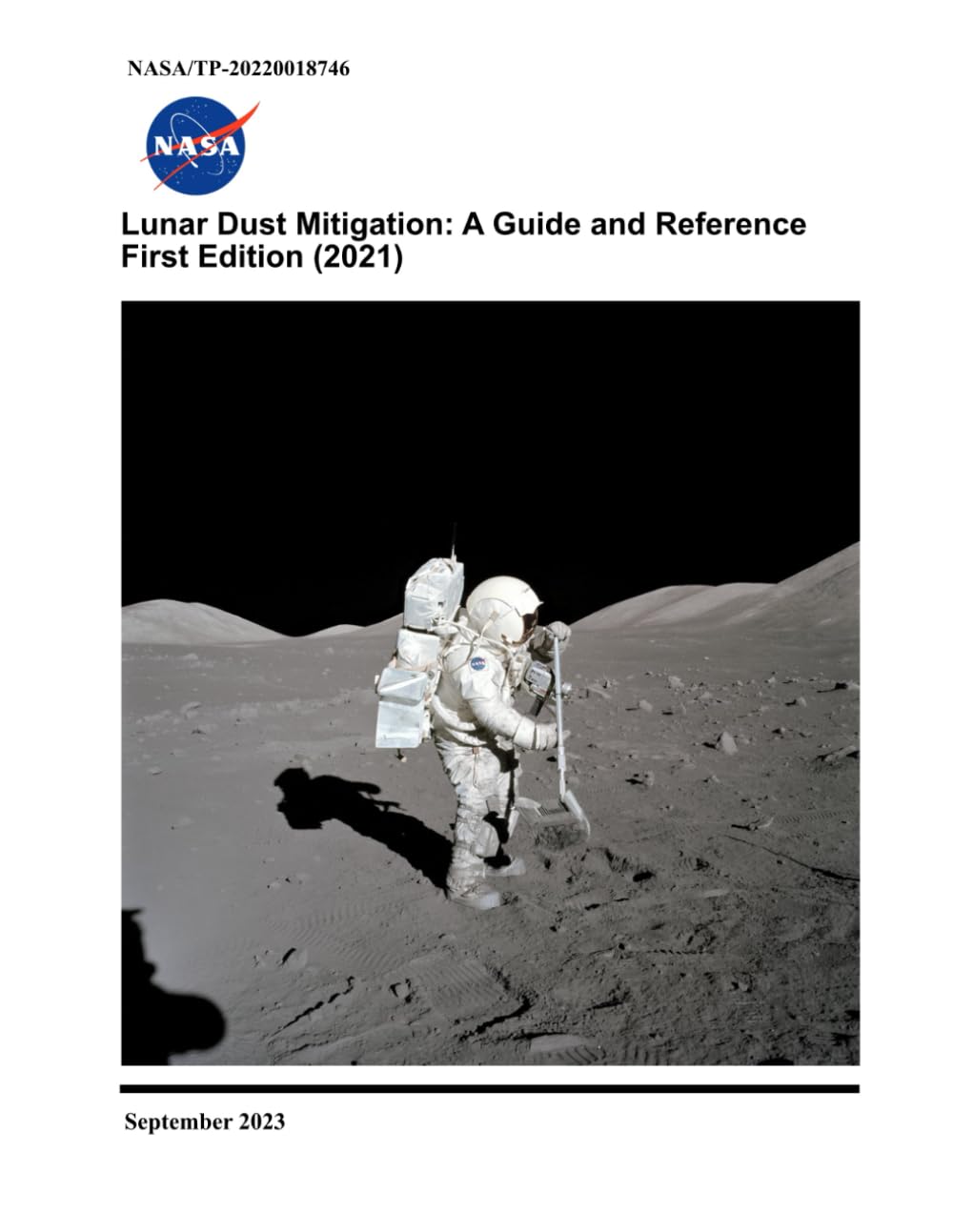
Lunar Dust Mitigation: A Guide and Reference: NASA/TP-20220018746 September 2023
$29.99
by National Aeronautics And Space Administration



Lunar Dust Mitigation: A Guide and Reference NASA/TP-20220018746 September 2023 On the surface of the Moon, lunar dust presents unique challenges to long-term operations due to the ubiquitous presence of dust particles in the lunar environment, the dust’s potential to electrostatically charge, and its possible chemical reactivity. Whether to avoid exposure, to attempt removal, or simply to tolerate lunar dust infiltrating a system becomes a complex question involving length of required service life, dust effects and critical risks, and mass and complexity trades for the entire system. This publication provides a snapshot of advice from topical experts for specific areas of concern to systems targeted for deployment on the lunar surface. Following introductory overview commentary, dust mitigation approaches appropriate to the lunar surface are first addressed for typically static structures such as optical surfaces, radiators, and other thermal control surfaces, followed by regolith exposure concerns for communications equipment and non-optical sensors. The broad topic of mechanisms and mechanical assemblies is broken down to address relevant component-level concerns, including issues affecting bearings and seals, as well as concerns specific to softgoods (fabric) components of spacesuits. Finally, human health issues and concerns are briefly addressed, though the emphasis of this publication remains with components directly exposed to the harsh lunar surface environment. A description of some lunar surface hazard details, in particular characteristics of lunar surface dust, follows in Appendix A, and more detailed explanations of quantification issues for particulates are given in Appendix B. The simple inertial removal of particles from a surface is discussed in Appendix C, followed by a summary of terrestrial best practices for dust mitigation recommended within select industries in Appendix D. The aggregated bibliography of references is very useful and can serve as a constructive start to finding further information. With return to the lunar surface set as a priority, safely and for more than a few days at a time, lunar dust is once again being recognized as a unique challenge. As this guidebook’s first edition nears completion, more than half a century has passed since humans last walked on the lunar surface. Most of the men with direct exposure to lunar dust are no longer with us, nor are the vast majority of the Apollo-era engineers who contributed to serial attempts at dust mitigation on successive Apollo lunar landing missions (Gaier, 2005). In the intervening decades, multiple nations have flown spacecraft past or orbited the Moon, gathering accumulating evidence that the lunar surface may hold resources valuable to human exploration beyond the surface itself (e.g., regolith minerals). In particular, the NASA Lunar Prospector orbiter mission, launched in 1998, detected hydrogen at both lunar poles, possibly in the form of water ice. The Lunar Crater Observation and Sensing Satellite (LCROSS), manifested with the Lunar Reconnaissance Orbiter (LRO), launched in 2009. LCROSS became the first NASA hardware to reach the lunar surface since Apollo 17 in 1972 and was an impactor, with its Centaur upper stage creating a rich plume from Cabeus crater, near the lunar south pole. Water and other valuable ejecta were detected in the plume, driving interest in visiting a lunar pole to map the potential usable resources (Williams, 2023). Eventual use of local materials such as water could enable much longer-term human exploration. The lunar environment is unique in human experience due to the lack of air to slow the motion of lightweight objects, to transmit sound, and to carry heat; the extreme temperature differences between sunlight and shadow (also experienced in orbit)