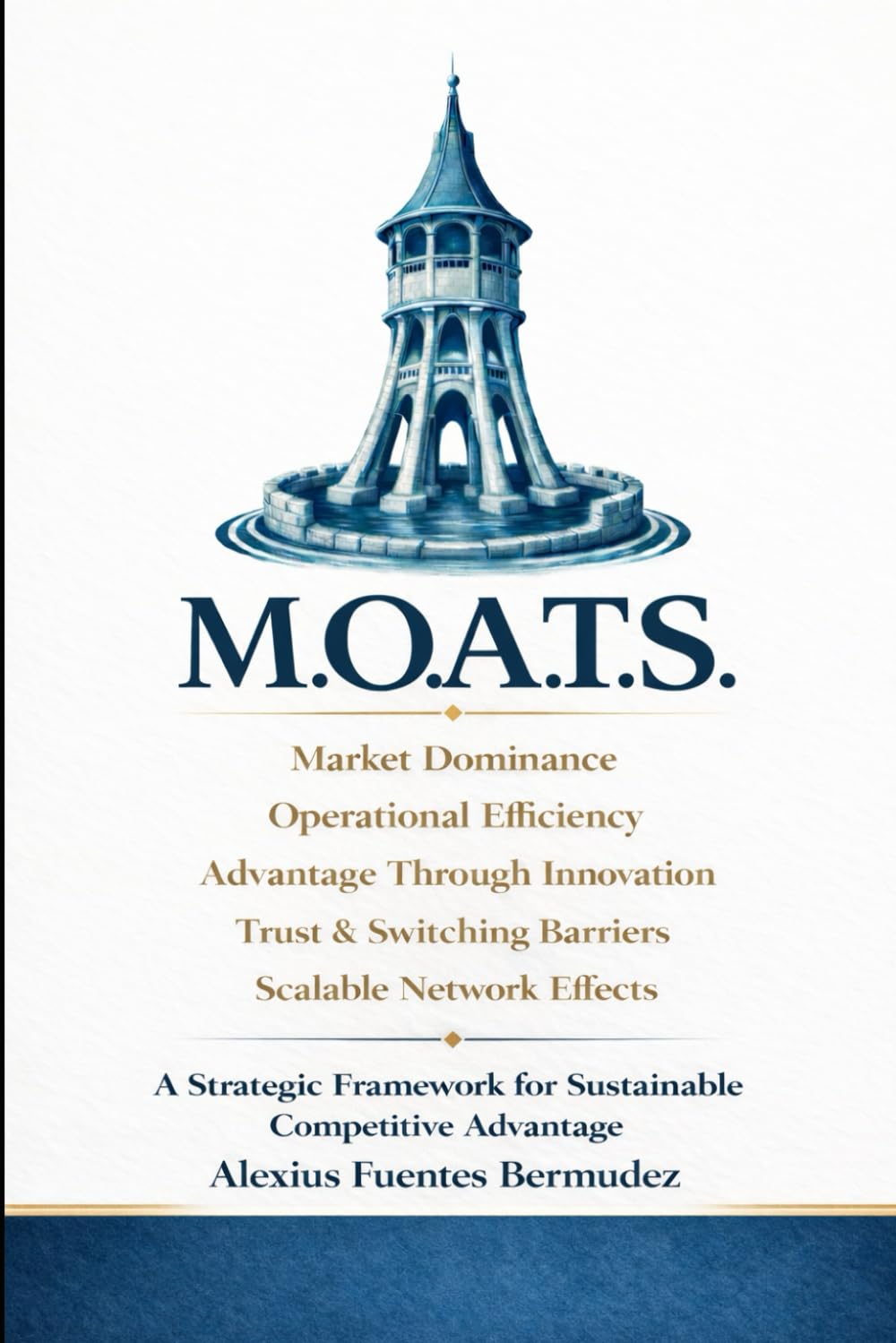
M.O.A.T.S.: A Strategic Framework for Sustainable Competitive Advantage
$24.99
by Alexius Fuentes Bermudez



What allows some organizations to endure while others fade—even when markets shift, technology disrupts, and uncertainty dominates decision-making? M.O.A.T.S. introduces a disciplined strategic framework for evaluating sustainable competitive advantage beyond surface-level performance metrics and short-term success. Rather than relying on financial ratios or static industry models, this book provides a structured method for assessing whether an organization’s advantages are durable, coherent, and resilient over time . The M.O.A.T.S. framework is built on five interdependent pillars: • Market Dominance – the strength and defensibility of an organization’s position within its competitive landscape • Operational Efficiency – the systems, processes, and execution capabilities that convert strategy into results • Advantage Through Innovation – the organization’s capacity to adapt, evolve, and renew its advantage • Trust & Switching Barriers – the depth of stakeholder relationships that anchor long-term value • Scalable Network Effects – the ability to grow advantage without proportional increases in cost or complexity Unlike traditional strategy texts, M.O.A.T.S. emphasizes judgment, trade-offs, and uncertainty . The framework does not promise certainty or prediction. Instead, it equips leaders, managers, students, and analysts with a practical lens for evaluating strategic strength , identifying hidden vulnerabilities, and understanding where apparent advantages may erode under pressure. This book is designed for: • MBA and DBA students studying strategy, competitive advantage, or organizational performance • Executives and operations leaders responsible for long-term strategic decisions • Analysts, consultants, and investors seeking a structured approach to qualitative evaluation • Educators looking for a clear, teachable framework grounded in real-world complexity M.O.A.T.S. is not a checklist, scorecard, or formula. It is a framework for disciplined strategic thinking —one that recognizes that sustainable advantage is not declared, but continuously tested by changing markets and human decisions.