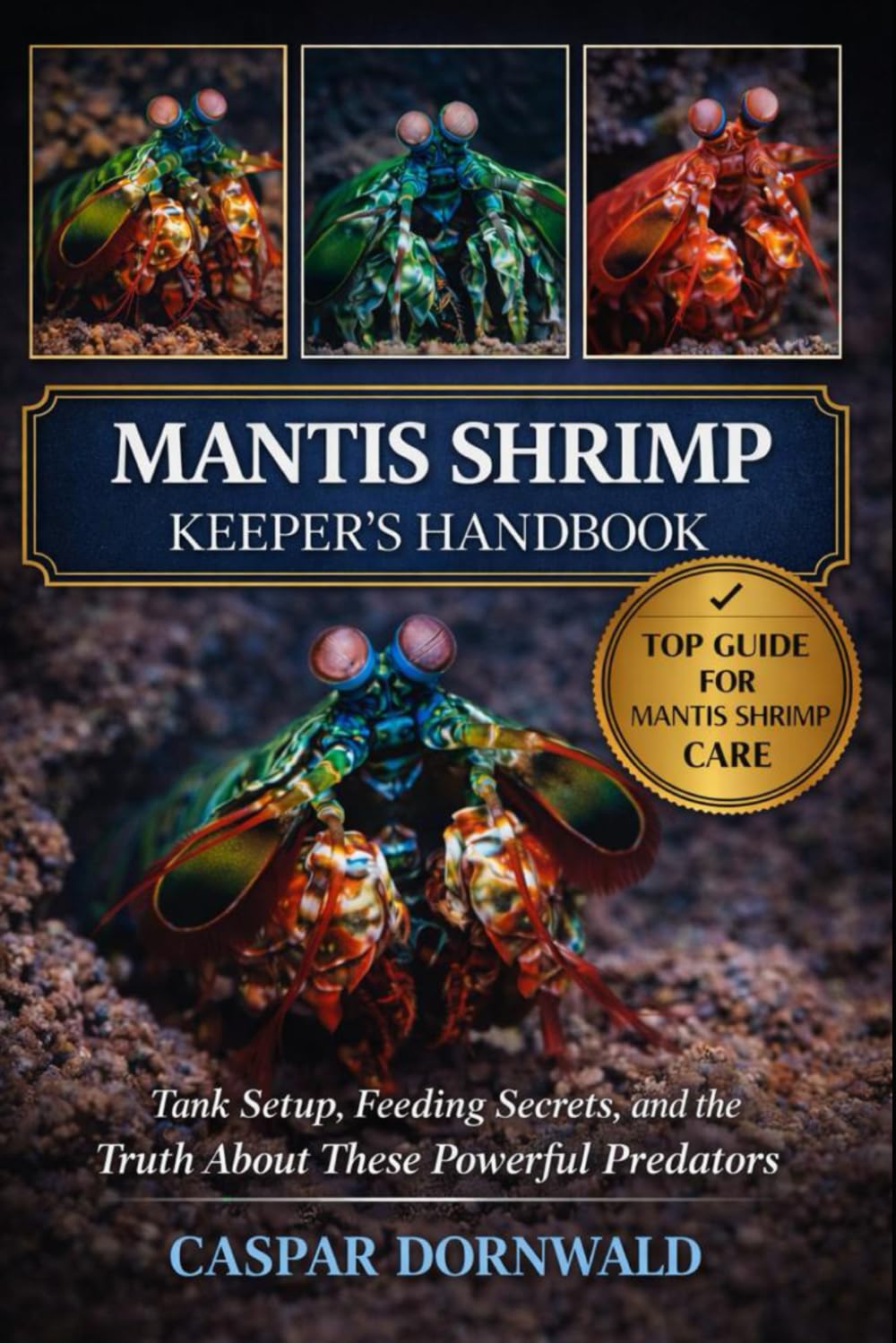
MANTIS SHRIMP KEEPER’S HANDBOOK: Tank Setup, Feeding Secrets, and the Truth About These Powerful Predators
$16.00
by CASPAR DORNWALD



The most widely known division within mantis shrimp is between smashers and spearers, but this distinction is often oversimplified. These are not merely different feeding styles; they represent fundamentally different ecological strategies with implications for habitat design, feeding protocols, and risk management. Smashers possess heavily calcified, club-like raptorial appendages. These appendages are reinforced with a complex internal lattice of mineralized layers that absorb shock and prevent structural failure during repeated impacts. Smashers specialize in breaking hard-shelled prey such as snails, crabs, and bivalves. Their strikes are among the fastest recorded movements in the animal kingdom, generating cavitation bubbles that collapse with additional destructive force. Behaviorally, smashers are territorial engineers. They excavate or appropriate burrows within rock or rubble and actively modify their surroundings. They memorize the layout of their territory, recognize individual neighbors, and will defend their burrow with calculated aggression rather than constant hostility. In captivity, this translates into predictable routines and identifiable stress responses rather than random violence. Spearers, in contrast, possess elongated, barbed raptorial appendages designed for impalement rather than impact. They typically inhabit sandy or muddy substrates where they construct vertical or U-shaped burrows. Spearers rely on ambush predation, remaining motionless with only their eyes exposed until prey enters striking range. Their strikes are equally fast but optimized for penetration and retention rather than shattering force. Spearers are more cryptic and less interactive with their environment. They require depth, substrate stability, and unobstructed strike zones. In captivity, spearers are often misunderstood because their inactivity is mistaken for poor health, when in reality it reflects successful ambush specialization. These two morphologies are not interchangeable in care requirements. Housing a smasher in a deep sand bed without rockwork or placing a spearer in a rock-heavy aquarium creates chronic stress and behavioral failure. Proper classification at the species level is therefore not optional but foundational.