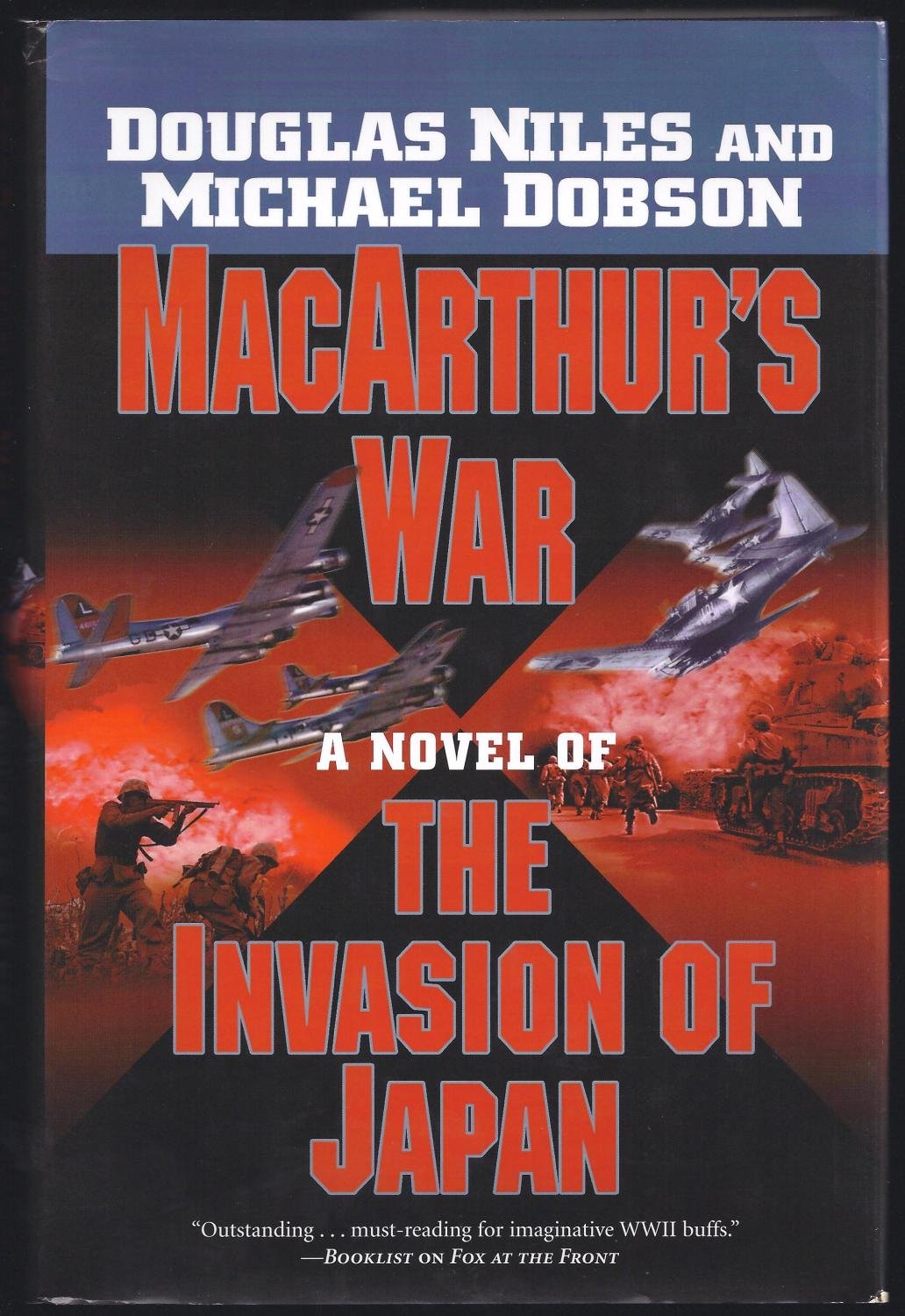



Just as Fox on the Rhine and Fox at the Front showed readers an alternate Europe in which Hitler had been killed, thereby radically changing the course of World War II, Douglas Niles and Michael Dobson bring us the Battle of Midway with a very different outcome. The Allies are wildly out maneuvered and sent home in disgrace. Back in the States things are looking rather grim as the ultra-secret Manhattan Project runs into snafus that greatly delay the final production of the atomic bomb. President Roosevelt’s approval ratings drop dramatically. Congress is desperate and the country cries out for a hero. That hero might just be Douglas MacArthur, who vowed that he would return to his beloved Philippines. He plans to do so with the backing of the entire US Armed Forces. MacArthur’s plan of action is simple: take the war back to the Japanese, island by bloody island, until standing on the shores of Japan, he can proclaim victory. And possibly gain the leadership of the United States as well. MacArthur's War recalls Niles and Dobson's excellent Fox on the Rhine (2000) and Fox at the Front (2003) in that it revises a large part of the war. A Japanese tactical victory at Midway leads to MacArthur in the southwest Pacific being entrusted with the major U.S. Pacific offensive. But MacArthur has to fight not only the Japanese, which he does very ably even when they continue to be led by Admiral Yamamoto, but also the secret of how near he came to a mental breakdown in the opening stages of the war. His dual battle gives the novel some aspects of a thriller, as MacArthur employs the same ruthlessness toward his American enemies that he directs on the Japanese military. Roland Green Copyright © American Library Association. All rights reserved Praise for the Fox duology: “Outstanding …must reading for imaginative WWII buffs”-- Booklist “The authors' attention to military detail and maneuvers would satisfy any drill instructor, and they imbue even minor historical characters with authenticity and personality, demonstrating how an individual's actions and reactions shape history.”-- Publishers Weekly Douglas Niles is an award winning game designer and the co-author of the alternate WWII duology Fox on the Rhine and Fox at the Front . He lives in Wisconsin. Michael Dobson is also an award-winning game designer and co-author of Fox on the Rhine and Fox at the Front. He served as a member of the team that built the Smithsonian's National Air and Space Museum. Chapter OneHawaiiWednesday, 10 June 1942Hickam Field, Pearl Harbor, Hawaii, 1310 hoursThe four-engine Douglas C-54 Skymaster transport plane emerged from the blazing tropical air, and for a brief instant it looked to the spy as if the plane was towing the sun across the sky like Apollo's chariot. The spy, who was posing as a reporter, listened to his supposed peers.One of the assembled photographers started to lift his camera but gave it up as hopeless. "That's gotta be Mac's plane," he said, shaking his head.A reporter standing next to him gave a single dry cough of a laugh. They had all been standing on the hot tarmac for nearly an hour. "You know the difference between Douglas MacArthur and God?""Naw. What?"The reporter took another drag on his cigarette. "God doesn't think he's Douglas MacArthur."There wasn't much laughter. Most of the press had long since heard that one, or some variation, and there wasn't much energy left for laughing, anyway. The regular afternoon rain shower hadn't come yet, and the normal flower-scented Hawaiian breeze had been hijacked by avgas and asphalt.The C-54 descended, flying in a great circle over the harbor. The reporters and photographers, casual and friendly for the long and boring wait, now jockeyed and pushed for position. Notebooks and pens came out. Cigarettes were hastily finished and butts ground underfoot.The spy stubbed out his cigarette and took out a notepad, too. He, too, was curious, though for different reasons."It's showtime," said the reporter who had compared MacArthur and God.General Douglas MacArthur--the General to the people who worked for him and who had known him longest--looked through the windblasted and scratched port of the C-54. His chief of staff, General Richard Kerens Sutherland, sat across the aisle. The remaining passengers, all members of the "Bataan Gang," as MacArthur's inner circle was known, sat farther back."There's the Arizona," the General said, pointing. He spoke slowly, pensively. Sutherland could barely get a glimpse of the twisted hull and shattered deck of the battleship still resting on the muddy bottom of Pearl Harbor."You know, Dick," MacArthur continued, "the men of Bataan were the only Americans who put up any sort of a decent fight against the Japanese, the only ones who slowed the Rising Sun during these terrible months. The men of Pearl Harbor were brave, perhaps as brave, but their battle lasted only an hour, and they had no success to show for their traged