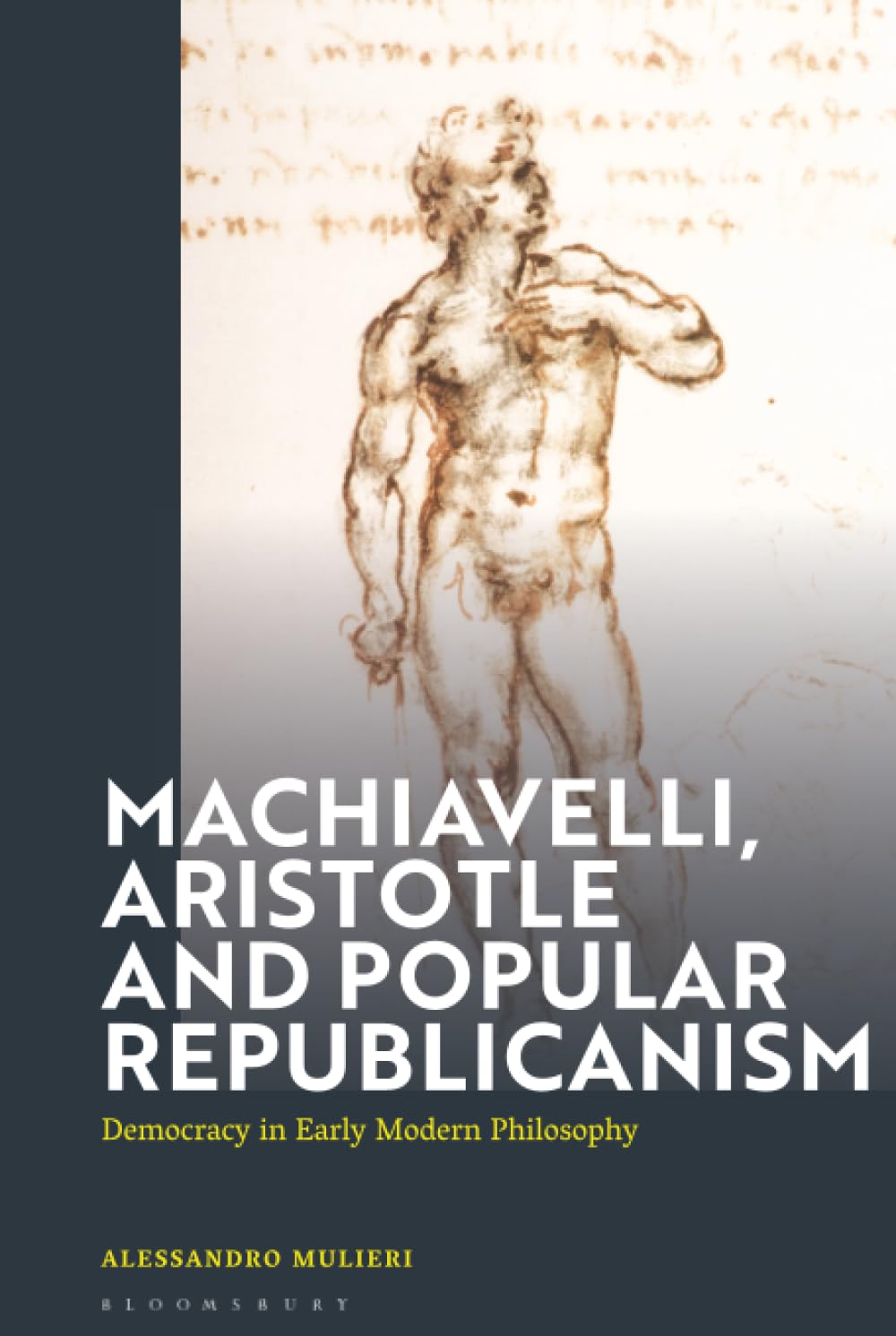
Machiavelli, Aristotle and Popular Republicanism: Democracy in Early Modern Philosophy
$115.00
by Alessandro Mulieri



Machiavelli, Aristotle, and Popular Republicanism offers the first comprehensive study of the relationship between Machiavelli, Aristotle, and the Aristotelian tradition. Alessandro Mulieri shows that the conceptual language of Aristotelianism not only shaped some of Machiavelli’s most radical ideas but also played a key role in the development of his popular republican thought and his critique of classical republicanism. Employing an interdisciplinary approach that blends the history of political thought, political theory, and the history of philosophy, the book presents an original interpretation of Machiavelli’s engagement with five Aristotelian themes: the nature of political science, the relationship between virtue and fortune, the preservation of tyranny, the premodern notion of democracy as “the rule of the poor”, and the prudence of the multitude. By analysing a wide range of Latin and vernacular Aristotelian texts circulating in Machiavelli’s time, alongside works by several Renaissance thinkers, the book addresses longstanding challenges in interpreting Machiavelli’s relationship with ancient, medieval, and early modern sources, revealing the selective and profoundly strategic nature of his engagement with the premodern tradition. “Mulieri breaks new ground by connecting Machiavelli's political philosophy to Aristotelian thought-a dialogue long neglected in scholarship. This rigorous and well-researched study reveals fresh insights into fundamental questions of political theory. Essential reading for political philosophers and intellectual historians.” ― Filippo Del Lucchese, professor of Political Philosophy, Alma mater studiorum, Università di Bologna “ Machiavelli, Aristotle, and Popular Republicanism by Alessandro Mulieri provides an indispensable corrective to the view that Machiavelli was a wholehearted opponent of Aristotle's (and Polybius's) view of mixed governments or republics. Mulieri shows definitively that the Florentine appropriated much more than he rejected salient aspects of the civic republicanism espoused by his Greek antecedents. The book is a must read in early modern political thought and republican political theory.” ― John P. McCormick Karl J. Weintraub Professor in Political Science and the College Faculty Director, Program in Law, Letters, and Society “Alessandro Mulieri's Machiavelli, Aristotle, and Popular Republicanism represents an important addition to Machiavelli scholarship. Identifying crucial angles of investigation (including virtue and fortune, but also prudence), Mulieri offers convincing explanations of Machiavelli's affinities or implicit dialogue with ancient and medieval sources. Adopting an interdisciplinary perspective, Machiavelli, Aristotle, and Popular Republicanism enriches our understanding of Machiavelli and his intellectual context, while offering a contribution to the history of the Aristotelian tradition.” ― Eva Del Soldato, Associate Professor of Italian Studies, University of Pennsylvania “Mulieri's book provides the strongest argument to date for Machiavelli's debt to radical Aristotelianism. Mulieri consolidates Machiavelli's stature as a decisive thinker of democracy” ― Miguel Vatter, Professor of Politics, Deakin University “This book provides a fresh perspective on Machiavelli's hybrid Aristotelianism, examining the impact of political Aristotelianism on his radical ideas about the “Popular State.” By focusing on this specific aspect, it advances research into Machiavelli's plebeian philosophy, offering a nuanced understanding that moves beyond the connection between Aristotelian naturalism and Machiavelli's impiety and irreligious view of the nature of the political.” ― Jérémie Barthas (CNRS, Paris), author of Machiavelli costituzionalista “In all his works, Machiavelli disputed Aristotle's main political beliefs. He praised regulated conflict rather than concord; he did not believe in the stabilizing power of the middle class; he admired Rome's conquests and criticized the idea that republics should avoid excessive expansion; he did not think that the different virtues formed a system, and contested the equivalence of virtue with the golden mean... This is all true. But now Alessandro Mulieri reveals another, unforeseen Machiavelli: deeply influenced by radical Aristotelianism and ready to build his plebeian republicanism upon Aristotle's most pro-popular stances. This is a discovery that will change the very way we recount the history of political thought between the Middle Ages and the Renaissance.” ― Gabriele Pedullà Alessandro Mulieri is Directeur de recherche at the Centre National de la Recherche Scientifique (CNRS), affiliated with Triangle – Action, Discours, Pensée Politique et Économique in Lyon. He teaches political theory and the history of political thought at Université Paris Cité and Sciences Po Paris. His research focuses on late medieval and early modern political thought, the history and theory of