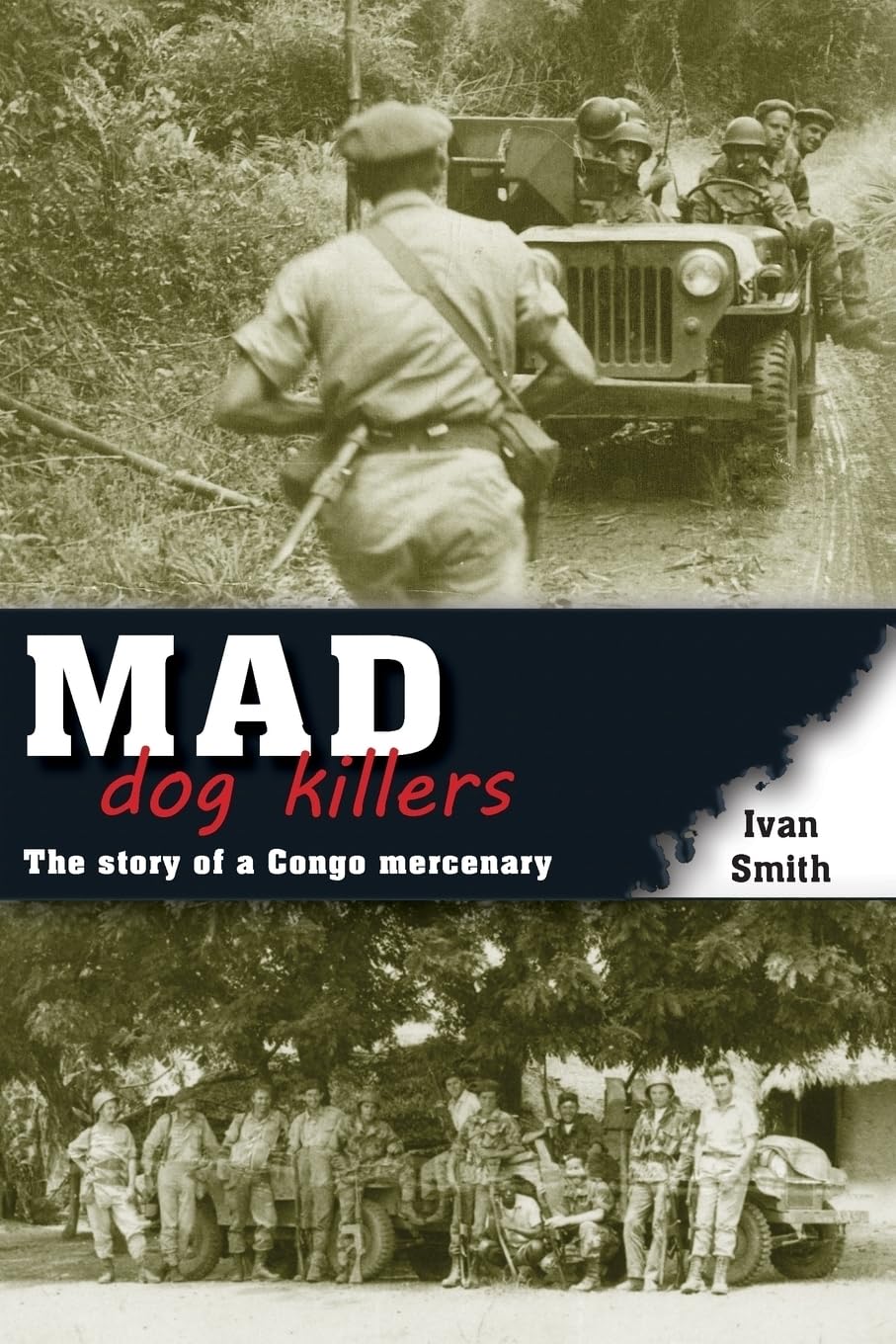



During that long, hot summer of 1964, Ivan Smith, a mercenary volunteer in the Armée Nationale Congolais, came to witness and understand fear, the law of the jungle and the lust for killing that permeates Africa. A member of 'Mad Mike' Hoare's 5 Commando Group he and his companions were nominally soldiers but there was little in the way of campaigns, tactics and discipline. Of conventional warfare there was none. Loyalty to country or unit did not exist and the fear of death was the only commander. Many more mercenaries died from an accidental discharge, in a drunken shoot-out or from a bullet in the back than were ever killed in action by Simba rebels. Nearly half a century later, Ivan Smith re-lives the nightmare that was the Congo. "...while Mad Dog Killers provides a superb historical context, it is also Smith's descriptions of the harrowing moments that invariably "feel like a lifetime" for a soldier of fortune that cuts to the core of the reader." Weekend Post South Africa Ivan Smith was a mercenary volunteer in the Armée Nationale Congolais. Mad Dog Killers The Story of a Congo Mercenary By Ivan Smith Helion & Company Limited Copyright © 2012 Ivan Smith All rights reserved. ISBN: 978-1-907677-78-6 CHAPTER 1 On the south-east coast at the bottom end of Africa, inland from what is known as the Garden Route in the Republic of South Africa, is the rural village of Joubertina. It stands in a valley that runs for over a hundred kilometres between the mountains that rim the ocean to the south and the mountains that rise in serried ranks to the north. It is about 20 kilometres from the sea; very far south in Africa. I retired to this village by chance, but as the clock turns Africa back to medieval times I am glad to be so far from it all. An extended family from the fruit lands of Germany travelled in a wagon train heading towards the Eastern Cape in the early 1800s. They were skilled in fruit growing, knew about peaches, plums, apples and pears; fruit that needs cold winters and water to irrigate the orchards. The Kritzinger families were on the way north on the old inland wagon trail that avoided the deep river gorges along the coast. They saw the valley, approved and stayed. The chosen place is semi-desert, where the endless mountain flanks are bare of trees. Black-stemmed aloes and shrubs grow on the stony hillsides with small tufts of tough grass. It is cold and rainy in winter so ideal for apples and other pomes fruit. A prevailing east wind often blows off the sea and picks up moisture which drops as rain as it crosses the mountains to the south of the valley. From these southerly, seaboard mountains run streams of crystal clear water, and along which bracken and heather grow at higher altitude and then as they gurgle down the lower valley, lush reeds and grass line the rivulets. The German family knew the value of the desert land with available water and founded the village and planted orchards. Those orchards now spread through the long valley and in this 21st century those who live in the valley still depend on the fruit industry. The fruit farms and the pack stores give work to most residents. Some families have worked the fruit farms for generations and are of mixed race, with German and Bushman antecedents. Those two races were the only humans living in the semi-desert for many decades. The fruit industry supports only a sparse population and in the village of Joubertina a few merchants' buildings are scattered along the one town road. Traffic on the main highway that runs along the mountainside above the village is light. The sounds of cattle calling, tractors working, geese fighting in the sky and distant dogs barking substitute the roar of big city traffic. In the new century, the year 2000, I came to live here in rural quiet after the sprawl and smog of Cape Town and sixteen years with the security department at the University of Cape Town. The proceeds of selling my house in the pretty little west coast suburb of Flamingo Vlei bought a rambling, broken-down, thatched farmhouse with ramshackle outbuildings on a hectare of land in the southern slopes above the village, the slopes opposite to where the main road runs and outside the municipal boundary. My early years were spent on my grandfather's farm in the midlands of what was then Rhodesia. The family was poor and lived in hard circumstances and so I am comfortably at home here in the long fruit valley in an old farmhouse. Some of my family live nearby. An old friend, Armand, lives in a mobile home and recently drove it from a wet summer in Scotland down to Derbyshire where it was warmer and drier. He does not like England's weather. He is a man of Africa and once we were stationed together in the remote Zambezi Escarpment. We drank a lot and seduced a lot of women and sometimes attended to our police duties. He doesn't like England either and roams the continent of Europe a lot. He tried Bermuda or one of those places,