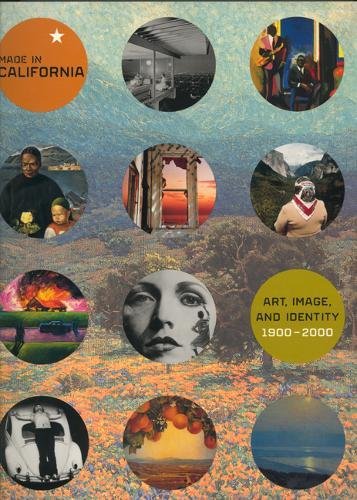



This opulent and expansive volume, published in conjunction with the Los Angeles County Museum of Art's monumental exhibition Made in California: Art, Image, and Identity,1900-2000, charts the dynamic relationship between the arts and popular conceptions of California. Displaying a dazzling array of fine art and material culture, Made in California challenges us to reexamine the ways in which the state has been portrayed and imagined. Unusually inclusive, visually intriguing, and beautifully produced, this volume is a delight throughout―both in image and in text―and will appeal to anyone who has lived in, visited, or imagined California. Drawn from the exhibition, which gathers more than 1,200 artworks and pieces of ephemera from many public and private collections, Made in California is an image-driven look at the past century, featuring more than 400 works in a range of media, from painting, sculpture, prints, drawings, and photographs to furniture, fashion, and film. The book also includes more than 150 cultural artifacts such as tourist brochures, posters, labor union tracts, personal letters, and government reports that convey the richness and complexity of twentieth-century California. Arranged provocatively by theme, these objects take us on a visual tour of a state that was promoted as a bountiful paradise early in the century; as a glamour capital by Hollywood in the 1920s and 1930s; as a suburban utopia in the late '40s and '50s; as a haven for counterculture in the '60s and '70s, and as a multicultural frontier in the '80s and '90s. The book's exploration of how these themes were reflected and contested in California's visual culture deepens our understanding of the state's artistic traditions as well as its fascinating history. The volume is divided into five twenty-year sections, each including a narrative essay discussing the history of that era and highlighting topics particularly relevant to its visual culture. Two overarching themes emerge that have been crucial for how we imagine and understand California: first, the landscape, including both the natural and built environment, and second, the multifaceted relationships California has had with Latin America and Asia. Geographer Michael Dear has contributed a sweeping overview of the social history of California that examines the vibrant and sometimes turbulent conditions out of which the culture emerged. Essayist Richard Rodriguez closes the volume with a uniquely personal meditation on the Golden State. One of the most ambitious art shows the Los Angeles County Museum of Art has ever mounted, the recent "Made in California: Art, Image and Identity 1900-2000" came with all the marketing trimmings, such as mugs, mouse pads, and a music CD (predictably containing tracks like "Valley Girl" and "California Dreamin' "). The two books that accompany the exhibition stand out, however, as especially edifying adornments to the marquee. Each book in its own way addresses the question, "What contribution has California made to the world's visual culture in the last 100 years?" The catalog presents more than 500 illustrations documenting the largest art exhibition ever mounted surveying California art and culture, a show comprising over 1200 examples of art and ephemera in a wide range of media. Opening with the words "Which California? Whose California?" the book demonstrates that the Golden State's image is of a contested Eden. Apart from being the capital of the film and television industries (a fact underemphasized in this catalog), the state has become identified with several iconographic threads that are herein extensively and entertainingly illustrated. The exhibition has come under blistering criticism for ignoring aesthetic considerations while epitomizing a trend among curators to blur the boundaries between artworks and historical artifacts. While at times this tendency results in the sublime sitting next to the ridiculous (e.g., a Frida Kahlo masterpiece shares space with a 1940s model wearing a sombrero-themed swimsuit), we also see outstanding art within a historic and geographic context from which it ordinarily is quite divorced. Also, a show this size inevitably exposes the works of lesser-known artists. Thus, along with the de rigueur Diebenkorns and Ansel Adams, we are treated to the work of countless other, lesser-known artists such as John Marshall Gamble and Enrique Chagoya, to name two separated by almost a century. Reading California collects 19 scholars' descriptions of different aspects of California's cultural identity, viewing each as elements of larger mythical notions of the state. The individual authors cover a broad range of topics, from the birth of auto tourism to "Beat Art." Most interesting are an essay by state librarian Kevin Starr describing the seminal influence of Angelino historian Carey McWilliams upon the state's self-image, a telling analysis of the important role played by art schools in fosterin