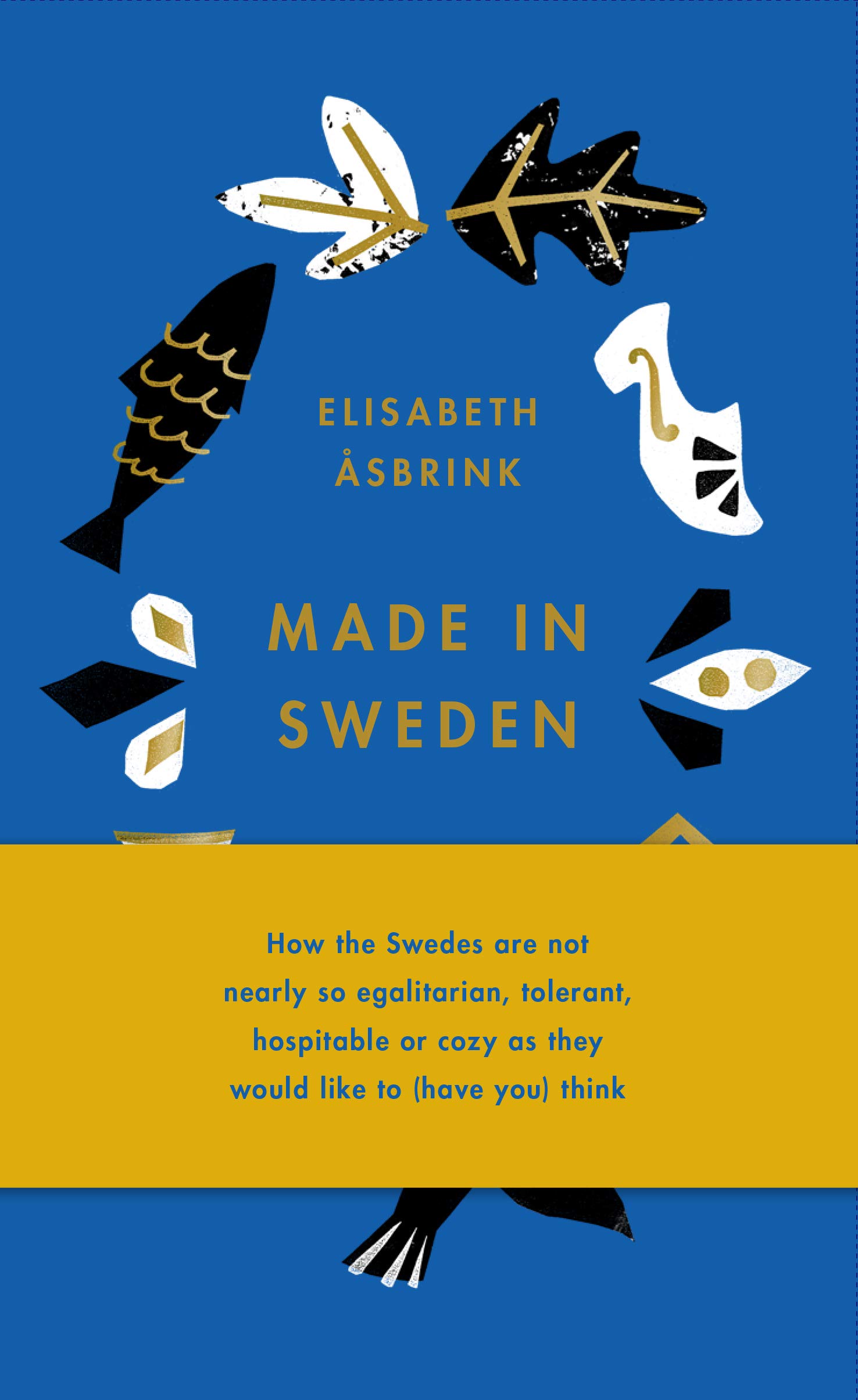
Made in Sweden: how the Swedes are not nearly so egalitarian, tolerant, hospitable or cozy as they would like to (have you) think
$11.19
by Elisabeth Åsbrink



What are the real Swedish Values? Who is the real Swedish Model? Is Sweden all that? In recent times, we have come to favor all things Scandinavian―their food, furnishings, fiction, fashion, and general way of life. We seem to regard the Swedes and their neighbors as altogether more sophisticated, admirable, and evolved than us. But what if Sweden has in fact never been as moderate, egalitarian, dignified, or tolerant as it would like to (have us) think? The recent rise to political prominence of an openly neo-Nazi party has begun to crack the illusion, and here now is Swede Elisabeth Åsbrink, who loves her country “but not blindly,” presenting twenty-five of her nation’s key words and icons afresh. “There is,” she writes, “a dark side to Utopia.” As she did in her acclaimed 1947 , she creates a collage that helps us not only see a more complex and problematic society, but also illustrates how national identity is constructed as much by what (or who) is excluded as what (or who) is included. “[A] telling glimpse of the regimentation and conformity lurking beneath the shiny surface of Sweden’s apparent utopia.” ― New York Post “[A] tasty geopolitical appetizer.” ― World Literature Today “This quirky inventory of Swedish values explores the shades of grey behind the branding of Sweden as the shiny home of ABBA and Volvo…But it’s not all Bergmanesque gloom. Åsbrink also celebrates Swedes’ sacred relationship with nature, the achievements of its social reformers and the indefatigable biologist Carl Linnaeus.” ― Sydney Morning Herald Praise for 1947: “ 1947 is one of those books that makes you want to major in history. It is one of the best books, certainly the best nonfiction book, that I’ve read recently. I think the subtitle, Where Now Begins , really speaks to one of the things that makes this book so important: The echoes of 1947 are resonating very, very clearly today.” ― Nancy Pearl on NPR’s Morning Edition “[A] gripping history, formed as a patchwork of significant events. In Paris, the final names are added to the treaties ending the war; in New York, Billie Holiday plays Carnegie Hall; in Cairo, the Arab League convenes on the issue of Palestine; on a Scottish island, George Orwell completes ‘1984’…[Åsbrink’s] careful juxtaposition of disparate events highlights an underlying interconnectedness and suggests a new way of thinking about the postwar era.” ― New Yorker “The Swedish journalist Asbrink’s 1947 is an extraordinary achievement. Careening around Europe and the Middle East as well as South Asia and the United States through a singular year, she deliberately juxtaposes the intimate and the ephemeral with immensely consequential political and diplomatic developments. New inventions like the Soviet engineer Mikhail Kalashnikov’s assault rifle, the French couturier Christian Dior’s resplendent New Look, the American Navy admiral Grace Hopper’s virtuoso development of computer language, Thelonious Monk’s and Billie Holiday’s musical genius and the Polish lawyer Raphael Lemkin’s coinage of the term “genocide” jostle with the United Nations’ efforts to find a workable resolution for Palestine, gruesome rapes during the partition of India, anti-Semitic riots in England and the Nazi Einsatzgruppen trial at Nuremberg. These, in turn, are nestled alongside evocative accounts of the ardent physicality of Simone de Beauvoir’s love for Nelson Algren, the struggles of George Orwell working on 1984 and ships filled―variously―with fugitive Nazis or displaced Jews. Amid all these gleaming fragments are meditations on the nature of historical time, the mysteries of human motivation, the endless riddle of causation and the heart-rending loss of once-possible alternatives. Asbrink is throughout attentive to the complex dynamic produced by the Holocaust’s multiple aftermaths, the urgently necessary and terrifyingly confusing process of decolonization and the consolidation of the Soviet bloc. Her constant intercutting of the world-shaking with the quotidian―including her father as a child navigating post-Nazi Budapest―underscores a challenge to more mainstream genres of history writing. The year 1947 did mark a tipping point between the savagery of the immediate past and the tentative stirrings of postwar potentialities. Ultimately most compelling is 1947’s relationship to our present. A chilling recurrent subplot involves the remarkably rapid regrouping of undeterred ex-Nazis, already inventing denialism, networking transnationally and dreaming up a renewed pan-fascist future.” ― New York Times Book Review “When journalist Asbrink was ten, her father left her a letter that was 19 lines long. The first 18 expressed his love; the last sentence said never to pity yourself. When Asbrink writes about 1947, she honors her father and others who disappeared under Nazi rule … During this year, writer Simone de Beauvoir went to the United States and had a passionate affair with writer Nelson Algren. A Swedish f