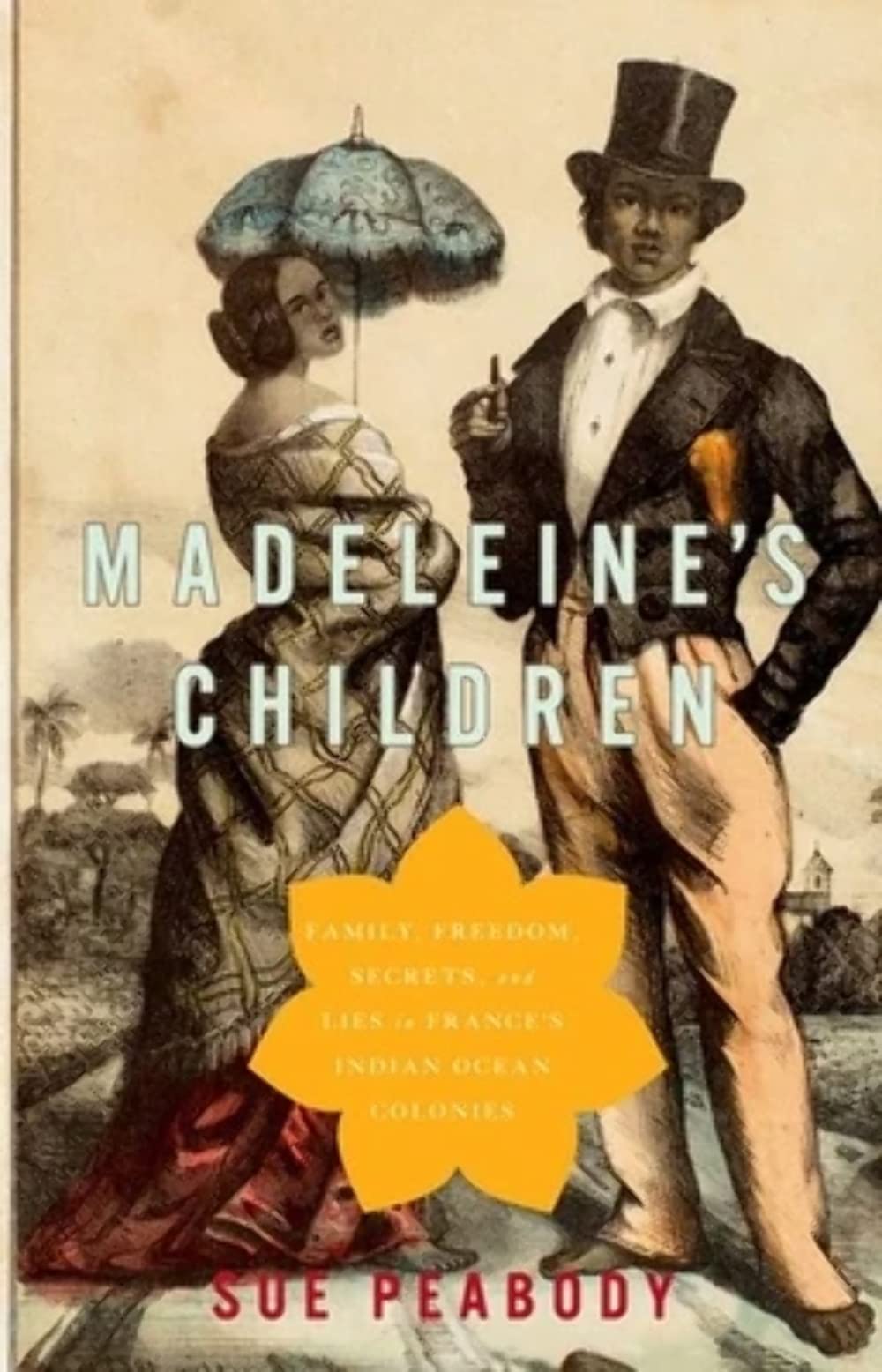
Madeleine's Children: Family, Freedom, Secrets, and Lies in France's Indian Ocean Colonies
$16.50
by Sue Peabody



Madeleine's Children uncovers a multigenerational saga of an enslaved family in India and two islands, Réunion and Mauritius, in the eastern empires of France and Britain during the eighteenth and nineteenth centuries. A tale of legal intrigue, it reveals the lives and secret relationships between slaves and free people that have remained obscure for two centuries. As a child, Madeleine was pawned by her impoverished family and became the slave of a French woman in Bengal. She accompanied her mistress to France as a teenager, but she did not challenge her enslavement there on the basis of France's Free Soil principle, a consideration that did not come to light until future lawyers investigated her story. In France, a new master and mistress purchased her, despite laws prohibiting the sale of slaves within the kingdom. The couple transported Madeleine across the ocean to their plantation in the Indian Ocean colonies, where she eventually gave birth to three children: Maurice, Constance, and Furcy. One died a slave and two eventually became free, but under very different circumstances. On 21 November 1817, Furcy exited the gates of his master's mansion and declared himself a free man. The lawsuit waged by Furcy to challenge his wrongful enslavement ultimately brought him before the Royal Court of Paris, despite the extreme measures that his putative master, Joseph Lory, deployed to retain him as his slave. A meticulous work of archival detection, Madeleine's Children investigates the cunning, clandestine, and brutal strategies that masters devised to keep slaves under their control-and paints a vivid picture of the unique and evolving meanings of slavery and freedom in the Indian Ocean world. "Peabody has sifted the documentary record with exquisite care in order to portray the contradictory ties of intimacy, exploitation, solidarity and betrayal that characterized the extended families that bound masters and servants in slave societies.... Madeleine's Children ...offers a quiet but necessary revision to much of the literature about slaves' search for freedom in the age of abolition." -- Paul Cheney, French History "As Sue Peabody shows in this impressive study of the family history of Madeleine, an enslaved woman from Bengal, the experiences of slaves in the Francophone world lacked for neither drama nor didactic imprint. Following Madeleine and her two children...Peabody delivers a tale of personal tragedy and salvation, set against a global backdrop of revolution, restoration, and imperial rivalry. The result is not only a compelling glimpse of figures marginally represented within the historical record, but also a provocative analysis of what it actually means to be free....Peabody has given us a readable, nuanced, and compelling piece of historical scholarship, one that is at once informative to specialists and accessible to a wider audience." -- Gregory Mole, H-France "A welcome addition to the historiography of French imperialism and slavery....French history does not have an equivalent of Equiano or Incidents in the Life of a Slave Girl ....While this study is not autobiographical, as are some of the English-language accounts of slavery, Peabody does reconstruct Furcy's life and incorporates the testimony he gave in various court cases. This analysis sheds light on some of his experiences as an enslaved person as well as his sense of the true implications of his legal status. For scholars of slavery and the history of the family, Furcy's testimony also offers valuable insights into what it means to be a father when one is nominally free, but not free in a total sense." -- Margaret Cook Andersen, English Historical Review "Peabody seeks to deepen understandings of freedom and slavery by enlarging the focus to include the French empire as it reached beyond the Atlantic. Her attention to the slave smuggling triggered by the abolition of transoceanic slave trading reinforces studies of contraband in the late eighteenth century. And while Madeleine, Marie Anne and Eugénie all inhabited a reality far from the revolutionary feminists in mainland France, Peabody is deeply invested in understanding the experiences of women, including highlighting the entangling practices of employing enslaved women as midwives and wet-nurses. Focusing on one family's experiences reveals the complex and messy underbelly of an empire in the process of transformation and France's bumpy trajectory toward the promises of the 1789 revolution." -- Isabelle Headrick, Not Even Past "A meticulous and insightful study of the life of a woman who, as a child, was sold into slavery in India, and it also chronicles the later struggles of her children to obtain freedom in the French Mascarenes in the first half of the nineteenth century ... Madeleine's Children , in the best tradition of microhistory, moves beyond this individual and exceptional story to provide insights into wider issues of race, abolitionism, and governan