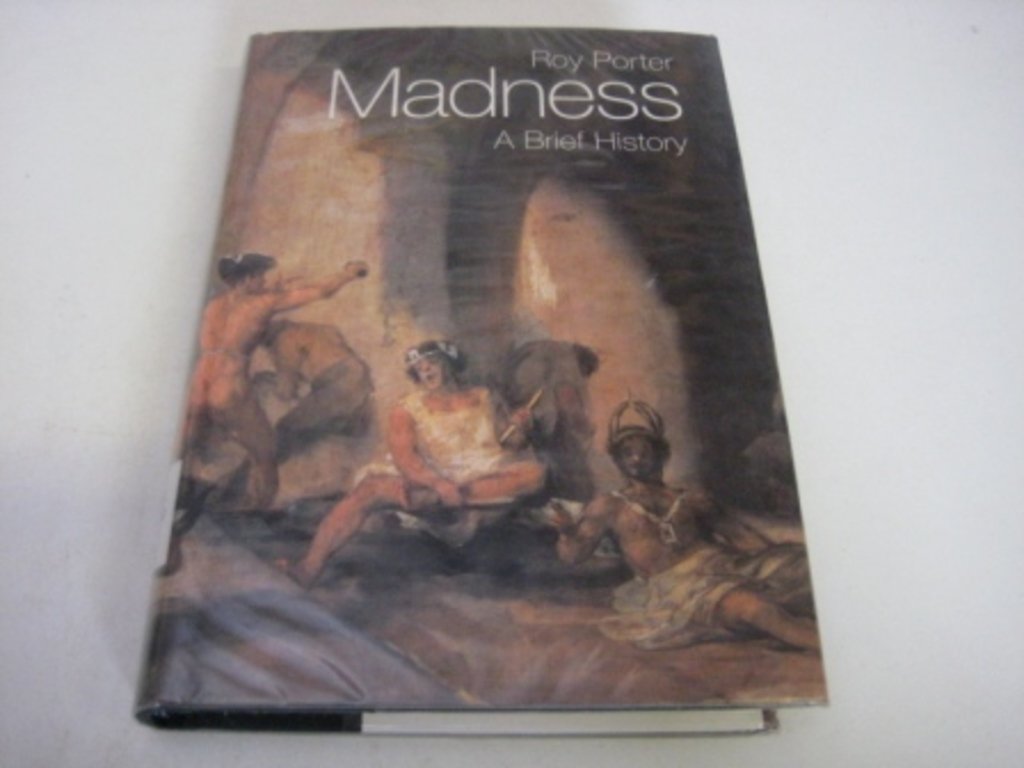



Looking back on his confinement to Bethlem, Restoration playwright Nathaniel Lee declared: "They called me mad, and I called them mad, and damn them, they outvoted me." As Roy Porter shows in Madness: A Brief History , thinking about who qualifies as insane, what causes mental illness, and how such illness should be treated has varied wildly throughout recorded history, sometimes veering dangerously close to the arbitrariness Lee describes and often encompassing cures considerably worse than the illness itself. Drawing upon eyewitness accounts of doctors, writers, artists, and the mad themselves, Roy Porter tells the story of our changing notions of insanity and of the treatments for mental illness that have been employed from antiquity to the present day. Beginning with 5,000-year-old skulls with tiny holes bored in them (to allow demons to escape), through conceptions of madness as an acute phase in the trial of souls, as an imbalance of "the humours," as the "divine fury" of creative genius, as sanity itself in a world gone mad, or as the malfunctioning of brain chemistry, Porter shows the many ways madness has been perceived and misperceived in every historical period. He also takes us on a fascinating round of treatments, ranging from exorcism and therapeutic terror--including immersion in a tub of eels--to the first asylums, the anti-restraint movement, shock therapy, the birth of psychoanalysis, and the current use of psychotropic drugs. Throughout, Madness: A Brief History offers a balanced view, showing both the humane attempts to help the insane as well as the ridiculous and often cruel misunderstanding that have bedeviled our efforts to heal the mind of its myriad afflictions. No branch of medicine faces as much popular skepticism as psychiatry. In this readable yet rigorous little book with a global slant, Porter (social history of medicine, University Coll., London; The Greatest Benefit to Mankind) addresses that controversy by recounting the history of mental illness from antiquity to modern times. A wealth of facts and literary references illuminate how people went from believing that supernatural forces cause mental illness to their reliance on more rational and naturalistic explanations, culminating in today's combination of the medical and psychosocial models. Porter also discusses topical issues, including the relationship between lunacy and creativity; the drive to institutionalize, which peaked in the mid-20th century; the rise and demise of psychoanalysis; and the development of the antipsychiatry movement. This book combines the appeal of history as narrative with the intellectual stimulation derived from cogent analysis. Less comprehensive than Edward Shorter's A History of Psychiatry: From the Era of the Asylum to the Age of Prozac but more academic than Alex Beam's Gracefully Insane: The Rise and Fall of America's Premier Mental Hospital, it will engage both general readers and psychiatry students with its sparkling prose and a well-annotated bibliography. Highly recommended. Antoinette Brinkman, M.L.S., Evansville, IN Copyright 2002 Cahners Business Information, Inc. Medical historian Porter authoritatively traces how Western culture has explained and treated insanity. Holes bored in 7,000-year-old skulls indicate the earliest assessment of madness as spirit-possession. The ancient Greeks and medieval and Renaissance philosophers influenced by them replaced possession with irrationality as the cause of madness and exorcists with physicians as its curers. The Enlightenment stressed folly as the mark of madness; romanticism reacted by considering genius akin to madness. Asylums arose to secure the insane for their own good, and newly emergent psychiatry developed several ostensibly successful asylum strategies. As asylums became overloaded with incurables, however, disillusionment induced underfunding. Freud and his spawn came to psychiatry's rescue, but madness persists despite a century of psychoanalysis and of listening increasingly to what the insane say about their conditions. New drugs quash symptoms but have undesirable side effects, including dependency. Meanwhile, the medical profession is divided about the legitimacy of psychiatry. An ideal introduction to its subject, and a timely supplement to Robert Whitaker's superb Mad in America [BKL D 15 01]. Ray Olson Copyright © American Library Association. All rights reserved "A brief and fascinating history of insanity."--Susan Salter Reynolds, Los Angeles Times Book Review "In just over 200 pages Porter manages to cram in everything from 7,000-year-old skulls with holes bored into them to release demons to the rise of psychopharmacology. In between we get Greco-Roman rationalism, the bloody and persistent belief that mental illness was caused by a compromised faith in God (approximately 200,000 witches killed), the rebirth of the humors (blood, choler, melancholy, and--my favorite--phlegm), institutionalization,