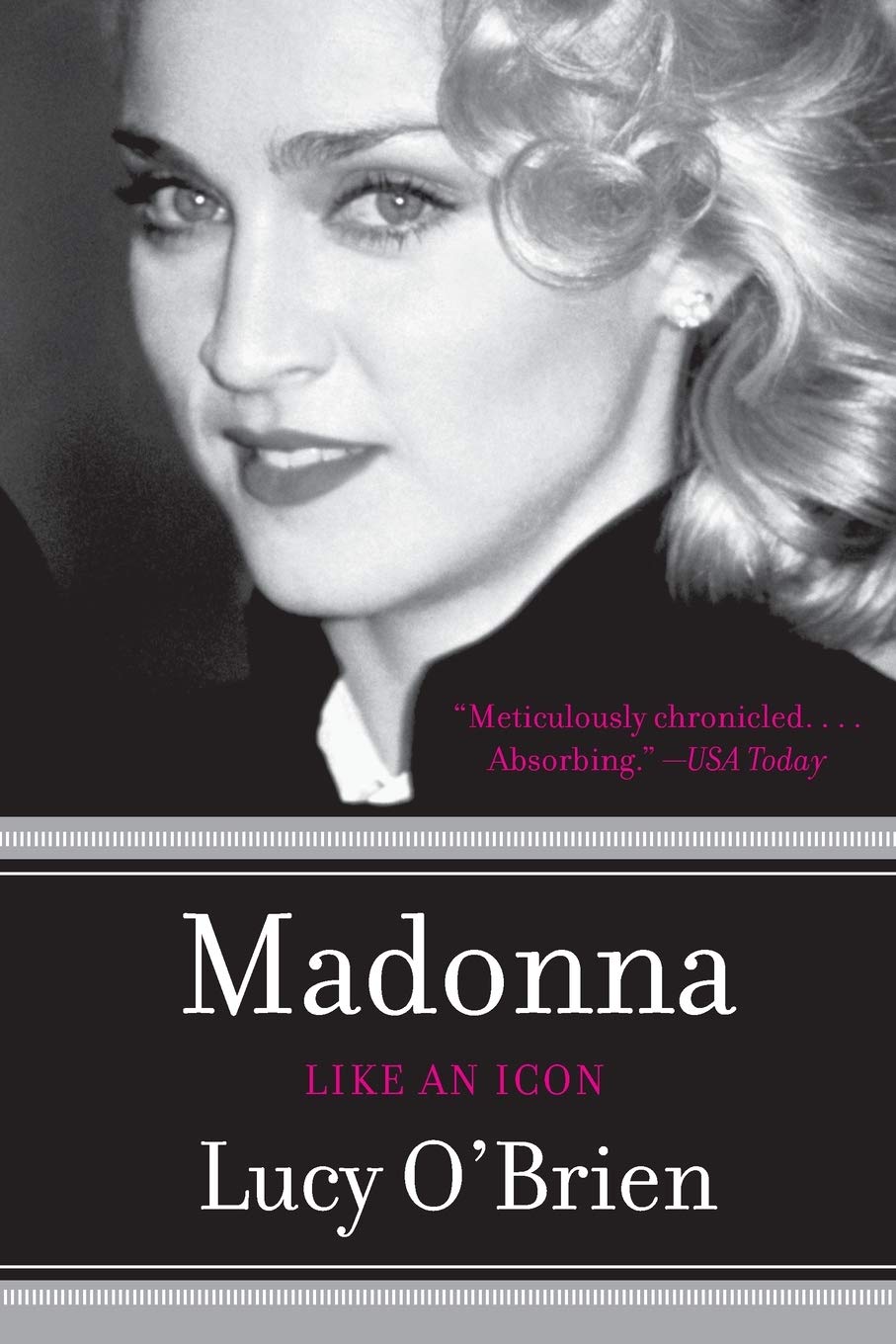
Madonna: Like an Icon: A Candid Biography Exploring the Complex Personality and Legendary Drive of a Pop Superstar
$8.38
by Lucy O'Brien



Material Girl . . . Immaculate sexpot . . . Superstar . . . Mother . . . Kabbalah enthusiast . . . For three decades she has defied categorization. . . . She remains one of our greatest living pop icons. Here is the groundbreaking biography that finally solves the mystery at the heart of Madonna's chameleonlike existence. Drawing upon scores of candid interviews with producers, musicians, collaborators, lovers, and friends, Lucy O'Brien's Madonna: Like an Icon explores the complex personality and legendary drive that have made Madonna the most famous female pop artist of our time. From her mother's premature death to Madonna's dynamic arrival on the New York club scene, from "Like a Virgin" to Evita and beyond, every stage of this dazzling star's life and career is brilliantly illuminated—the stereotypes deconstructed, the lies exposed, the artist examined, the legend celebrated. “Meticulously chronicled”... [and] absorbing.” - USA Today “O’Brien masterfully weaves together material from her extensive research and interviews to create an engrossing study of Madonna...with candor and serious reflection. The result is a fine study of the life and art of a complex individual. Fans of Madonna will want to read this but so will those interested in the sociology of a pop-culture icon.” - Library Journal Material Girl . . . Immaculate sexpot . . . Superstar . . . Mother . . . Kabbalah enthusiast . . . For three decades she has defied categorization. . . . She remains one of our greatest living pop icons. Here is the groundbreaking biography that finally solves the mystery at the heart of Madonna's chameleonlike existence. Drawing upon scores of candid interviews with producers, musicians, collaborators, lovers, and friends, Lucy O'Brien's Madonna: Like an Icon explores the complex personality and legendary drive that have made Madonna the most famous female pop artist of our time. From her mother's premature death to Madonna's dynamic arrival on the New York club scene, from "Like a Virgin" to Evita and beyond, every stage of this dazzling star's life and career is brilliantly illuminated—the stereotypes deconstructed, the lies exposed, the artist examined, the legend celebrated. Music critic Lucy O'Brien has contributed to many publications, including the Sunday Times (London), Marie Claire , Cosmopolitan , and Q . The author of She Bop and She Bop II , as well as acclaimed biographies of Dusty Springfield and Annie Lennox, O'Brien lives in London and teaches at Westminster University and the University of London's Goldsmiths College. Madonna: Like an Icon By Lucy O'Brien HarperCollins Publishers, Inc. Copyright © 2008 Lucy O'Brien All right reserved. ISBN: 9780060898991 Chapter One The Death of Madonna Just north of Detroit is the suburb of Pontiac. Now a depressed area, back in Madonna's day it was a thriving manufacturing town servicing Detroit's huge automobile industry. Rising up by the highway is a cavernous bubble-shaped structure called the Silverdome. It was built in 1970s for Detroit's football team, but since the Lions moved downtown in 2002, it's been more or less abandoned. In its heyday, it hosted the NBA All-Star games and welcomed such rock bands as Led Zeppelin and The Who. In January 1987, Pope John Paul II celebrated a mass there. Just across the road from the Silverdome is a small working-class neighborhood. Here Madonna spent her early childhood, at 443 Thors Street, in a modest, pale green single-story house. When I arrived there in 2006, it had a worn, dilapidated air, as if the ghosts hadn't quite left the building. Back in the early 1960s it would have been filled with children. It was Madonna's parents' first house, the place where they started their married life and where their eldest daughter first hatched her adventurous dreams. "My grandparents came from Italy on the boat . . . [they] spoke no English at all. They weren't very educated, and I think in a way they represented an old lifestyle that my father really didn't want to have anything to do with," Madonna once said. Her grandfather Gaetano Ciccone came from Pacentro, a small village in the Abruzzo region of Italy. He came from a family of peasant farmers, but was encouraged to go to school and broaden his opportunities. In 1920, there was no work for this ambitious teenager, so he left for America, and made his way to Aliquippa, a steel town just outside Pittsburgh. After finding a job working on the blast furnace floor, he brought from Italy his young wife, Michelina di Ulio. They lived in a rented one-bedroom house near the steel mill, and raised six sons, five of whom worked at the mill. The youngest, Madonna's father, Silvio (also known as Tony), was the only one fortunate enough to go to college. The Ciccones found being an immigrant family tough: there was considerable prejudice against the new wave of European immigrants, particularly Italians, who often came from impoverished background