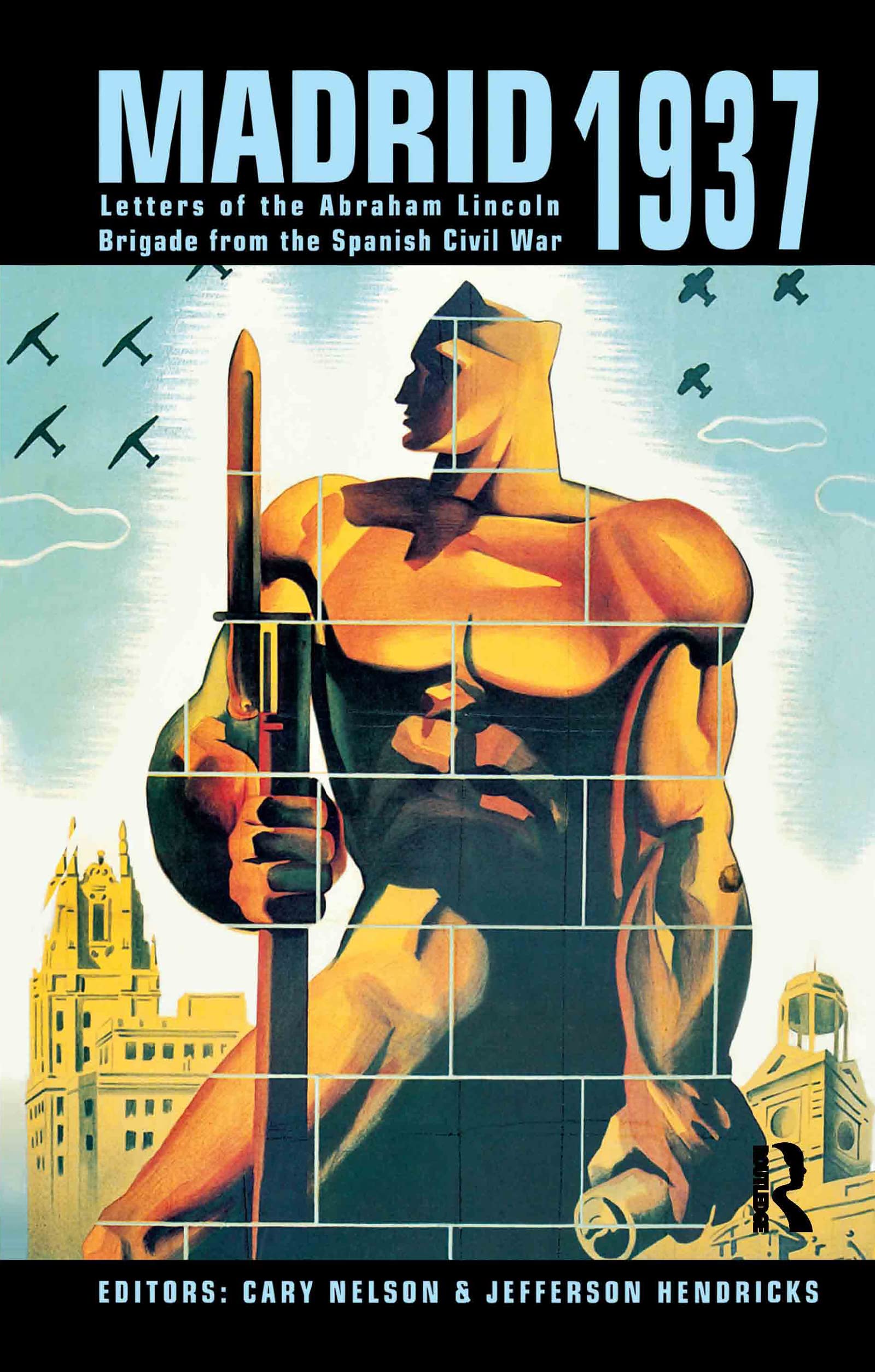
Madrid 1937: Letters of the Abraham Lincoln Brigade From the Spanish Civil War
$112.20
by Cary Nelson



Few topics in 20th century history generate as much interest as the Spanish Civil War. These letter from the Abraham Lincoln Brigade take us back to a time when 2800 Americans took up arms and confronted Hitler's Condor Legion, Mussolini's Black Shirts, and Franco's fascist calvary on the battlefields of Spain. Here are their combat experiences, the love letters they wrote under fire, friendships formed among themselves and with their Spanish comrades, and reports of Madrid and Barcelona undergoing history's first saturation bombing of civilian targets. It was the eve of World War II, and these men and women saw first-hand the danger facing the world. Iadrid 1937 captures for the first time the thoughts, words and dreams of those who fought. More than a collection of separate letters, Madrid 1937 gathers letters from many hands to tell a group story. Richly illustrated with over 50 color and black and white plates, this chronicle enables the reader to travel with the volunteers through France and Spain; visit the beseiged city of Madrid and walk the streets of Barcelona under fascist bombardment; experience the chaos of battle and the excitement of celebrations behind the lines; stand beside nurses and doctors as they struggle to save the lives of the wounded; and encounter famous writers such as Ernest Hemingway and Langston Hughes. Madrid 1937 tells a story of epic proportion, the struggle of a volunteer army who chose to risk their lives in the struggle against Fascism. The Spanish Civil War (1936-39) was a bloody dress rehearsal for World War II, but few Americans realized it at the time. Over 2800 Americans volunteered to fight for Spain's democratically elected government against the Fascists, who were supported by German and Italian troops, planes, and tanks. The Americans of the Abraham Lincoln Brigade came from all social classes and occupations. Few had any military skills and training, but all possessed a desire to fight the rising tide of Fascism. The editors, both college professors, have collected hundreds of letters from the American veterans and their families. Organized chronologically by subject, these letters reveal the American volunteers to be idealistic about politics and naive about war. Covering training, battles, and hardships, the letters reveal the volunteers' patriotic fervor, hope, fatigue, despair, and friendships, as well as the numbing fear of artillery and air attack and the chilling terror of close combat. Historically concise and humanly real, this book is a superb companion to Peter Wyden's The Passionate War (1983). For the general reader and history buff. Col. William D. Bushnell, USMC (ret.), Brunswick, Me. Copyright 1996 Reed Business Information, Inc. " Madrid 1937 is a crowning achievement. Not only are the letters living documents, palimpsests of flesh and blood and spirit, they are tender and wild flowers awakening our sense to the past and also to the present." -- The Nation "The Lincoln Brigade was the only American Fighting force in this century made up entirely of volunteers... These letters from survivors and non-survivors reveal the fears and frustrations and hardships, the surprises, the ironies and the heroics, of any military front... What makes these letters special is that they were all written by men and women who had freely chosen to risk their lives in a cause they believed was worth it." -- Ring Lardner, Jr. "These letters are the real thing: heroism and idealism from the folks who volunteered to fight Hitler and Mussolini before it was popular to do so." -- Pete Seeger "The[se] letters are poignant, powerful, unforgettable." -- Howard Zinn "We usually talk about war from the standpoint of Generals, but as these letters written from the field by Lincoln Brigade members show, the words of ordinary people who were actually involved are much more meaningful--both emotionally and historically." -- Stephen Jay Gould "Collected from one of the most literate battalions ever mustered, these are the very personal dispatches from Somebody Else's War against Fascism that was about to become everybody's. Funny, sad, and moving." -- John Sayles "There is no way to understand the present or chart the course of the future without understanding the past. Some would keep the past in darkness. Others would illuminate it, putting us in touch with our past and thereby helping us design a better future. Such a light comes from the Abraham Lincoln Brigade letters. Everybody should read them." -- Harry Belafonte "For me, these letters constitute a remarkable and valuable historical document. They are wonderfully innocent, truthful, and strangely without self-consciousness." -- Howard Fast "[These letters] provid[e] an invaluable insight into the well-spring of hope that sent forth these Americans -- a racially integrated, cross-section of our nation -- to prevent the onset of a larger war that would, in time, engulf the world." -- Ronald V. Dellums, Congressm