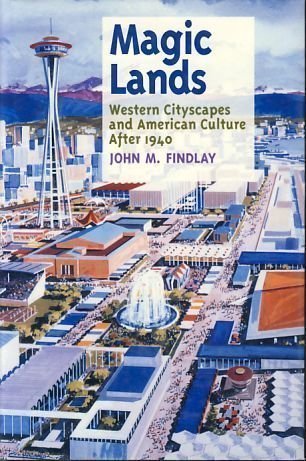



The American West conjures up images of pastoral tranquility and wide open spaces, but by 1970 the Far West was the most urbanized section of the country. Exploring four intriguing cityscapes―Disneyland, Stanford Industrial Park, Sun City, and the 1962 Seattle World's Fair―John Findlay shows how each created a sense of cohesion and sustained people's belief in their superior urban environment. This first book-length study of the urban West after 1940 argues that Westerners deliberately tried to build cities that differed radically from their eastern counterparts. In 1954, Walt Disney began building the world's first theme park, using Hollywood's movie-making techniques. The creators of Stanford Industrial Park were more hesitant in their approach to a conceptually organized environment, but by the mid-1960s the Park was the nation's prototypical "research park" and the intellectual downtown for the high-technology region that became Silicon Valley. In 1960, on the outskirts of Phoenix, Del E. Webb built Sun City, the largest, most influential retirement community in the United States. Another innovative cityscape arose from the 1962 Seattle World's Fair and provided a futuristic, somewhat fanciful vision of modern life. These four became "magic lands" that provided an antidote to the apparent chaos of their respective urban milieus. Exemplars of a new lifestyle, they are landmarks on the changing cultural landscape of postwar America. New York and Chicago may have traditionally been the architectural meccas of the United States, but don't discount the American West as a prime example of urban architecture in the 20th century. Author Findlay didn't, and he has presented in this volume studies of four Western cityscapes: Disneyland, Stanford Industrial Park, Sun City, and the 1962 Seattle World's Fair. His thesis here is that the architects for these areas were attempting to build cities that had no counterpart in the East, cities that were totally different from what had gone before. There's not much written on this subject, and Findlay's clear writing style adds to this book's attractiveness. Recommended for special collections. - Carol Spielman Lezak, General Learning Corp., Northbrook, Ill. Copyright 1992 Reed Business Information, Inc. "Even for lay urbanists, Magic Lands is a fascinating look at the evolution of the West. . . . The book examines the history of each cityscape, then considers its fallout. And these cities pose frightening problems for both residents and the future of urban design. . . . Readers will appreciate Findlay's research and clear focus." -- Michael Singer, Los Angeles Readers Monthly Review John M. Findlay is Associate Professor of History at the University of Washington and the author of People of Chance: Gambling in American Society from Jamestown to Las Vegas (1986). Magic Lands: Western Cityscapes and American Culture After 1940 By John M. Findlay University of California Press Copyright © 1992 John M. Findlay All right reserved. ISBN: 0520077032 Introduction Perhaps the most distinguishing social feature of the American Far West during the twentieth century has been the nature of its population growth. In 1900 the region had barely 5 percent of the nation's population; by 1970 it had almost 17 percent. In every decade the percentage growth in the West far exceeded both the national average and the percentage increase of every other region. Furthermore, this population was increasingly headed toward metropolitan areas, again at a pace that no other section of the country could match. Cities had been important to the Far West since the first onrush of Anglo-Americans during the mid-nineteenth century, yet its proportion of urbanities as late as 1920 remained near the national average. After 1930, however, while urban growth in other regions slackened, in the Far West it maintained its rapid pace. By the time of the 1970 census the West had become the most highly urbanized of the four American sections, with 83 percent of its population dwelling in urban areas. Ten years later, when the figure for the West reached 84 percent, its closest competitor, the Northeast, was at only 74 percent. Paradoxically, as the population of the West grew larger and became more concentrated, historians supposed that the region's impact upon the rest of the country had diminished, though few of them doubted that the relatively lightly settled and largely rural West had been a crucial factor in the development of the nineteenth-century United States. Perhaps they believed that demographic and urban growth, along with other changes, had made the modern region too much like the rest of the country to be able to affect American culture in any significant way. This book takes a different view. It argues that the ability of the West to influence the nation grew with its population and its urbanization. The West during the twentieth century remained a distincti