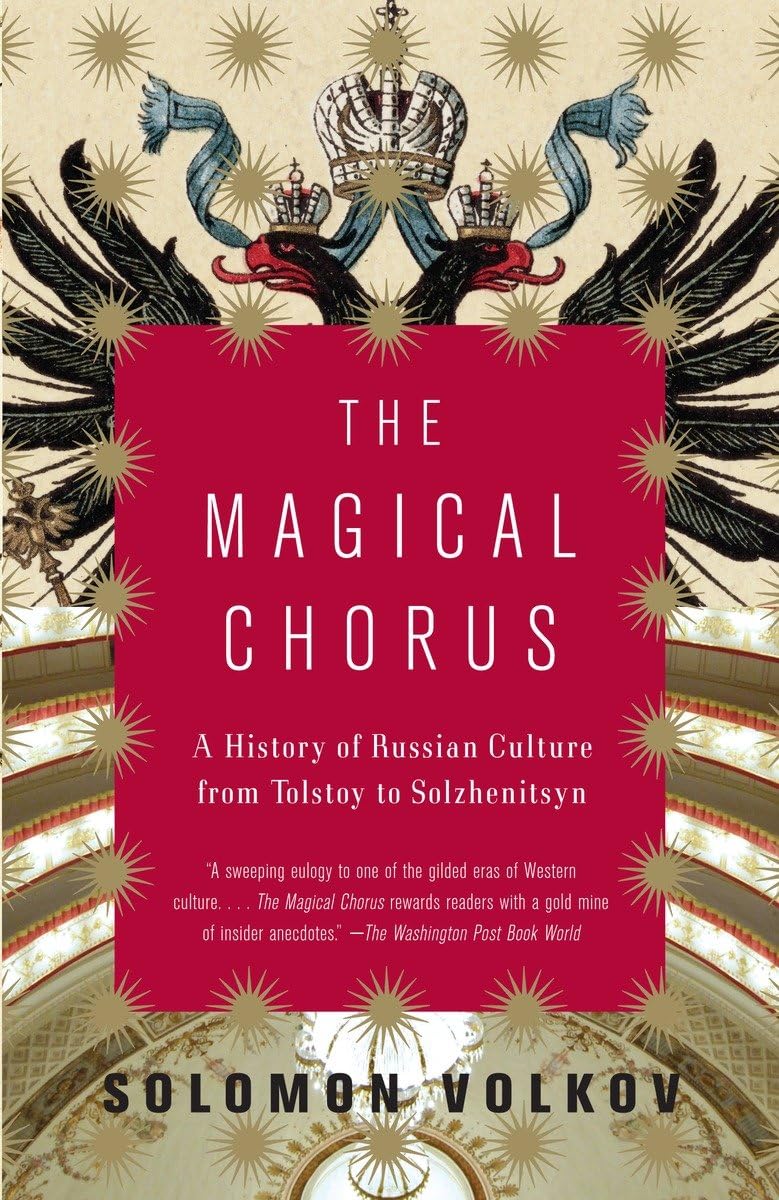
Magical Chorus: A History of Russian Culture from Tolstoy to Solzhenitsyn
$24.00
by Solomon Volkov



From the reign of Tsar Nicholas II to the brutal cult of Stalin to the ebullient, uncertain days of perestroika, nowhere has the inextricable relationship between politics and culture been more starkly illustrated than in twentieth-century Russia. In the first book to fully examine the intricate and often deadly interconnection between Russian rulers and Russian artists, cultural historian Solomon Volkov brings to life the experiences that inspired artists like Tolstoy, Stravinsky, Akhmatova, Nijinsky, Nabokov, and Eisenstein to create some of the greatest masterpieces of our time. Epic in scope and intimate in detail, The Magical Chorus is the definitive account of a remarkable era in Russia's complex cultural life. “A sweeping eulogy to one of the gilded eras of Western culture. . . . The Magical Chorus rewards readers with a gold mine of insider anecdotes.” — The Washington Post Book World “An ideal guide, clear but still subtle and nuanced, to the rich complexity of Russian culture, its splendors, controversies, achievements, and tragedies throughout the twentieth century. Volkov evokes the excitement of that far-off time with compelling immediacy.” — Los Angeles Times “Volkov offers a unique perspective from his position as an eyewitness: He had close friendships with many of the people he describes and his work is filled with an insider's insights.” — The Christian Science Monitor “For lovers of Russian culture, [Volkov's] vignettes and portraits . . . are a joy to consume, as is his analysis of their legacies.” — The New York Sun Solomon Volkov is the award-winning author of several notable books about Russian culture, including St. Petersburg: A Cultural History and Shostakovich and Stalin , published worldwide. After moving to the US from the Soviet Union, he became a cultural commentator at the Voice of America and then Radio Liberty broadcasting to the USSR (and later, Russia), discussing contemporary artistic developments in his former homeland. He lives in New York City with his wife, Marianna, a pianist and photographer. Part One THE GATHERING STORM Chapter One On November 8, 1910, people all over Russia snatched up the latest editions of newspapers reporting the death of Count Leo Tolstoy on the previous day, at 6:05 a.m. at Astapovo Station. The photographs showed perhaps the most famous writer in the world at that time: an austere, gray-bearded man of eighty-two, with high-set, very large ears and shaggy brows drawn over his piercing (some said "vulpine") eyes. Another world-celebrated writer, though a lesser light, Maxim Gorky, was living in exile on the Italian island of Capri and wrote when he learned of Tolstoy's death: "This struck the heart, and I howled with hurt and longing." In a letter to a friend, Gorky exclaimed in a typically fanciful manner, "A great soul has departed, a soul that had embraced all of Russia, everything that was Russian-about whom save Tolstoy can that be said?" The cosmopolitan modernist poet Valery Briusov stressed the writer's universality in his memorial essay: "Tolstoy was for the entire world. His words went to Englishmen, and Frenchmen, and the Japa-nese, and the Buryats." From Paris, the political émigré Bolshevik Vladimir Ulyanov (Lenin), doggedly-as only he could-insisted that Tolstoy's "global significance as an artist and his worldwide fame as a thinker and preacher, both reflect in their own way the widespread significance of the Russian revolution." As it happens, all three were probably right. We tend to think of Tolstoy as a cultural phenomenon of the nineteenth century, the author of War and Peace (1863-77, perhaps the greatest novel in the history of the genre) and such masterpieces as Anna Karenina (1873-77) and "The Death of Ivan Ilyich" (1886). Yet this giant dominated both the cultural and the political life of the early twentieth century also. Briusov wasn't exaggerating: Tolstoy combined the fame of Voltaire, the popularity of Rousseau, and the authority of Goethe; he was compared routinely to biblical prophets. In his estate at Yasnaya Polyana, two hundred kilometers south of Moscow, Tolstoy received devotees from all over the world, who flocked to hear his antigovernment and antibourgeois sermons. Gorky, in his memoirs of Tolstoy (a tour de force of twentieth-century Russian nonfiction), confessed that when he looked at him, he thought, not without envy: "That man is godlike!" However, Tolstoy was made up of contradictions, containing "multitudes," to use Walt Whitman's phrase. He was simultaneously a born archaist and a natural innovator-in his life, in his writing, and in his passionate religious and political beliefs, which sometimes verged on total anarchism. Gorky noted, somewhat caustically (and in seeming contradiction to his worship of Tolstoy): "Psychologically it would be quite natural for great artists to be larger than life in their sins, as well." Tolstoy's works, while belonging to the apex