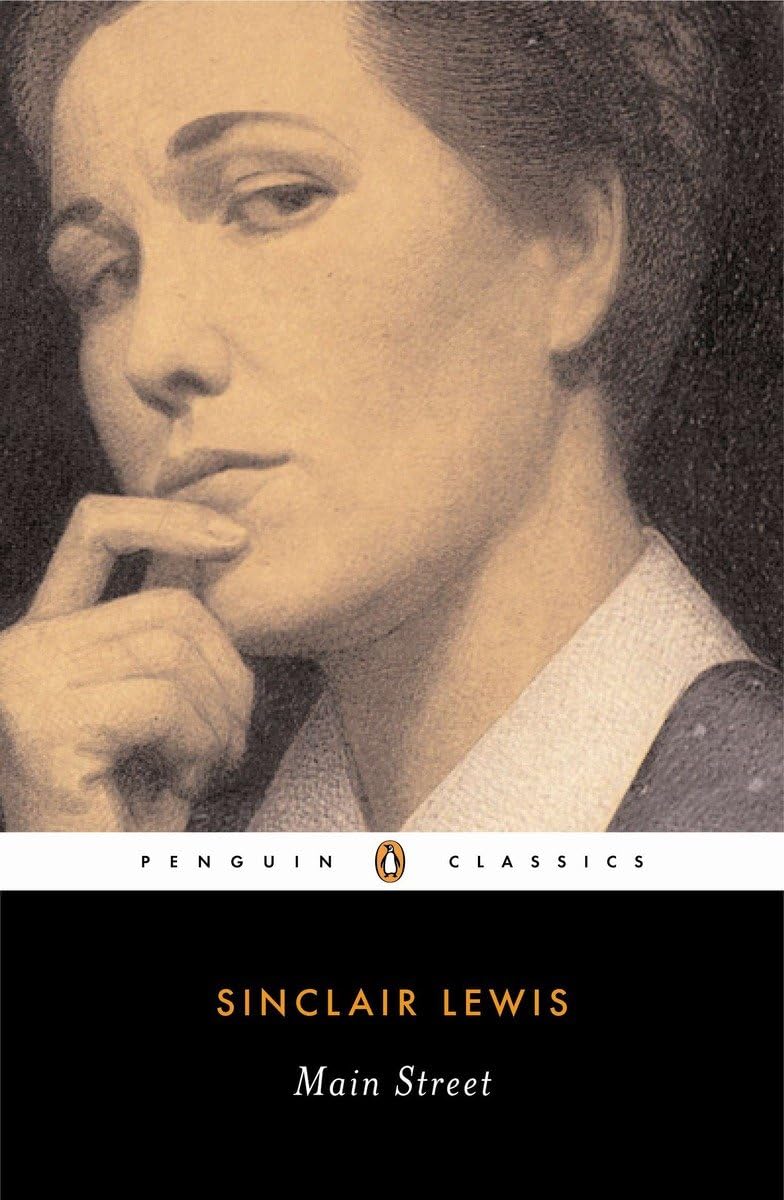
Main Street: The Story of Carol Kennicott (Penguin Twentieth-Century Classics)
$13.99
by Sinclair Lewis



Nobel Prize winner Sinclair Lewis's barbed portrait of Gopher Prairie, Minnesota, shattered the myth of the American Middle West as God's Country and became a symbol of the cultural narrow-mindedness and smug complacency of small towns everywhere. A Penguin Classic At the center of Main Street is Carol Kennicott, the wife of a town doctor, who dreams of initiating social reforms and introducing art and literature to the community. The range of reactions when it was published in 1920 was extraordinary, reflecting the ambivalence in the novel itself and Lewis's own mixed feelings about his hometwon of Sauk Centre, Minnesota, the prototype for Gopher Prairie. For more than seventy years, Penguin has been the leading publisher of classic literature in the English-speaking world. With more than 1,700 titles, Penguin Classics represents a global bookshelf of the best works throughout history and across genres and disciplines. Readers trust the series to provide authoritative texts enhanced by introductions and notes by distinguished scholars and contemporary authors, as well as up-to-date translations by award-winning translators. By the Winner of the Nobel Prize in Literature “Sinclair Lewis observed his fellow white Midwesterners with terrifying precision. This book, a social novel from 1920 with cutting satirical elements, features a woman named Carol. . . . Like Dorothea Brooke of Middlemarch , Carol is a cosseted young woman who wants to change her world and be useful, yet is restricted by the patriarchal society she lives in. Lewis documents the life of this educated and liberal white American woman and her anxieties about marriage, small towns, and social reform, with great sympathy and wisdom.” — Min Jin Lee, The New Yorker This famous novel of life on Main Street, Gopher Prairie, mirrors with devastating honesty life on Main Streets from Albany to San Diego. Sinclair Lewis (1885-1951) was born in Sauk Centre, Minnesota, and graduated from Yale University in 1908. His college career was interrupted by various part-time occupations, including a period working at the Helicon Home Colony, Upton Sinclair’s socialist experiment in New Jersey. He worked for some years as a freelance editor and journalist, during which time he published several minor novels. But with the publication of Main Street (1920), which sold half a million copies, he achieved wide recognition. This was followed by the two novels considered by many to be his finest, Babbitt (1922) and Arrowsmith (1925), which was awarded the Pulitzer Prize in 1926, but declined by Lewis. In 1930, following Elmer Gantry (1927) and Dodsworth (1929), Sinclair Lewis became the first American author to be awarded the Nobel Prize for distinction in world literature. This was the apogee of his literary career, and in the period from Ann Vickers (1933) to the posthumously published World So Wide (1951) Lewis wrote ten novels that reveal the progressive decline of his creative powers. From Main Street to Stockholm , a collection of his letters, was published in 1952, and The Man from Main Street , a collection of essays, in 1953. During his last years Sinclair Lewis wandered extensively in Europe, and after his death in Rome, his ashes were returned to his birthplace. Chapter One ON A hill by the Mississippi where Chippewas camped two generations ago, a girl stood in relief against the cornflower blue of Northern sky. She saw no Indians now; she saw flour-mills and the blinking windows of skyscrapers in Minneapolis and St. Paul. Nor was she thinking of squaws and portages, and the Yankee fur-traders whose shadows were all about her. She was meditating upon walnut fudge, the plays of Brieux, the reasons why heels run over, and the fact that the chemistry instructor had stared at the new coiffure which concealed her ears. A breeze which had crossed a thousand miles of wheatlands bellied her taffeta skirt in a line so graceful, so full of animation and moving beauty, that the heart of a chance watcher on the lower road tightened to wistfulness over her quality of suspended freedom. She lifted her arms, she leaned back against the wind, her skirt dipped and flared, a lock blew wild. A girl on a hilltop; credulous, plastic, young; drinking the air as she longed to drink life. The eternal aching comedy of expectant youth. It is Carol Milford, fleeing for an hour from Blodgett College. The days of pioneering, of lassies in sunbonnets, and bears killed with axes in piney clearings, are deader now than Camelot; and a rebellious girl is the spirit of that bewildered empire called the American Middlewest. Chapter Two Blodgett College is on the edge of Minneapolis. It is a bulwark of sound religion. It is still combating the recent heresies of Voltaire, Darwin, and Robert Ingersoll. Pious families in Minnesota, Iowa, Wisconsin, the Dakotas send their children thither, and Blodgett protects them from the wickedness of the universities. B