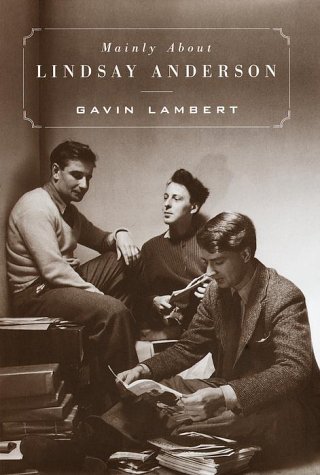



Lindsay Anderson was the most original British filmmaker and theatrical director of his generation. His films If . . . , O Lucky Man!, and Britannia Hospital created a Human Comedy of life in Britain during the second half of the twentieth century and were witty, daring, and often prophetic. This Sporting Life and O Lucky Man! made Richard Harris and Malcolm McDowell international stars; The Whales of August provided Lillian Gish, Bette Davis, and Ann Sothern the opportunity to give extraordinary farewell performances. He also directed notable documentaries in several countries: in Britain, the Academy Award-winning Thursday's Children, about a school for deaf-mute children; in Poland, The Singing Lesson, a personal impression of a group of students at a drama school. In China, he recorded the 1985 concert tour by George Michael and Andrew Ridgeley of WHAM! As a theatre director he collaborated with playwright David Storey on a series of successes ( The Contractor, The Changing Room, In Celebration, Home ), and he worked with such actors as John Gielgud, Ralph Richardson, Alan Bates, Albert Finney, Helen Mirren, Peter O'Toole, Joan Plowright, and Rachel Roberts. Anderson was, as well, an outspoken and sometimes ferocious critic of British films--and of Britain itself. He was the author of the most important and acclaimed book on John Ford. And he was one of Gavin Lambert's closest friends for more than fifty years. Lambert's book begins with his and Anderson's days as movie-struck schoolboys, becoming fast friends, growing up in the shadow of World War II. He shows us their postwar creation of and collaboration on the influential magazine Sequence --a magazine that was produced on love and a shoestring, and which shook up the British film world with its admiration for both Hollywood noir and MGM musicals (at the time unfashionable genres) and its celebration of such directors as Ford, Buñuel, Cocteau, Vigo, and Sturges. He describes how both men rebelled in opposite directions--Anderson remaining in England, Lambert leaving in 1958 for Los Angeles--and traces their unorthodox paths through the film industry. An illuminating, multifaceted portrait--of a friendship, of postwar moviemaking on both sides of the Atlantic, and, mainly, of the remarkable Lindsay Anderson. Lindsay Anderson left a legacy as one of Britain's most engag creators. As a filmmaker, he directed such important features as This Sporting Life, If, and O Lucky Man! As a theatrical director, he attracted the services of actors like John Gielgud and Ralph Richardson. As a theorist, he cofounded and coedited Sequence, a film periodical militating against staid British attitudes, during the late 1940s. He was also one of the driving forces behind the Free Cinema movement of the 1950s, which advocated contemporary settings and problems. Anderson's engagement with art and politics is ably chronicled by his lifelong friend Lambert, himself a novelist and accomplished biographer (Nazimova). With its distinctly personal touch, this book compares favorably with David Sherwin's Going Mad in Hollywood: And Life with Lindsay Anderson (Andre Deutsch, 1997. o.p.) and Erik Hedling's Lindsay Anderson: Maverick Filmmaker (Cassell, 1998). Recommended for large film collections.DNeal Baker, Earlham Coll., Richmond, IN Copyright 2000 Reed Business Information, Inc. Novelist-biographer Lambert and film and theater director Anderson (1923-94) were friends from their late teens on. Being so close to Anderson, Lambert elected to write a memoir rather than a formal biography, and to devote substantial space to his own life and career. He shifts focus throughout between Anderson and himself, which effectively contrasts the two men and points up Lambert's interpretation of his friend. Both were homosexual, but while Lambert adapted, taking lovers and sex in stride, Anderson resisted and, as his diary confirms, fell in love with one unattainable coworker after another, including Richard Harris, star of Anderson's first feature film, This Sport ing Life. Loneliness plagued Anderson, and so he filled his home with informal dependents, became a mainstay for anguished souls such as actress Rachel Roberts, and strove to work steadily. He became, first, the most important post-World War II British film critic, then, with If . . . and O Lucky Man , Britain's best filmmaker. But he never had a major hit and the clout that goes with it, and most of his work was done in the theater, primarily in a long partnership with playwright David Storey, author of the novel This Sporting Life . Anderson is fascinating, and Lambert describes his work with the keen insight of a fine critic. The relatively well adjusted Lambert is tedious in comparison, especially when telling celebrity anecdotes. Those stories are actually pretty good, though no competition for Anderson's story and achievement. Ray Olson Copyright © American Library Association. All rights rese