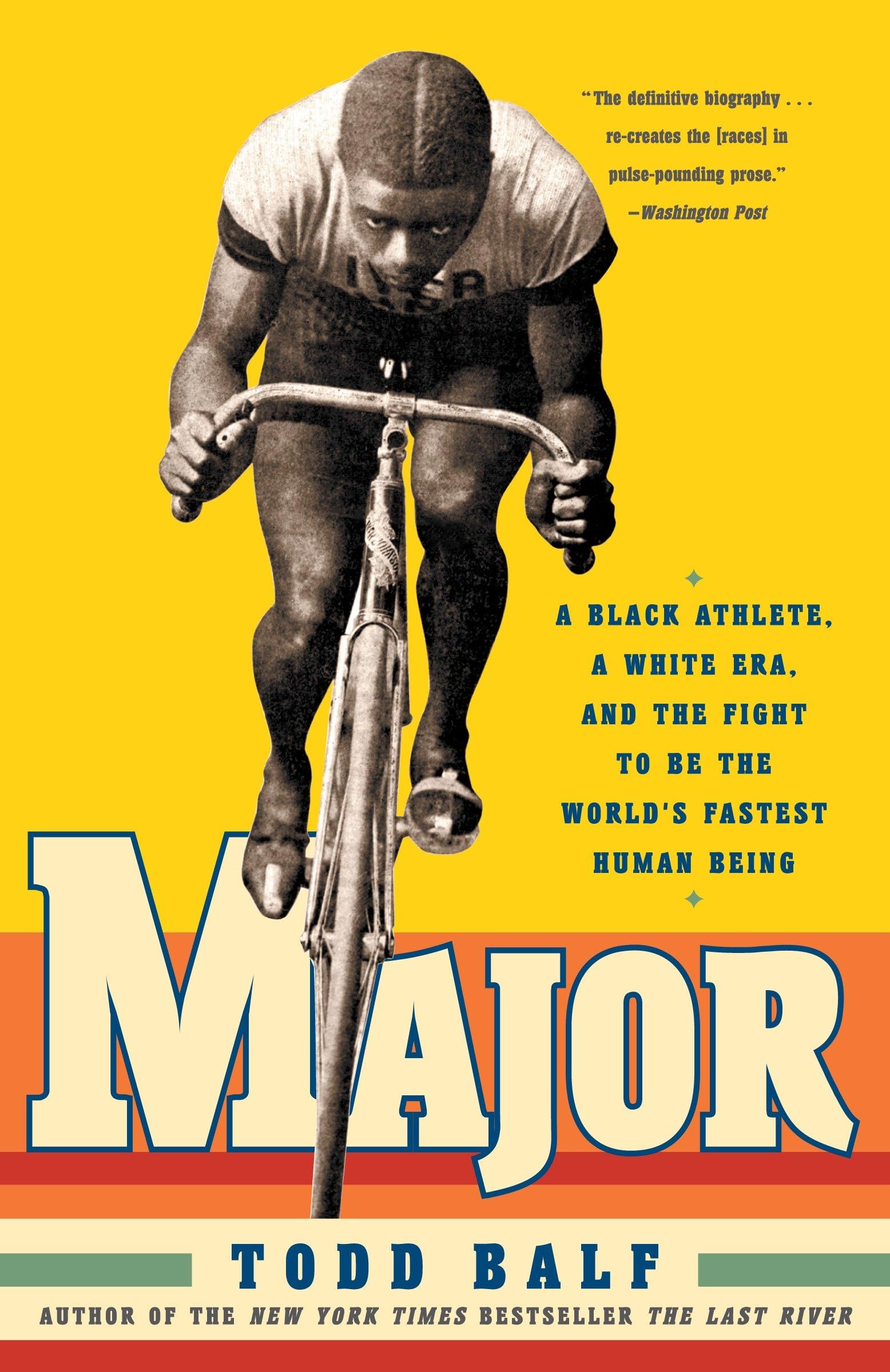



The story of a man who transcended the handicaps of race to become America’s first African American mega sports celebrity At the turn of the 20th century, hundreds of lightning-fast racers won the hearts and minds of a bicycling-crazed public. Scientists studied them, newspapers glorified them, and millions of dollars in purse money were awarded to them. Major Taylor aimed to be the fastest of them all. Taylor’s most formidable and ruthless opponent-a man nicknamed the "Human Engine" was Floyd McFarland. One man was white, one black; one from a storied Virginia family, the other descended from Kentucky slaves; one celebrated as a hero, one trying to secure his spot in a sport he dominated. The only thing they had in common was the desire to be named the fastest man alive. Finally, in 1904, both men headed to Australia for a much-anticipated title match to decide who would claim the coveted title. Major is the story of a superstar nobody saw coming, the account of a fierce rivalry that would become an archetypal tale of white versus black in the 20th century, and, most of all, the tale of our nation’s first black sports celebrity. "Balf revels in the bicycle’s bone-shaking evolution and the top-gun fraternity of daredevils who literally risked life and limb to race." — Entertainment Weekly "With Major, Todd Balf has given us an astonishing book about race and racing in Gilded Age America. This is literary sports writing at its finest. In the tradition of David Halberstam and Frank DeFord, Balf painst intimate portraits of young athletes at the top of their game- and takes us on an epic ride to a nearly forgotten world of sport." –Hampton Sides, author of Blood and Thunder and Ghost Soldiers "If a literary magician could somehow combine the longshot thrill of Seabiscuit , the groundbreaking nobility of Jackie Robinson, and the dramatic flair of Babe Ruth, the result would be something close to this book. Major Taylor is perhaps the greatest American underdog story ever told; I couldn't put it down." -- Daniel Coyle, author of Lance Armstrong's War and Hardball " In Major , Todd Balf has given us the true story of a fascinating, vanished sports world, and one of America's first, great black champions. It reads as fast and as beautifully as its heroes spin." -- Kevin Baker, author of Paradise Alley and Dreamland TODD BALF is the author of the New York Times bestseller T he Last River and The Darkest Jungle . He is a former senior editor for O utside magazine. Chapter 1 Free July 1865 CITY OF LONDON Atlantic Ocean It glides along as though it were alive, and with a smooth grace . . . everlasting and beautiful to behold. --Scientific American Magazine on the early pedal-powered bicycle The South was still burning. Thousands of Confederate POWs remained in Union custody, having refused allegiance to their Yankee victors, and only a partial accounting of the 623,000 war dead had been made. It was a mere eight weeks after Appomattox and the end of the Civil War, but people were already on the move. The promise of America's large northern industrial cities, where work could be had and lives remade, triggered a massive response home and abroad. The swell of humanity included a twenty-two-year-old French mechanic whose July transatlantic passage was notable because of what he steadfastly towed in a large clanging steamer trunk. Within were the unassembled parts of the first modern-era bicycle to land upon U.S. shores. Pierre Lallement, a baby-faced man with short legs and a penguin's stride, was the first of what would be a very long line of dreamers, schemers, and spectacular failures who would see in the beautiful symmetry of moving bicycle parts a new beginning. His wrought-iron frame didn't look like much, but he won a patent in 1866 and, more incredible still, he rode the thing, nobly taking to the green at New Haven, Connecticut, as a few rubbernecking strollers looked on. Lallement's bicycle was, in truth, a giant advance that somehow eluded the best and brightest minds for generations, with "two wooden wheels, with iron tires, of nearly equal size, one before the other, surmounted by a wooden perch." The patent description, however, failed to emphasize the genius of the new design--foot pedals that would not just propel it but balance it. For the first time a rider could elevate his feet from terra firma (earlier versions were straddled and powered by hard, scooter-style pushes), drive his wherewithal into foot pedal cranks, and directly propel his earthly volume. One hundred and fifty years later it is the advance that a six-year-old who rides a bicycle for the first time remembers, the moment when the ground gives way, the wind sweetens, and nerve ends spark like dry tinder. It is the moment when doubt and fear release in a simple, fundamental expression of pungent emotion--something that sounds like "Wheeeee!" Lallement didn't wait around long enough to see his bicy