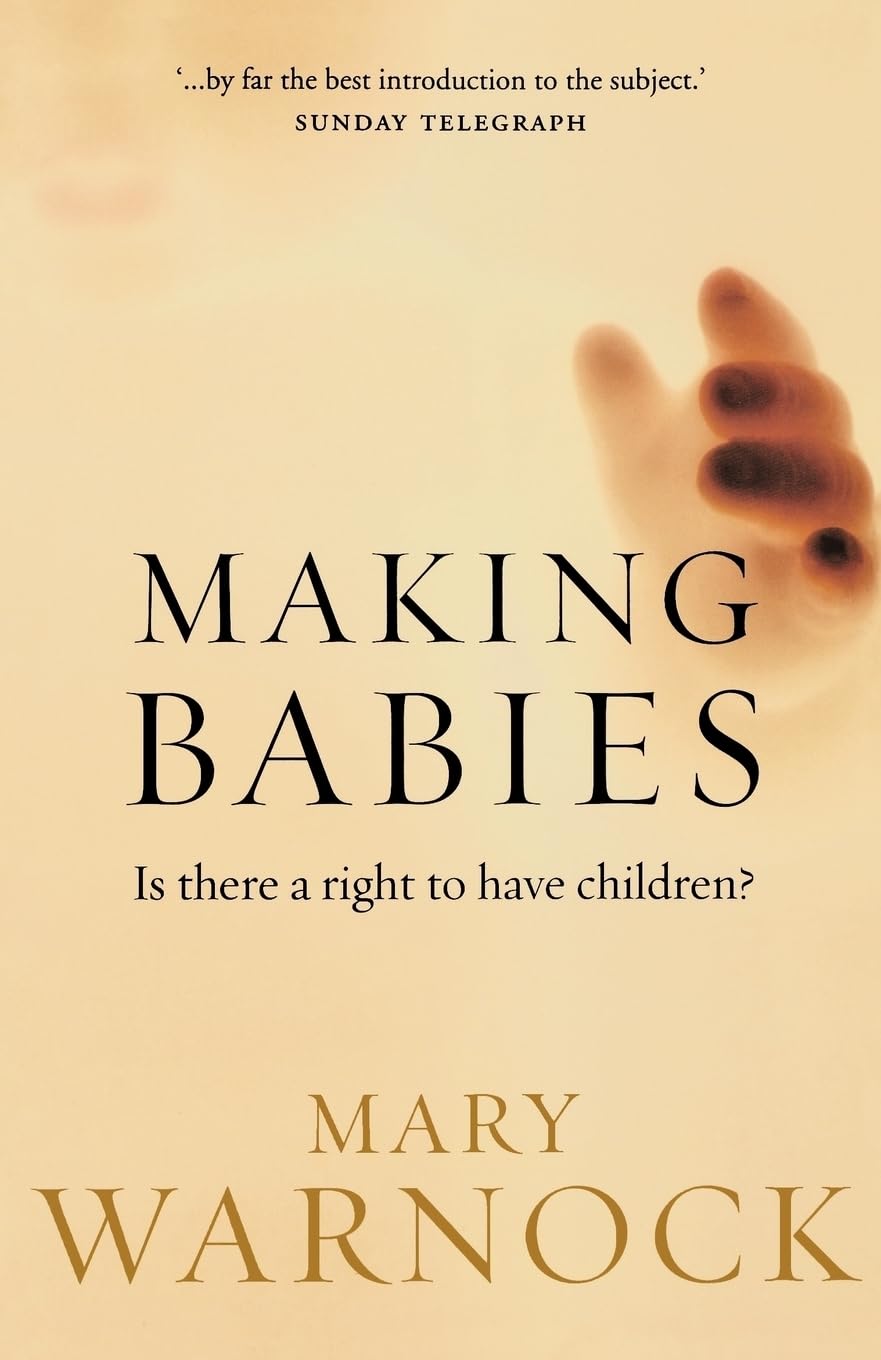



Is there a such thing as a universal right to have children? Should medical assistance to have children be available to everyone? Are all methods of assisted reproduction legitimate? Mary Warnock steers a clear path through the web of complex issues underlying these questions. She analyzes what it means to claim something as a "right," examines the ethical problems faced by particular types of assisted reproduction, including artificial insemination, in-vitro fertilization, and surrogacy, and argues that in the future human cloning may well become a viable and acceptable form of treatment for some types of infertility. `Review from previous edition In this book Mary Warnock discusses legal, natural, and ethical rights with particular references to human reproductive rights, and the right of access to the new reproductive technologies ... Essential reading for all.'' Professor Sir Malcolm MacNaughton`... a combination of common sense and clear, rigorous and, above all, honest, argument.' Mark Rowlands, TLS`... a remarkable and revealing book.' Derek Morgan, THLS`... the book is sprightly reading and food for serious thought. It would provide a good basis for discussion in high schools, colleges, and book clubs.' Nature`This is a well-informed and fair-minded contribution to an ongoing debate. It should be required reading for anyone intending to become a GP or a geneticist. More importantly, it is written in jargon-fee language that is readily comprehensible to the non-specialist reader.' Scotland on Sunday`... powerful little book.' Dea Birkett, The Independent`Warnock is delightfully clear-eyed - no mindless jargon or mind-numbing theory in this elegant book.' Sylvia Ann Hewlett, New Statesman`[Mary Warnock] writes with such lucidity that it is a pleasure to read her... This is practical philosophy as it should be written: concise, elegant and comprehensible. ... her book is a masterpiece of faultless clarity, that will enable everyone to think better about the ethical problems of the new technology. It is by far the best introduction to the subject.'' Theodore Dalrymple, The Sunday Telegraph`Warnock manages to communicate a wealth of accumulated insight into the ethics of assisted reproduction.' Susanne Gibson, Analytic Teaching`... a 'quick read' and a rather enjoyable one. No academic apparatus. No clutter.' Anthony Fisher Steers a clear path throught the complex ethical issues underlying the development of new reproductive technologies Mary Warnock's work in academic philosophy includes the books Imagination , Memory , and Existentialism . Much of her career was spent at Oxford University, and she was later Mistress of Girton College Cambridge. She was made a life peer in 1985, and chaired the Committee of Enquiry into Human Fertilization and Embryology, whose report formed the basis of legislation in the United Kingdom. Her most recent book is her autobiography, Mary Warnock: A Memoir .