Making Home Work: Domesticity and Native American Assimilation in the American West, 1860-1919 (Gender and American Culture)
$27.79
by Jane E. Simonsen



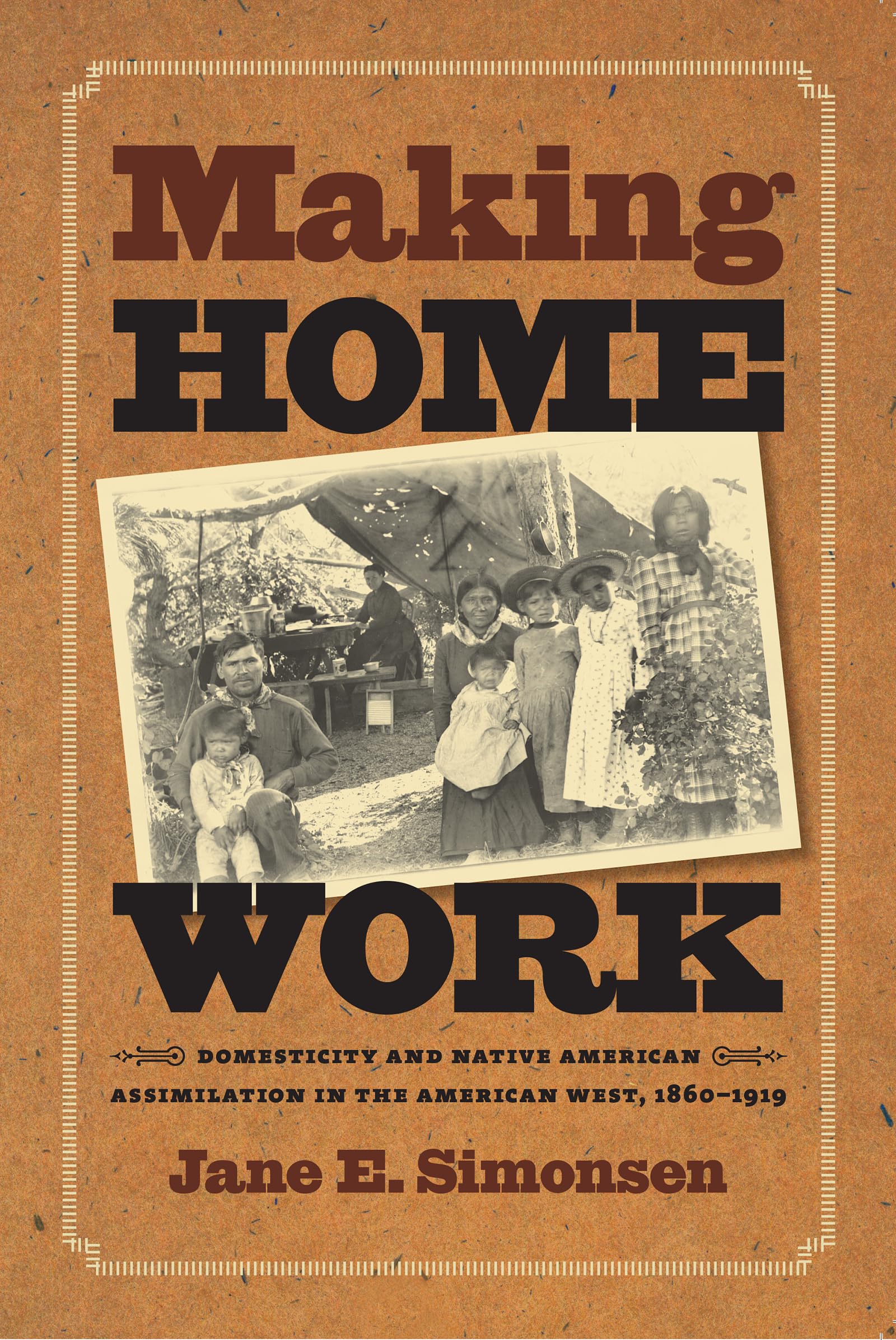
During the westward expansion of America, white middle-class ideals of home and domestic work were used to measure differences between white and Native American women. Yet the vision of America as "home" was more than a metaphor for women's stake in the process of conquest--it took deliberate work to create and uphold. Treating white and indigenous women's struggles as part of the same history, Jane E. Simonsen argues that as both cultural workers and domestic laborers insisted upon the value of their work to "civilization", they exposed the inequalities integral to both the nation and the household. Simonsen illuminates discussions about the value of women's work through analysis of texts and images created by writers, women's rights activists, reformers, anthropologists, photographers, field matrons, and Native American women. She argues that women such as Caroline Soule, Alice Fletcher, E. Jane Gay, Anna Dawson Wilde, and Angel DeCora called upon the rhetoric of sentimental domesticity, ethnographic science, public display, and indigenous knowledge as they sought to make the gendered and racial order of the nation visible through homes and the work performed in them. Focusing on the range of materials through which domesticity was produced in the West, Simonsen integrates new voices into the study of domesticity's imperial manifestations. "A bold, multifaceted, and well-documented study of a newly surprising old American West." -- Legacy "A valuable scholarly work that would be engaging to readers interested in nineteenth-century disputes in the American West over women's labor, gender roles, indigenous cultures and assimilation, and attitudes toward housework and home." -- Western American Literature "An absorbing study of the material culture of domestic imperialism and a cogent synthesis of the literature on several important topics. . . . An impressive body of ideas on many facets of these gendered cultural encounters [that] offers intriguing suggestions for how to think about women's work at the turn of the century." -- H-AmIndian "An innovative study of women's work and social hierarchies in the West." -- Journal of American History "Highly engaging. . . . A stunning example of making 'new' western studies work." -- Great Plains Quarterly "Presents a useful summary of the way non-Native women related to Native women during the industrializing years of 1860-1910, a period in Indian history that needs much more research." -- CHOICE "Simonsen's adept handling of many complex examples and issues, and especially the contextualization of domesticity in wider nineteenth-century intellectual currents, is extremely valuable." -- Western Historical Quarterly "The steady theme that unites the book . . . illuminates this period and topic in a new and exciting manner." -- American Historical Review Using domesticity to organize ? and expose ? the nation?s inequality During the westward expansion of America, white middle-class ideals of home and domestic work were used to measure differences between white and Native American women. Treating white and indigenous women's struggles as part of the same history, Simonsen argues that as both cultural workers and domestic laborers insisted upon the value of their work to "civilization," they exposed the inequalities integral to both the nation and the household. Includes analysis of texts and images created by writers, women's rights activists, reformers, anthropologists, photographers, field matrons, and Native American women. During the westward expansion of America, white middle-class ideals of home and domestic work were used to measure differences between white and Native American women. Treating white and indigenous women's struggles as part of the same history, Simonsen argues that as both cultural workers and domestic laborers insisted upon the value of their work to "civilization," they exposed the inequalities integral to both the nation and the household. Includes analysis of texts and images created by writers, women's rights activists, reformers, anthropologists, photographers, field matrons, and Native American women. Jane E. Simonsen is assistant professor of history and gender/women’s studies at Augustana College. Used Book in Good Condition