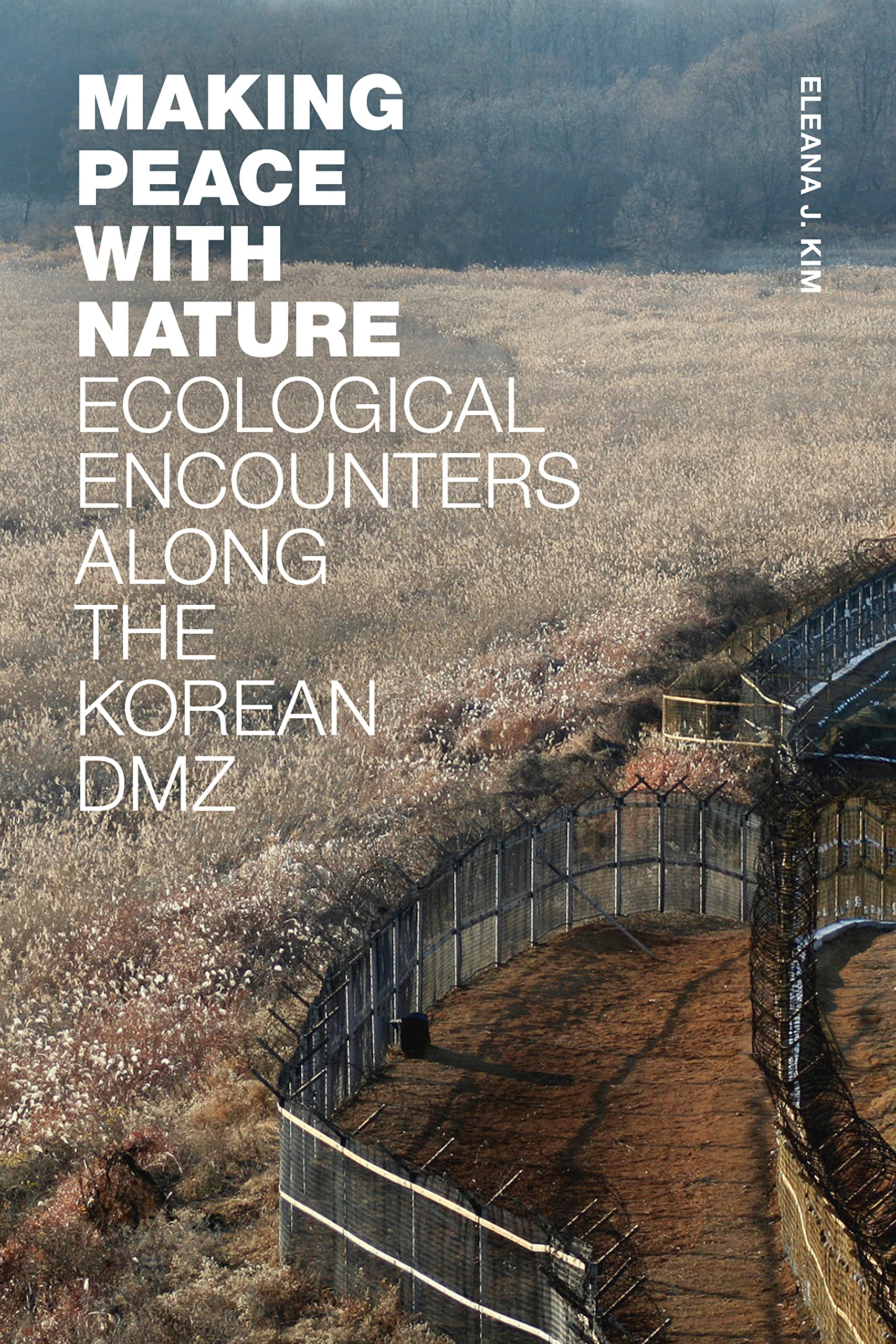
Making Peace with Nature: Ecological Encounters along the Korean DMZ
$26.95
by Eleana J. Kim



The Korean Demilitarized Zone (DMZ) has been off-limits to human habitation for nearly seventy years, and in that time, biodiverse forms of life have flourished in and around the DMZ as beneficiaries of an unresolved war. In Making Peace with Nature Eleana J. Kim shows how a closer examination of the DMZ in South Korea reveals that the area’s biodiversity is inseparable from scientific practices and geopolitical, capitalist, and ecological dynamics. Drawing on ethnographic fieldwork with ecologists, scientists, and local residents, Kim focuses on irrigation ponds, migratory bird flyways, and land mines in the South Korean DMZ area, demonstrating how human and nonhuman ecologies interact and transform in spaces defined by war and militarization. In so doing, Kim reframes peace away from a human-oriented political or economic peace and toward a more-than-human, biological peace. Such a peace recognizes the reality of war while pointing to potential forms of human and nonhuman relations. " Making Peace with Nature is to be commended for its thoughtful attention to the competing priorities and placemaking of the DMZ region by both human and more-than-human actors. In decentring the human, Kim makes a critical intervention in discourses of peace that instrumentalise the DMZ for political or economic gain. Making Peace with Nature makes a valuable contribution across disciplines and may be of particular interest to scholars and students in Korean studies, Asian studies, cultural anthropology, political science, and the environmental humanities."― Ivanna Sang Een Yi , Asian Studies Review "Kim offers an opportunity to think of the ecological ramifications of the closed borders of the last few years. One particularly powerful chapter is her study of undetonated mines along the DMZ from the Korean War."― Adrian De Leon , Public Books "Kim’s astute theoretical work … is a refreshing approach to the puzzle of nonhuman agency." ― Caterina Scaramelli , American Ethnologist "Eleana Kim’s book stands as a thought-provoking contribution to our understanding of the Korean DMZ. ... She presents a compelling case for the future sustainability of the Korean DMZ area and leaves an indelible mark on the discourse surrounding this historic landmark." ― Chae-han Kim , Pacific Affairs “ Making Peace with Nature is an exceptional book that deserves wide readership.”― Lisa M. Brady , Journal of Anthropological Research " Making Peace with Nature is a highly innovative and exciting scholarly contribution to the growing body of research on environmental humanities."― Su-kyoung Hwang , Journal of Military History " Making Peace with Nature offers an excellent anthropological analysis of the interaction between militarization, local residents, and wildlife in the DMZ. . . . Kim’s book provides deep insights beyond the DMZ region. It focuses on the academic activities related to the DMZ’s nature and demonstrates that nature helps certain groups of people build connections, overcoming the political division of the peninsula."― Horus Tan , H-Environment, H-Net Reviews “Eleana J. Kim poignantly details the lasting impact of the Demilitarized Zone. . . . At a time of multiple ecological crises coupled with geopolitical conflicts, Making Peace with Nature warns us that we ignore our relational ontologies and symbiotic relationship with natureculture at our own peril.”― Suzy Kim , Journal of Asian Studies “A book that is both a pleasure to read and offers insights . . . Kim’s exploration of biological peace in Korea is well worth a read.” ― Roland Bleiker , Journal of Development Studies “Politically astute and intellectually compelling, this provocative ethnography asks new questions about the interrelationship between human and nonhuman actors while offering fresh understandings and possibilities for political action. In the best tradition of critical thought, it takes a topic that is of passing familiarity to most readers and upends it. Making Peace with Nature will have an immediate impact across cultural anthropology, East Asian studies, environmental studies, political science, and policy studies.” -- Christopher T. Nelson, author of ― Dancing with the Dead: Memory, Performance, and Everyday Life in Postwar Okinawa Eleana J. Kim is Associate Professor of Anthropology at the University of California, Irvine, and author of Adopted Territory: Transnational Korean Adoptees and the Politics of Belonging , also published by Duke University Press.